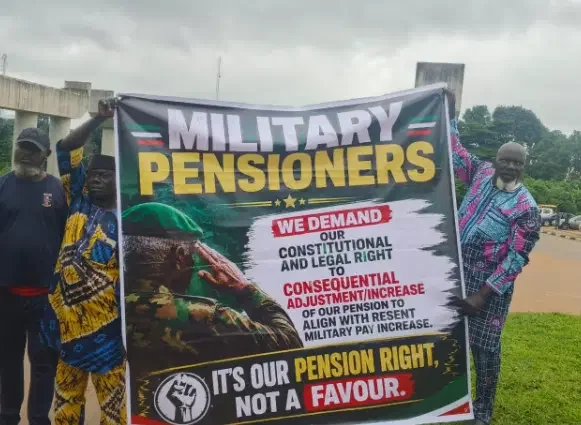
A group of retired military personnel converged in Abuja on Wednesday to protest what they described as a disparity in their pension scheme and demanded a consequential adjustment.
The veterans, carrying placards with different inscriptions as seen in a viral video seen by this newspaper, raised concerns about the exclusion of retirees from recent salary increments for military and paramilitary personnel.
Vanguard newspaper reported that the pensioners converged near the Ministry of Defence in Area 10, Garki. In the viral video, security operatives, including police officers, soldiers and personnel of the Nigeria Security and Civil Defence Corps (NSCDC), prevented the protesters from advancing to the ministry.
The pensioners said the federal government had approved a salary increase for military and paramilitary personnel in November 2025, but alleged that the adjustment had not been implemented despite repeated acknowledgements by the military high command.
| | |
|---|
One of the protesters, Innocent Anas, a retired lieutenant colonel, said the recent salary increment for military personnel did not reflect in the pension structure of retired officers.
“Since last November last year, Mr President approved the new salary increase for the military and the paramilitary; this is August this year; they have not implemented it as if it’s a scam, and then a new pronouncement comes up again,” he said.
He argued that the exclusion violates their constitutional and legal rights.
“We have paid our dues in patriotic service to this nation. There is a constitutional provision that when you increase the pay of any personnel, there should be a consequential allowance, consequential adjustment for pensioners,” he said.
“If you compute the fund requirement for implementing the most recent increase, and you exclude pensioners, you are depriving them of their constitutional and legal right, as enshrined in the Constitution and the Armed Forces Act,” Mr Anas added.
According to him, the latest salary structure should also be accompanied by corresponding adjustments to pension payments to prevent retired personnel from being disadvantaged. “If they want to implement it by law, constitution, and the Armed Forces Act, there should be a consequential adjustment, that is, an increase in the pay of pensioners to meet up to par,” he said.
He warned that failure to implement the consequential adjustment would create significant disparities between the pensions of personnel who retired at different periods.
Mr Anas gave the example of a captain who retired 10 or 15 years ago potentially receiving a pension comparable to that of a sergeant retiring under the current salary structure.
The purpose of consequential adjustment demand, he said, was to preserve parity among personnel who served under the same military structure, irrespective of when they retired.
“They know it. None of them is denying the legal or constitutional provision,” the pensioner said, alleging that some officials were indifferent to the plight of retired personnel because they had other sources of wealth and property.
Mr Anas said the issue was particularly serious for the majority of veterans who depend largely on their pensions to survive.
“There are peasant masses within the veteran community,” the retired lieutenant colonel said. “The vast majority of us are affected. That is the real issue.”
They also appealed for improved welfare and medical support for veterans, saying many retired personnel had served the country for decades and deserved adequate care after retirement.
“We served for 35 years. We need medical help,” said Augustine Duru, another retired officer who said he’s been sick and could not afford medical care.
Mr Duru appealed to President Bola Tinubu and Minister of Defence, Christopher Musa, to help retirees.
The veteran said it is painful to die within five or three years after you retire from active service of 35 years.
“We are here crying and begging them, please, help us,” he pleaded.