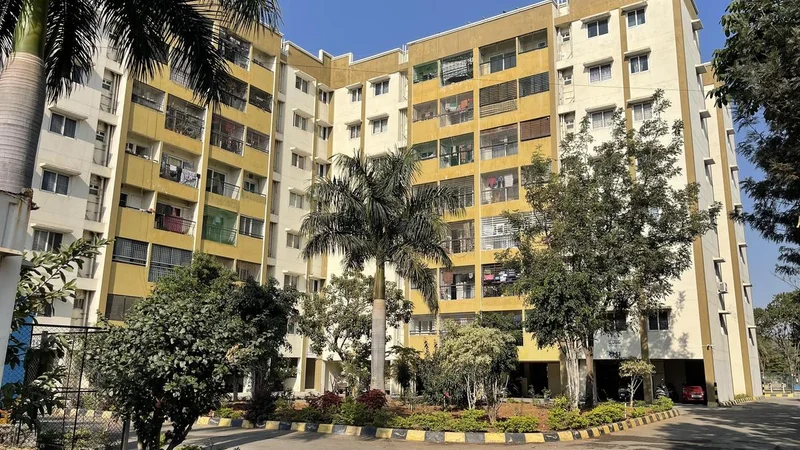
No fully completed apartment complex project can have multiple associations within the same apartment complex, says the Karnataka Apartment (Ownership and Management) Bill, 2026, which was tabled during the ongoing Monsoon Session on Wednesday (August 19).
The draft of the Bill, which was presented at a stakeholders’ meeting on July 15, had proposed forming a federation to resolve the issue, but the final Bill has removed the provision.
The draft Bill treated a federation as a higher-level body responsible for managing infrastructure shared by multiple apartment associations.
Now, the Bill says, “There shall be a single registered association for every project. The association may permit the formation of subcommittees, if required. Where a project is developed in phases, the majority required for the purpose of formation of the association shall be determined based on the first phase.”
Earlier, the Bill stated that separate apartment associations must be formed where an apartment project is implemented in phases. Now, the new Bill states that after completion of every phase, the occupants or flat owners will be added to the same association immediately. However, flat owners say that a single association for a substantially large complex can be very chaotic.
Competent authority can form associations
The Bill also mandates the promoter to form an association within three months from the date on which a majority of the flats in the project are allotted. The association has to be registered with the competent authority.
Earlier, the competent authority was empowered to impose a penalty when the promoter failed to register an association within the specified period. Now, the competent authority is also empowered to cause the association to be formed and operationalise it.
Community and commercial facilities
In the earlier draft, the Bill stated that the community and commercial facilities shall primarily serve the flat owners and occupiers of the project. Access to or use of such facilities by persons other than flat owners shall not be permitted on a regular or commercial basis except with the prior approval of not less than two-thirds of the flat owners present and voting at a general meeting of the association.
Now, the final Bill bars any person other than flat owners from accessing the facilities on a regular or commercial basis.
In addition to this, in the event of default in payment of common expenses, the association may recover such dues together with prescribed interest and costs, as prescribed in the bylaws, or by approaching the competent authority for appropriate directions.
The Bill
Second appellate authority
The Bill has proposed that the government will have to, within three months from the date of commencement of this Act, by notification in the official gazette, appoint one or more officers of the local authority or the planning authority, or another senior-scale Group A officer, to act as the second appellate authority.
Sale deed
The Bill has also seen an addition stating that where sale agreements have been executed for flats prior to the commencement of this Act, but sale deeds have not been executed for any of the flats, the provisions of the new Bill
However, if the sale deed is executed for a flat prior to the commencement of this Act, the deed of transfer for all flats in the project shall be executed as per the provisions of the relevant laws in force prior to the commencement of this Act.
Published - August 19, 2026 09:59 pm IST