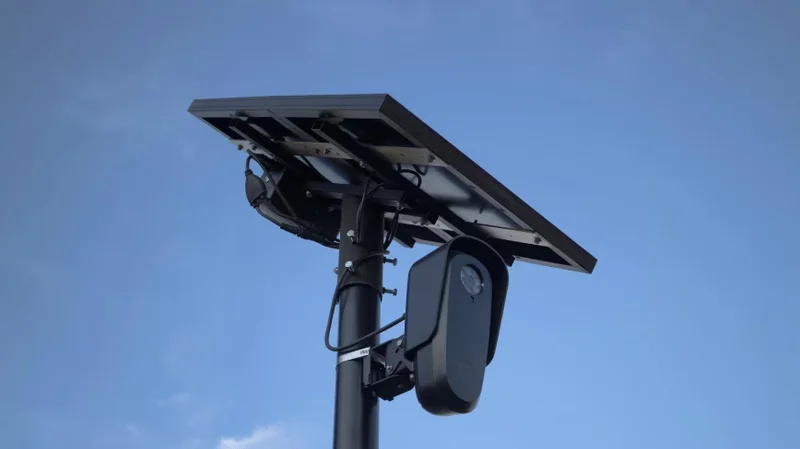
The surveillance firm Flock Safety has told the public for years that its cameras “cannot recognize, identify, or track individuals.” It has now built a tool that does both, according to a new investigation. The artificial-intelligence system lets police search for people and vehicles by their patterns of movement alone. It needs no licence plate, no name, and no crime to start from, WIRED reported on Tuesday.
WIRED reporters Dhruv Mehrotra and Dell Cameron said they reconstructed the tool from files exposed through Flock’s own login pages. The code showed its prompts, its search forms and its intended workflows, they said. It did not reveal the model’s underlying instructions or the checks applied on Flock’s servers.
Flock first called the system Nightshift, and now calls it OS Investigate. The tool can connect vehicle scans with police case files and arrest records, according to WIRED. It can also pull in 911 dispatch logs, ballistics results and commercial identity databases. That turns Flock’s network of cameras from a record of where cars have been into an engine for generating suspects.
Searching by behaviour
Some searches start with ordinary police work, WIRED said. An officer can enter a plate and ask for vehicles seen near it. Others run the logic in reverse. One prompt looks for likely witnesses, finding the vehicles most often seen in a neighbourhood over the past 14 days. Another flags vehicles that visited three or more shops in three days.
Of the prompts WIRED examined, it said 19 focus on patterns. Fourteen need no plate, name or physical description at all. An officer supplies a place, a period and a behaviour, and the tool returns people or vehicles that fit. It can then attach names, addresses, relatives, phone numbers and online accounts to a plate. One prompt starts with people arrested more than twice in two years. It maps their homes and orders a detailed “workup” on three of them.
Those outputs are leads, not proof. An inferred link between two vehicles does not mean their owners know each other. Repeated trips through a shopping district are not evidence of a crime. Critics say a ready-made prompt can make a weak statistical match look like a routine database result.
What the experts and Flock say
Chad Marlow, an attorney at the American Civil Liberties Union, told WIRED the danger was that officers could go fishing for crimes. He said the wording of a prompt shapes the result. “The difference between a police officer saying ‘Do you see any criminal patterns’ or ‘Find me criminal patterns’ is going to produce two different things.” The lack of limits on the prompts, he added, lets police “lead the AI.” A former officer who reviewed the software, Noel Pichardo, was blunter, saying it showed Flock “literally tracks people.”
Flock said the tool is still being built. A spokesperson, Paris Lewbel, told WIRED that OS Investigate is in development with a small group of law-enforcement partners, that it is separate from the company’s licence-plate product, and that its capabilities may change before any wider release. The company did not dispute the features WIRED described.
A pattern of scrutiny
The report lands as Flock faces mounting criticism over how police use its existing tools. The Washington Post reported this month that at least 50 law-enforcement officials had faced accusations or charges over misusing plate-reading technology. Flock cameras figured in 46 of those cases, the paper said. The misuse has included officers allegedly stalking former partners.
On 13 August, Flock announced new safeguards, cutting its default data-retention period to seven days, adding automatic lockouts for unusual activity and requiring officers to attach case codes to searches by the end of 2026. Flock designed those controls around searches that a person starts. OS Investigate adds automated lead generation and editable prompts, which critics say oversight built for manual lookups may not capture.
A separate project is trying to open the same records to the public. A website called “Have I Been Flocked” lets drivers check whether an operator has run their plate through the system. It draws on audit logs its organisers gathered through public-records requests to more than 6,500 agencies. Its organisers caution that the data is incomplete and often redacted.
The business behind the tool
OS Investigate fits a direction Flock has pursued for years. The company has pushed beyond fixed plate readers into video cameras, gunshot detection, drones and 911 software, and OS Investigate is the layer that can query all of it together. Chief executive Garrett Langley told the All-In podcast this week that drones are now the company’s fastest-growing business.
Investors have backed the expansion. Flock raised $275 million in March 2025 at a $7.5 billion valuation, in a round led by Andreessen Horowitz, and Business Insider put its more recent valuation at $8.4 billion. Its cameras are now spread across more than 6,000 communities. Rivals are chasing the same ground, with Axon tying its own plate-reading cameras to a real-time operations platform, part of a wider contest to fold dispatch, video and records into one searchable policing system.
Resistance is already shaping where Flock can sell. Several communities, from Mountain View in California to Bandera in Texas, have cancelled or reconsidered their contracts, according to WIRED, and one Minnesota town found its Flock cameras had vanished overnight. For now, Langley’s challenge is whether the company can put enforceable limits inside OS Investigate before an AI-generated lead reaches someone who was never suspected of a crime.
Get the TNW newsletter
Get the most important tech news in your inbox each week.