My favorite interviews over the course of my career have involve people I'd never normally get the chance to speak to in everyday life.
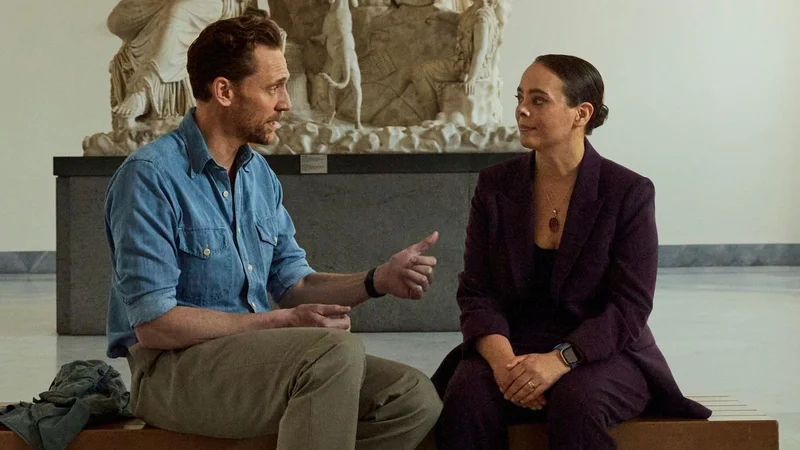
So far this year that's involved two former FBI agents, but Dr. Sarita Robinson — who you can see in Pompeii: Out of Time, out now on Disney+ and Hulu — might just take the cake. Known as "Dr. Survival," her work specialises in figuring out why some people are more likely to survive disasters than others.
This makes her a compelling expert for the three-part docuseries, which explores the events leading up to the eruption of Mount Vesuvius in 79AD, which destroyed the nearby Roman city of Pompeii, and features Tom Hiddleston as presenter.
But it's not her take on the past that I'm actually as interested in... it's her take on the disasters of the future. As a TechRadar writer, I can't pass up an opportunity to talk to Robinson about the dangers of the rise of AI usage across the globe.
While some of us happily wile away the hours asking ChatGPT to generate images of us as hot dogs, others are getting concerned about increasingly awry security reports, such as Open AI models breaching rival company, Hugging Face.
Add in potential climate change risk, and I think that AI is more than a viable candidate for the sort of survival emergencies that Robinson researches. But surprisingly, AI isn't what she's most worried about.
'We theoretically have a risk from AI'
First, I begin by asking Robinson exactly how she defines a survival emergency. Does it have to be a natural occurrence, like the Mount Vesuvius eruption near Pompeii?
Sign up for breaking news, reviews, opinion, top tech deals, and more.
"Absolutely not," she replies. "For me, when I'm looking at emergencies, it's anything where your life is at risk. That can be as simple as you walking across a road and a car coming, small scale emergencies that are just enough that you have to respond, or it can be huge emergencies. The last one that I did quite a lot of research on, as you might expect, is the pandemic. The next one will be climate change, the era of global boiling."
"Medium scale would be an earthquake in a region, a terror attack — so they can be human made disasters... they don't have to be just natural disasters."
So far, so good. When it comes to categorizing AI within Robinson's research boundaries, is this kind of technological disaster something she's ever considered?
"I think I've watched enough science fiction movies to know that we theoretically have a risk from AI," she tells me. "Exactly what that risk would be or how it would look is very difficult to predict at this moment. But yes, absolutely, I would definitely add it onto my list of things that can go wrong... my list is quite extensive."
'I would be far more worried about a solar pulse'
"To be fair, I think the thing I worry about more on the tech front is something like a solar pulse that then knocks out a whole load of technology," Robinson adds. "I can't imagine my life without a mobile phone, a computer... it would be very odd to go into an age of no internet."
It's at this point of the interview where I stop feeling bad for adding a disaster scenario to Robinson's list, as she's certainly just added one to mine. Before this point, I'd never even heard of a solar pulse, which can best be described as a sudden burst of energy from the sun. According to the University of Minnesota, they can trigger "explosive releases of radiation and magnetized plasma ripple through space, occasionally triggering geomagnetic storms on Earth and producing auroras."
Fantastic, another reason to have anxiety in 2026. But what is Robinson's advice for not feeling so anxious about... well, general impending doom?
"Be prepared: active coping, doing something about it, keeping it in perspective, but making sure that you have the resources if something goes wrong," she responds. "I don't mean building a nuclear bunker in your back garden. For example, when the pandemic hit back in 2020, I had a 'pandemic kit' under my sink. I felt like I had a little bit more control in that moment."
"I did some research on the pandemic and what it did show was that those people who'd made some preparations prior to the lockdown were doing much better in terms of mental health, stress, anxiety and depression."
Can we make a solar pulse or anti-AI kit for under our sinks? Most likely not. But that doesn't mean that Robinson's advice should be discarded — control also means vigilance, so keeping a mix of online and offline resources in day-to-day life could be a great way of achieving this.
Jasmine is a Streaming Staff Writer for TechRadar, previously writing for outlets including Radio Times, Yahoo! and Stylist. She specialises in comfort TV shows and movies, ranging from Hallmark's latest tearjerker to Netflix's Virgin River. She's also the person who wrote an obituary for George Cooper Sr. during Young Sheldon Season 7 and still can't watch the funeral episode.