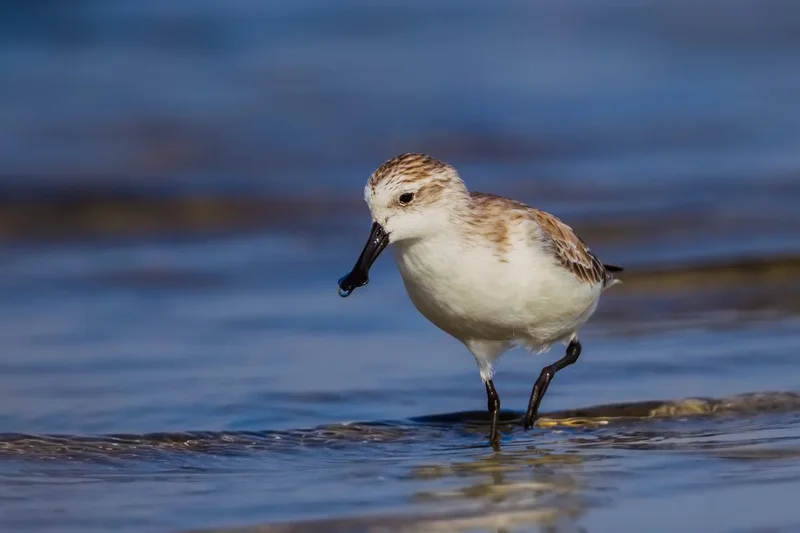
Every year, billions of migratory birds connect the world’s continents, oceans and ecosystems as they undertake epic journeys between their foraging habitats and their breeding grounds.
A bobolink (Dolichonyx oryzivorus) leaves its breeding grasslands of North America for the Pampas of South America. A Newell’s shearwater (Puffinus newelli) spends months soaring across the North Pacific before returning to the Hawaiian Islands to breed. A spoon-billed sandpiper (Calidris pygmaea) travels from Arctic Russia to the rapidly disappearing tidal mudflats of Southeast Asia for its nonbreeding season.
These birds could hardly be more different. They occupy different habitats, follow different migratory routes and face different threats. Yet they share one remarkable characteristic: Their survival depends on networks of habitats stretching across thousands of miles and multiple countries.
Today, all three species and many others are in trouble. Their migrations remain among nature’s greatest spectacles, but the birds themselves are increasingly at risk as the habitats and ecological connections they depend upon are lost or degraded and threats to their survival and ability to reproduce increase.
We study migratory birds as scientists. With an international group of colleagues, we just published a comprehensive assessment of the status, threats and conservation efforts involving more than 3,380 of Earth’s migratory bird species.
The results are sobering. We found that more than half of the world’s migratory bird species are declining because of an array of threats, including habitat loss, invasive species that harm birds, collisions with buildings, hunting, the pet trade, toxic pesticides and, in some cases, being caught in commercial fishing nets.
But our study offers a second conclusion with more hope. The science around migratory birds has changed dramatically over the past two decades, and conservation can help save these incredible species – if governments act before they become endangered.
Protecting birds across their epic journeys
If migratory bird conservation is refocused on the birds’ full annual cycles, it can protect birds and their habitats throughout the year, from their breeding grounds to their nonbreeding homes and their migratory routes in between.
This approach combines protecting and restoring important places, reducing threats wherever they occur. It also relies on international cooperation and proactive conservation led by engaged governments before species become endangered.
Migratory birds are far more than remarkable travelers. They pollinate plants, disperse seeds, control agricultural pests, transport nutrients between ecosystems and support local economies by drawing birdwatchers and ecotourism. Their declines are not simply a loss of biodiversity; they signal a growing breakdown in ecosystems that sustain both wildlife and people.
The encouraging news is that humans have never been better equipped to reverse these species’ declines.
Miniature tracking devices, genetics, automated radio telemetry networks, long-term monitoring and citizen-science initiatives such as eBird that document species numbers around the world have transformed knowledge of migratory birds’ habits and the risks they face.
For the first time, scientists can follow individual birds across continents and determine where conservation actions will have the greatest impact.
A new strategy
For much of the past century, migratory bird conservation focused on protecting important places, such as the breeding grounds, wetlands, nonbreeding habitats and migration stopover sites birds depend upon.
That strategy has been enormously successful and remains indispensable. Protected areas have prevented countless extinctions and will continue to be a cornerstone of biodiversity conservation.
But research has revealed something equally important: Protecting places, while essential, is often not enough to conserve species whose lives unfold across continents and oceans. It’s also important to understand where and when populations are most at risk and address those constraints across the birds’ entire annual cycle.
The three species that opened this story illustrate why.
Bobolinks breed across North American grasslands but spend much of the year in South America. Conserving breeding habitat alone cannot reverse their declines if grasslands continue to disappear or if birds are poisoned by pesticides.
Newell’s shearwaters spend most of their lives over the Pacific Ocean but return to Hawaii to breed, where artificial lights, collisions with power lines, and introduced predators such as domestic cats threaten already vulnerable populations.
Critically endangered spoon-billed sandpipers depend on a shrinking network of tidal mudflats that serve as stopover sites between their breeding grounds on Russia’s Chukotka Peninsula and their nonbreeding areas in Southeast Asia. Losing even a handful of these staging areas can jeopardize one of the world’s rarest migratory birds.
Each species requires a different conservation strategy, but all require the same way of thinking: conserving their entire annual cycle rather than focusing on a single place, season or threat.
Fortunately, this approach is already starting to take hold in the United States and demonstrates what is possible.
What success can look like
Road to Recovery is an international initiative designed to reverse the losses of North America’s fastest-declining bird species before they require protection under U.S. endangered species legislation.
Rather than waiting for populations to collapse, Road to Recovery brings together scientists, governments, conservation organizations, landowners and local communities to form species working groups. These groups help identify the harms bird populations are facing and how to be more surgical in where limited conservation dollars are invested.
Today, more than 50 international working groups are developing conservation strategies for species including bobolinks and lesser yellowlegs (Tringa flavipes) to evening grosbeaks (Coccothraustes vespertinus) and yellow-billed cuckoos (Coccyzus americanus). Their work has already led to new research, habitat protection, policy changes, hunting reforms and international partnerships.
International agreements such as the Convention on the Conservation of Migratory Species of Wild Animals, along with regional flyway partnerships and treaties, provide ways for nations to work together to conserve migratory species across political boundaries.
However, the convention’s effectiveness is severely hindered when many of the world’s largest, wealthiest and most influential countries have not signed on to it. That includes the United States, Canada, Mexico, Russia and Japan.
Broader international participation and sustained investment from governments can help translate scientific knowledge into coordinated conservation action across the full annual cycle.
But governments cannot do it alone. Landowners, businesses, conservation organizations and individuals all have roles to play. They can help protect and restore habitat and reduce threats, such as free-ranging cats and collisions with buildings. They can support bird-friendly policies and participate in citizen-science programs that help track migratory bird populations.
Applying these lessons
There is every reason for hope.
Around the world, conservation initiatives repeatedly demonstrate that when threats are identified and addressed, bird populations recover. The pesticide DDT almost caused the extinction of species such as the bald eagle, peregrine falcon and osprey, but humans stepped in, banned its use, and all species recovered.
The challenge now is applying what science has found.
Next spring, bobolinks will once again return to North America’s grasslands. Newell’s shearwaters will navigate thousands of miles of open ocean back to Hawaii. Spoon-billed sandpipers will once again attempt one of the world’s most extraordinary migrations.
Whether future generations can continue to see these magnificent migrations will depend on the choices of current generations and the steps they take to save them.