- See more Daily Mail on Google - save us as a Preferred Source
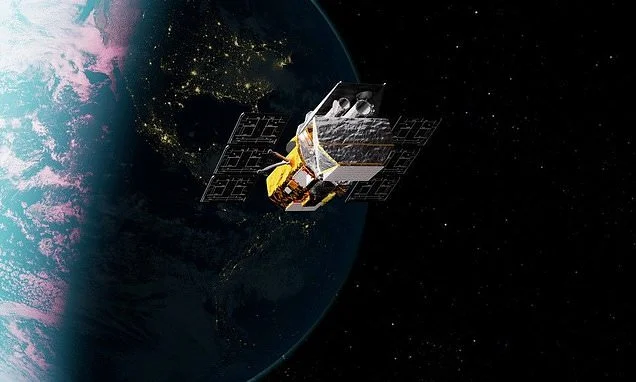
NASA called off the mission to save its dying space telescope on Wednesday, dooming it to a fiery reentry later this year.
The space agency had spent $30 million in hopes of sending another spacecraft to push its Swift Observatory into a higher orbit and avoid an uncontrolled fall back to Earth. The exact date and location of reentry are not yet known.
The rescue spacecraft, named Link, went into an uncontrollable spin a few weeks after its liftoff in early July.
While flight controllers managed to slow Link’s tumble, issues continued to plague its pointing and positioning in orbit.
NASA Administrator Jared Isaacman said in a statement: 'This is not the outcome we were working toward, but it does not change why this mission was worth attempting.'
Swift was launched in 2004 to study gamma-ray bursts, the most powerful explosions in the universe, and other cosmic objects and events.
It was designed for a two-year prime mission.
After 21 years of science operations, Swift’s low Earth orbit began to rapidly decay because of increased solar activity.
NASA had spent $30 million in hopes of sending another spacecraft to push its Swift Observatory into a higher orbit and avoid an uncontrolled fall back to Earth
Link was developed by Katalyst Space, an aerospace startup based in Flagstaff, Arizona, that specializes in robotic spacecraft, on-orbit satellite servicing, and autonomous space infrastructure.
The rescue craft launched in early July to approach the observatory, also known as Swift, some 216 miles in space, grapple onto it and then tug it to a higher orbit of roughly 373 miles, extending its life by years.
However, Link suffered its own issues, sending engineers scrambling for weeks in an attempt to regain control.
The team uploaded new positioning control software last week that slowed but did not stop its errant spinning.
Katalyst and NASA said in a joint statement on Wednesday: 'Following continued monitoring and assessment of the LINK spacecraft, Katalyst Space and NASA together have concluded that due to ongoing attitude control issues, the mission will not include the capture and boost of NASA’s Neil Gehrels Swift Observatory.'
The goal to boost the observatory's orbit and extend its life by years, the first US mission of its kind, was an ambitious endeavor for Katalyst, which said it built and tested the Link rescue vehicle on an unprecedented nine-month production schedule.
Katalyst CEO Ghonhee Lee said in a statement: 'We took on this high-risk, high-reward challenge and are proud of the milestones we reached along the way.'
Swift Observatory captured the afterglow of a gamma-ray burst. The bright rings are X-rays scattered by dust layers within our galaxy. Multiple space and ground-based telescopes witnessed one of the brightest explosions in space when it reached Earth
However, Link still will attempt to conduct rendezvous and proximity operations with NASA’s Neil Gehrels Swift Observatory to demonstrate key capabilities for the future of space exploration.
Isaacman said: 'NASA should be willing to move quickly and take smart risks when the potential return is worth it, and that is exactly what we did with this mission.
'The team moved with extraordinary speed to give Swift a chance to carry out more science while advancing capabilities America will need for satellite servicing in the future.
'We are going to learn everything we can from Link’s rendezvous attempt and put those lessons to work on the missions that follow.'