Kako Satoshi: Yokohama Exhibition Celebrates Picture Book Master
Culture Manga Education Guide to Japan Family## Rooted in Folklore
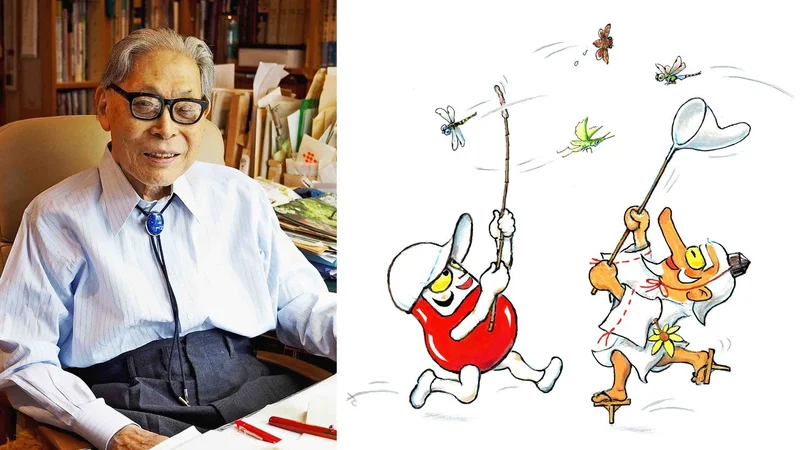
An exhibition marking the centenary of the birth of the Japanese children’s book writer Kako Satoshi (1926–2018) will run until September 23 at the Kanagawa Museum of Modern Literature. The author of more than 600 titles, Kako is well-known for his Little Daruma series, which reimagines the celebrated Buddhist monk as a curious child. Other characters in the series who play and go on adventures with Daruma are also rooted in Japanese folklore and beliefs, such as the birdlike demon Little Tengu and Little Kaminari, a horned representation of the thunder god. Kako’s daughter Suzuki Mari says that Little Daruma incorporates aspects of many children that the author encountered in his life.
One of the highlights of the exhibition is an area lining up initial sketches and final artworks for Little Daruma and Little Tengu for comparison. They demonstrate Kako’s attention to detail, such as in adjusting the height of the tengu’s wooden geta footwear so the two characters meet eye to eye.
In other instalments, Little Daruma meets with the thunder god, rabbits, a tiger cub, and a child modeled after Daikokuten, the god of prosperity. Books from the series have been translated into English, Chinese, Korean, and other languages.
Supporting Children Through Community Work
While studying applied chemistry at the University of Tokyo, Kako also involved himself in theater activities. After he graduated in 1948, he started an office job, but spent free time in a social welfare initiative supporting children’s learning and play in Kawasaki, Kanagawa.
Kako drew pictures, played with the children and created kamishibai paper theater stories, which are told dramatically, using large picture cards. The exhibition includes the cards from Kako’s early kamishibai work My Mother, which drew on children’s writing and pictures to represent the lives of families where mothers worked to support their children after the fathers had died in the war. This and other works from the start of his creative career are on display for the first time.
One of Kako’s drawings caught the eye of a publisher, leading to his debut with the picture book The Dam Builders.
Thieves and Crows
In Kako’s popular Thief School, the principal who is meant to be training the students up into thieves blunders along with them. This is based on the author’s earlier kamishibai work.
Kako wrote many works about crows, of which the most famous is Mr. Crow’s Bakery. The titular bakery becomes a huge success by making 84 different kinds of bread in unusual shapes from a mushroom, a zebra, and a pencil to a saw, an airplane, and a violin. Young readers get a thrill from the display of these eccentric varieties of bread spreading across two pages.
The crow series draws upon Kako’s understanding of children’s perspectives from his community work. In the afterword of Mr. Crow’s Bakery he writes, “The foundation for this story . . . was a picture book I made by hand for a senior colleague’s wedding gift, which was refined through meetings of the children’s club.” The exhibition includes crow-centered works that he drew before publishing the picture book series.
Mr. Crow’s Bakery has been translated into English and Italian. In a number of sequels, the young crows from the original story grow up to get involved in selling pastries, fruit and vegetables, tempura, and noodles.
Getting Started with Science
As well as stories, Kako wrote many picture books introducing a range of scientific topics to children.
Kako’s daughter says, “Children have a great ability to see how things really are. If something is boring, they walk away. But if it touches their heart, or they feel they want to do it too, then they become interested. Children are honest, and my father thought that this honesty applied to the understanding of science too. He thought that science isn’t about memorizing symbols or chemical formulas. It’s about finding differences in the small things in front of you, and making discoveries. This is the way to get started with science. I think this belief led him to publish science picture books for children.”
Think for Yourself
Kako was 19 when World War II ended with the surrender of Japan, and he became deeply disillusioned with how he’d unquestioningly accepted the militaristic system that led to war. For this reason, he wanted to encourage children to see with their own eyes and think and act for themselves, rather than just accepting what adults told them.
Works such as Autumn, based on what he witnessed during the war, and Papo the Jellyfish, about a jellyfish searching for a dead soldier in the South Pacific, were published posthumously after the manuscripts were discovered following Kako’s death. The exhibition also displays posters by Kako calling for peace.
A passage contributed by Kako to a parenting magazine produced by Fukuinkan Shoten, one of his publishers, reads as follows. “The most incompetent kinds of leaders use war to solve disputes between nations. Whoever wins, the vulnerable and poor people of each country suffer most. We must be able to see how those who try to profit from war and expand their control are scheming across the world to prop up such leaders and reap the benefits for themselves.”
While his daughter says Kako did not lecture about the importance of peace at home, he quietly conveyed his conviction through his stories and science books.
At the exit to the exhibition, visitors can receive one of eight cards with quotations from Kako Satoshi’s 2014 autobiography To the Little Darumas of the Future. These include the words that form the exhibition’s subtitle: “Living is, indeed, a joy.”
Kako Satoshi Centenary Exhibition
- Venue: Kanagawa Museum of Modern Literature, Yokohama
- Exhibition dates: July 25–September 23, 2026 (closed on Mondays, except September 21)
- Hours: 9:30 am–5:00 pm (last entry 30 minutes before closing)
- Admission fees: Adults ¥800; Visitors over 65 or under 20, students ¥400; high school students ¥100. Admission is free for junior high school students and younger.
- Access: A 10-minute walk from Exit 6 of Motomachi-Chūkagai Station on the Minatomirai Line.
- Official website (Japanese):
Information on Works Mentioned
- Daruma-chan to Tengu-chan(- Little Daruma and Little Tengu) and- Karasu no pan’ya san(- Crow’s Bakery) are translated by Peter Howlett and Richard McNamara
- Boku no kāchan(My Mother),- Damu no ojisantachi(The Dam Builders),- Dorobō gakkō(Thief School),- Aki(Autumn),- Kurage no Papo-chan(Papo the Jellyfish), and- Mirai no Daruma-chan e(To the Little Darumas of the Future) are untranslated
(Originally published in Japanese. Banner photo: Kako Satoshi in his home, at left, and the poster he originally created for the 2008 exhibition at Kanagawa Museum of Modern Literature. © Kako Research Institute.)