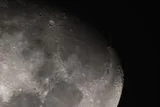
The moon is pocked with craters from asteroid, comet, and meteoroid impacts. However, it now has a rather large one, thanks to a SpaceX Falcon 9 rocket.
On August 5, 2026, part of a Falcon 9 rocket struck the moon, leaving a crater. Now, thanks to images from NASA’s Lunar Reconnaissance Orbiter (LRO), we can finally see the impact it left on our only natural satellite.
Though the LRO successfully recorded images of the crater, it did so with its own set of challenges.
How Big Is the Moon’s New Crater?
After the impact, NASA engineers tilted LRO to photograph the impact site. Between August 11 and August 12, 2026, the LRO captured a series of images of the crater. The LRO was able to capture multiple angles and lighting conditions of the crater site.
From the information gathered, NASA scientists estimate that the crater has a 60-foot width. Based on the length of the crater’s shadow, NASA estimates that the crater is only about 10 feet deep.
Though the LRO is orbiting the moon at about 60 miles above the surface, thanks to its Narrow-Angle Camera, the craft is able to spot features on the moon as small as three feet wide, according to a NASA statement.
Read More: Scientists Are Still Pondering These Mysteries of the Moon
What Else Did the Images Reveal?
From the different photo lighting and angles, NASA experts identified a few other features created by the impact. Some angles show either bright or dark rays extending out from the crater. The dark rays are from surface dust that has long been altered by solar wind, micrometeorite impacts, and galactic cosmic rays, according to NASA. This darker material likely comes from the first 1.5 feet of the lunar surface.
The lighter streaks likely come from fresher moon material that was pushed out by the collision as it moved deeper into the moon’s surface.
Challenging Images to Capture
While the LRO captured many detailed images of the crater, taking them was not as simple as flying by the impact site. The LRO is traveling around the moon at about one mile per second and can orbit from pole to pole in about two hours. During this time, the moon is slowly rotating beneath the LRO, so the LRO has to wait for the crater to come into view before it can be photographed.
Besides getting the location to line up, timing was another key factor in capturing clear, accurate images. According to NASA, if the LRO took photos of the crater 10 seconds too early or 10 seconds too late, the crater would have drifted off-center by 10 miles, and the photos would not have been as clear.
A Global Effort
Tracking the collision and the crater was part of a global effort, according to NASA. Using public data, private astronomers, hobbyists, and experts all worked together to first track the rocket’s trajectory.
Using that data, NASA’s Jet Propulsion Laboratory (JPL) then refined the trajectory to the point of predicted impact. The team at JPL then shared the data with the Republic of Korea for use in its Korea Pathfinder Lunar Orbiter (Danuri) program. The program used Danuri’s high-resolution LUTI camera to image the impact site and confirm that the prediction was accurate to within about 0.6 miles, according to NASA.
The Danuri program shared its findings with NASA, and the LRO team recalibrated the satellite to obtain the most accurate follow-up images.
NASA’s Center for Near Earth Object Studies — the experts who track objects that could pose an impact threat to Earth — also used this event to test techniques and tools for predicting impacts.
The moon now has another crater, and this event highlights the importance of working together to better understand our space technology and our natural satellite.
Read More: Why We See Only One Side of the Moon’s Surface
Article Sources
Our writers at Discovermagazine.com use peer-reviewed studies and high-quality sources for our articles, and our editors review for scientific accuracy and editorial standards. Review the sources used below for this article:
- This article references information from NASA: NASA’s LRO Images Falcon 9 Crater on Moon, Learns New Details