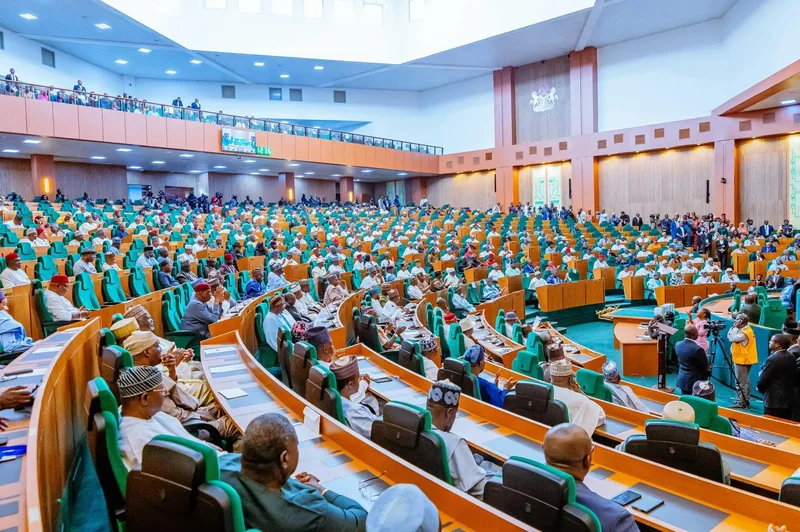
The House of Representatives has passed the Constitution Alteration (State Police) Bill, 2026, seeking to establish a constitutional framework for the creation and operation of state police services across Nigeria.
The bill was passed on Thursday during plenary after lawmakers considered and adopted the report of the House Committee on Constitution Review, chaired by the Deputy Speaker, Benjamin Kalu.
The proposal is part of the ongoing constitutional alteration process aimed at restructuring Nigeria’s security architecture and improving the country’s response to rising insecurity, including terrorism, banditry, kidnapping and other violent crimes.
The House dissolved into the Committee of the Whole to consider the bill clause by clause, with Mr Kalu presenting a synopsis of the proposed constitutional amendment.
| | |
|---|
He described the bill as a significant step towards establishing a modern, professional, accountable and effective state police system in Nigeria.
“Today presents a rare opportunity and a historic one that will give us the opportunity to strengthen the Nigerian security architecture, and that is by leaving a lasting legacy for our nation,” Mr Kalu said.
According to him, the constitutional amendment would provide the foundation for the establishment of state police, while subsequent legislation would address the detailed administrative and operational issues required for the effective implementation of the system.
“This bill represents a significant and practical first step towards the establishment of state police. It lays the constitutional foundation upon which a modern, professional, accountable and effective state police system can be built,” he said.
He added that the amendment would not, by itself, resolve all the concerns surrounding the creation of state police, but would provide the legal framework for the development of detailed implementation legislation.
“The detailed implementation legislation that will follow will provide ample opportunity to address critical issues relating to administration, recruitment, training, vetting, certification, standardisation, operational standards, information and accountability, oversight, intergovernmental coordination and other implementation mechanisms,” he said.
Mr Kalu said the concerns raised by lawmakers and other stakeholders could be addressed during the implementation phase.
He also referred to the committee recently set up by President Bola Tinubu to examine the implementation of the proposed state police system.
“In other words, many of the legitimate concerns expressed by members and stakeholders can still be comprehensively addressed during the implementation phase, and I am happy that Mr President has set the ball rolling by setting up a committee that will look into this implementation bill,” he said.
The deputy speaker urged lawmakers not to allow the pursuit of perfection to prevent the country from taking a major step towards reforming its security architecture.
Mr Kalu said the decision before the House was an opportunity for the National Assembly to place national interest above political and other considerations.
“History will judge the parliament not only by the debates we held, but by the courageous decisions we made when our nation required bold leadership,” he said.
He urged lawmakers to support the bill, arguing that the proposed reform had the potential to strengthen Nigeria’s security architecture, deepen federalism and improve the protection of lives and property.
“I believe that there is nobody who is seated here today who is against state police because it concerns you, it concerns your safety, it concerns the safety of those you are representing,” Mr Kalu said.
“I therefore urge every honourable member. I plead with every member in this House, I beg every member in this House to vote in favour of this bill and join in making history by supporting the successful passage of the establishment of state police, the same way you did when it first came to this House.”
Following the presentation of the synopsis, the Speaker, Abbas Tajudeen, who presided over the Committee of the Whole, provided details of the lawmakers participating in the voting process.
He said 211 members physically present in the chamber were from the All Progressives Congress, while 65 members belonged to other political parties.
He added that 35 members participated virtually through the National Assembly’s electronic platform and declared their support for the bill.
According to him, the total number of members who had signed the attendance register and those who participated virtually stood at 311.
“If you add the total members who have signed our register, totalling 276, plus the 35 members that have joined us on the platform of the House, we have a total of 311 members,” Mr Tajudeen said.
He stressed that the constitutional requirement for the passage of the bill was two-thirds of the 360-member House, which translates to 240 members.
He said the report before the House contained 26 clauses, an explanatory memorandum and the long title of the bill.
The bill was subsequently passed without the clause-by-clause consideration of its provisions, prompting the minority caucus to walk out of the chamber in protest.
The passage marks another major step in the long-running debate over the creation of state police in Nigeria, an idea that has received increasing support amid concerns over the capacity of the centralised policing structure to effectively respond to security threats across the country.
The latest passage came after the House had earlier passed a state police constitutional amendment bill on 11 June, with 289 members present during the exercise. Only one member voted against the bill, while the overwhelming majority supported its passage.
Tinubu’s intervention
The passage followed a fresh legislative process initiated by President Bola Tinubu.
The House had earlier passed a state police constitutional amendment bill on 11 June under a separate bill number.
However, Mr Tinubu subsequently transmitted an Executive Bill to the National Assembly seeking to amend the 1999 Constitution to provide a legal basis for the establishment of state police services alongside the Nigeria Police Force.
In his letter to the House, the President urged lawmakers to give the Constitution of the Federal Republic of Nigeria (Alteration) (State Police) Bill, 2026, expedited consideration.
He described the proposed amendment as a major pillar of his administration’s efforts to reform Nigeria’s security architecture.
According to Mr Tinubu, the bill is designed to establish “a constitutional pathway for the establishment of State Police Services” as part of efforts to improve the country’s capacity to tackle its growing security challenges.
Following the President’s intervention, the House withdrew its earlier approval of the constitutional amendment bill, paving the way for consideration of the revised Executive proposal.
The bill subsequently passed first and second readings and was referred to the Committee on Constitution Review for further consideration.
The committee, chaired by Mr Kalu, then commenced consideration of the Executive Bill.
At a meeting of the committee on Monday, the deputy speaker said the version of the bill already passed by the Senate would serve as the working document for the House committee.
He said the committee would review the Senate amendments and adopt them where necessary.
“The purpose of today’s meeting is to consider the Executive Bill clause by clause and make appropriate recommendations to the House. We must note that the Senate has already considered and adopted the bill with certain amendments, and copies of that version have been circulated to members. This document will serve as our working draft throughout this exercise,” Mr Kalu said.
He explained that the Executive Bill was largely consistent with earlier versions considered by the National Assembly, making significant changes to the proposal unlikely.
The Senate had earlier passed the Executive Bill after considering the report of its Committee on Constitution Review, chaired by Deputy Senate President Barau Jibrin.
At the time of the vote, 87 senators were present, exceeding the two-thirds constitutional threshold required for the passage of a constitutional amendment.
The Senate subsequently passed the bill after more than two-thirds of the senators voted in support through a manual voting process.
The bill must now undergo the remaining stages of the constitutional alteration process, including consideration by the state Houses of Assembly, before it can become part of the Constitution.
The House thereafter adjourned plenary till September 15 to observe its annual recess.