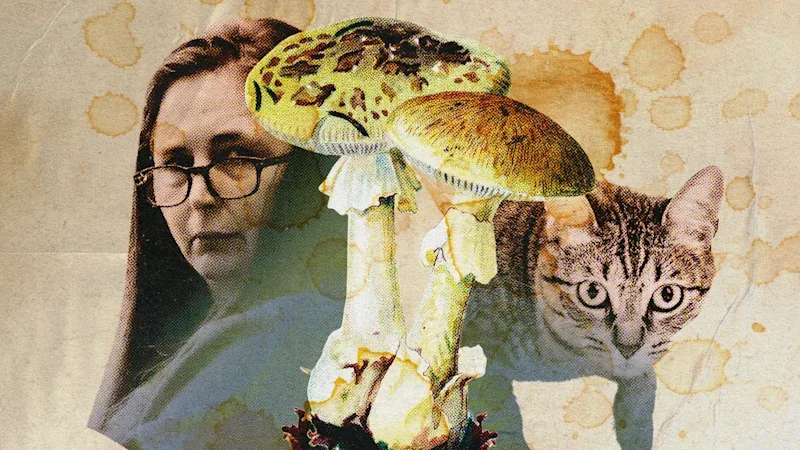
Death cap mushroom killer Erin Patterson’s interest in picking and eating wild mushrooms was at the centre of her appeal on Thursday, after her legal team argued she was effectively forced to enter the witness box during her trial to explain why she had lied to police.
On the second day of Patterson’s appeal hearing, on Thursday, three judges were taken back to the killer’s 2023 police interview, in which she denied ever foraging for wild mushrooms, and her estranged husband’s evidence that he’d never known the 51-year-old to forage for wild fungi.
An accused person is not required to provide evidence in their own criminal trial, but Patterson spent eight days in the witness box during her 2025 trial. The jury ultimately found Patterson guilty of murdering three people and attempting to murder a fourth by serving them a lunch of beef Wellington laced with poisoned mushrooms at her Leongatha home in July 2023.
Crown prosecutor Jeremy McWilliams on Thursday rejected the suggestion Patterson was forced to give evidence, and argued there was no evidence before the trial of any “innocent interest in foraging for wild mushrooms”. He said it was Patterson’s own defence team that first raised that explanation in its opening address to the jury.
“The only reference to the concept of innocent interest … came from counsel for the application’s opening to the jury, where he told the jury that the applicant lied to police in her record of interview about this fact and asserted that she did have an innocent interest in foraging, including foraging and eating wild mushrooms,” McWilliams told the Court of Appeal.
“It must be the case that it was anticipated the applicant would have to give evidence [about that fact] ... to both overcome the lie and the suit of evidence that tended to support the lie.”
The Court of Appeal heard that at her 2025 trial in Morwell, the prosecution had sought to rely on photographs found on an SD card at Patterson’s Leongatha home, and her posting of one picture on a poisons page on Facebook to prove she had an enduring interest in poisons.
In pretrial arguments, the trial judge ruled the evidence inadmissible in the form in which the prosecution sought to use it. But at trial, the defence team introduced the photographs in an attempt to support their argument that Patterson had instead an innocent interest in foraging for wild mushrooms.
“There was evidence that, on the Crown case, the applicant had posted [one] of these photographs …on a Facebook poisons page and said, ‘Help, my cat has eaten one of these mushrooms and become very sick are they poisonous?’” McWilliams told the appeals court.
He said the prosecutors in the trial wanted to tell the jury that the post about the cat was an example of Patterson seeking to gather information about poisonous mushrooms before the fatal lunch.
“The applicant [Patterson] did not own a cat or have a cat at the time,” McWilliams said.
At the trial, jurors were told by the defence team that Patterson might have accidentally picked death cap mushrooms during a foraging trip, and that they had somehow accidentally made their way into her beef Wellington.
Patterson was sentenced to life in prison, with a non-parole period of 33 years, in September 2025 for the 2023 murders of her in-laws, Don and Gail Patterson, and Gail’s sister, Heather Wilkinson, after a jury found her guilty of all charges.
She was also convicted and sentenced for the attempted murder of the lunch’s sole survivor, Baptist pastor Ian Wilkinson.
Wilkinson survived after spending several weeks in an induced coma, and Patterson’s trial heard that medical staff determined the illness suffered by the other three victims were unsurvivable. They died from toxic mushroom poisoning.
In October, the Director of Public Prosecutions (DPP) launched an appeal against Patterson’s 33-year non-parole period, arguing the sentence was “manifestly inadequate”.
A month later, Patterson’s legal team filed an application to appeal her conviction on seven grounds they argue caused a substantial miscarriage of justice.
These include claims that Patterson was unfairly questioned by the prosecution during her eight days in the witness box, that 35 errors occurred in the prosecution’s closing address, that large tranches of evidence shouldn’t have been put to the jury, and that evidence from Facebook friends and Facebook messages were not relevant and unfair.
A hotel bungle is also at the centre of her fight for freedom with Patterson’s team arguing it contributed to a miscarriage of justice. On Wednesday, Patterson’s barrister, Richard Edney, said an “inexplicable failure” to separate the jury from the prosecution and police – who were all staying in the same hotel – during deliberations created a potential miscarriage of justice.
In the days after the 11-week-long trial, jurors were sequestered for their deliberations in the same Traralgon hotel as members of the prosecution team and police officers involved in the case. Edney on Wednesday said this was a catastrophic and fundamental failure to comply with the rules.
It was the first time in the state’s history, Edney said, such a situation was believed to have occurred.
DPP Brendan Kissane, KC, dismissed Edney’s claim and said it had substance.
Court of Appeal judges Stephen McLeish, Leslie Taylor and Peter Kidd are hearing the appeals.