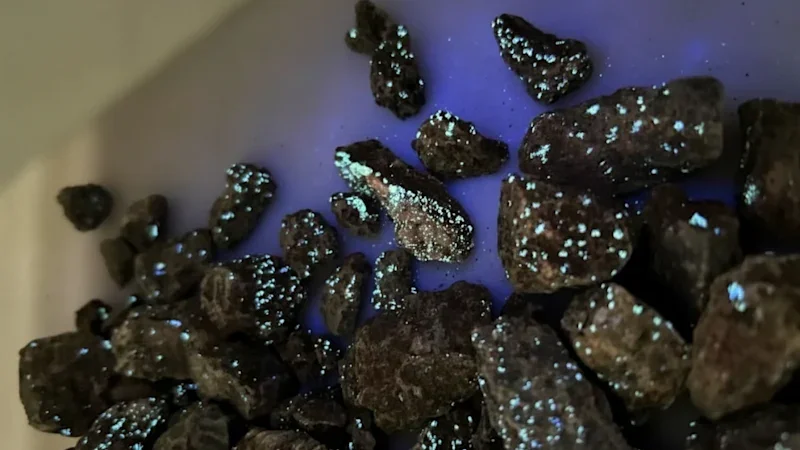
Viking Mines has kicked a major goal in its tungsten processing journey with ore sorting technology successfully upgrading its material by more than 400 per cent to produce a high-grade product at its Linka project in Nevada, USA.
Assay results from testwork conducted by industry leader TOMRA using its X-ray Transmission (XRT) ore sorting technology, have confirmed the process could deliver spectacular results.
A sample from the historical Linka stockpile, with an already promising feed grade of 0.45 per cent tungsten trioxide, was upgraded by a whopping 4.1-fold to produce a concentrate grading 1.83 per cent.
Simultaneously, a sample from the Conquest pit, with a feed grade of 0.61 per cent tungsten trioxide, was upgraded by a factor of 3.1 to deliver an even higher-grade product running at 1.91 per cent tungsten trioxide. This particular fraction contained 27.3 per cent of the total tungsten from the sample in just 8.8 per cent of the original mass, highlighting the efficiency of the sorting process.
‘Ore sorting has produced a high-grade product at up to 4.2x times the feed grade in both samples, while rejecting a low-grade stream...’Viking Mines managing director and chief executive officer Julian Woodcock
The testwork also demonstrated the technology’s ability to effectively reject waste, with the low-grade reject streams from both samples grading just 0.2 per cent tungsten trioxide.
The strategic implications for Viking are twofold.
First, it could allow for the pre-concentration of run-of-mine ore, rejecting waste rock before expensive chemicals are applied, significantly lifting the feed grade, reducing processing costs and optimising its tungsten production.
Secondly, it opens the door to potentially converting extensive, existing low-grade surface stockpiles at the historic mine site into a viable, high-grade plant feed.
Viking Mines managing director and chief executive officer Julian Woodcock said: “These assay results confirm what we observed visually in June. Ore sorting has produced a high-grade product at up to 4.2x times the feed grade in both samples, while rejecting a low-grade stream grading just 0.2% WO3. Importantly, the results demonstrate flexibility. By selecting different combinations of the sorted products, we can prioritise either grade uplift or tungsten recovery. This data will now inform how ore sorting may be incorporated into the conceptual process flowsheet for the Linka Project.”
While the lab coats have been busy proving up a potential processing route, Viking’s field crew has been equally active on the ground. The company’s maiden drilling program at Linka - the first in 40 years - has recently intersected multiple wide zones of visual tungsten mineralisation.
Geologists identified fluorescent scheelite under UV light - an 80.5 per cent tungsten-bearing mineral - in reverse circulation (RC) drill chips over significant widths of up to 12 metres. The visual estimates are an encouraging early sign as the company awaits the assays from its first modern-day tilt at the project, while drilling at the project continues.
The Linka project is part of a portfolio of six high-grade tungsten projects Viking acquired in the mining-friendly jurisdiction of Nevada. The project has a history of high-grade production, but operations ceased in the 1950’s due to a slump in tungsten prices.
Tungsten has recently jumped to an eye-watering $US3075 (A$4400) per metric ton unit (MTU), where one MTU equates to 10 kilograms, in the second quarter of 2026 - a more than sixfold jump from just twelve months earlier, as the critical mineral becomes highly sought after by Western nations for its use in defence, aerospace and high-tech manufacturing.
Ore sorting might not be glamorous, but it could be the breakthrough that transforms Linka. By proving the technology can effectively upgrade its tungsten ore, Viking has taken a major step towards its low-capex, fast-track production strategy in Nevada.
With the technology now validated and drilling underway for the first time in 40 years, the company is steadily de-risking the project. Further gravity and flotation testwork will help shape a conceptual flowsheet for a planned 300,000 tonnes per annum plant, with Linka increasingly looking like a serious contender in the race to secure US tungsten supply.
Is your ASX-listed company doing something interesting? Contact: mattbirney@bullsnbears.com.au