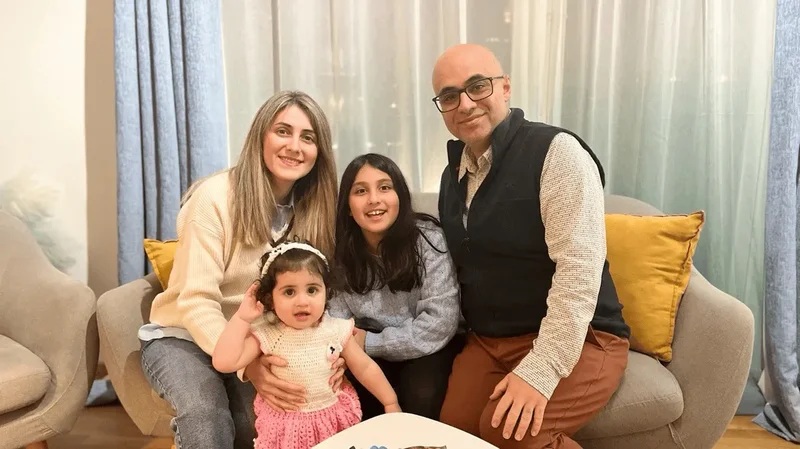
It was for an industrial design position at Chalmers University in Gothenburg that the family decided, in 2019, to move to Sweden from the UK, where Bijan held a similar post at Lancaster University.
Once they moved to Sweden, his wife Shima, who was in the same field – she holds a Master's of Industrial Design – decided to focus on learning the language of their new country.
She spent two and a half years studying Swedish, in which she is now fluent, then went to university to retrain as a teacher – a in-demand profession in Sweden. She now works as a technology teacher in a school in Gothenburg, but the position is neither permanent nor full-time.
The couple also now has a second child, but even with their larger family, Bijan's salary (he is now an associate professor of industrial design at Chalmers, as well as director of the university's industrial design engineering programme) is high enough that part-time work for Shima would be enough for them financially.
But without a higher salary and a permanent contract – which Shima, despite much ongoing effort, has not been able to find – the family is stuck in legal limbo in terms of their status in Sweden.
They are also divided, by that same measure. Sweden's current immigration laws mean that families – even those who moved to the country together, who have children born here, and who have lived together in Sweden for many years – are often not assessed together.
The laws also prioritise stable and relatively high income over, for example, level of social integration. For Shima and Bijan's family, this has resulted in a situation where Bijan – who works entirely in English and speaks Swedish at a beginner level – and their eldest daughter (now 10, born in the UK) are Swedish citizens. But their youngest child – a two-year-old daughter, born in Sweden – and Shima, who works in a Swedish school and speaks fluent Swedish, are both on temporary permits.
Shima has never applied for permanent residency, because she is not eligible, and doesn't know when she ever will be.
"**I'm not checking the news because it's so stressful." **
The family is thus divided by legal status in the country where they have made their home, with one parent and one child having the rights and freedoms of citizenship and the other parent and child being on tenuous legal footing.
Given the relatively short (two-year) validity period of temporary permits and the often long processing times for renewals – during which you can't leave Sweden, at risk of being denied re-entry – the family says they feel trapped.
"Basically you can't move [around], " Bijan says, "because there are periods of year that some member of the family is waiting for the results [of a temporary permit renewal]. So it's like you are locked in in the country, for many reasons. And then with children, when they go to school, it's not easy."
The couple's eldest daughter is a Swedish citizen, because the timing of Bijan's citizenship approval meant that she was able to be attached to his application. But since his application was still in process when their youngest daughter was born, she could not get citizenship and was given temporary residency status instead.
"I would really like to find a [permanent] job because of residency," Shima tells The Local. "It's not because of, for example, finances. But yes, it's an important thing because we have two children."
If Shima is lucky and lands a permanent job with a sufficiently high salary, then she will be eligible for permanent residency and then citizenship, at which point their youngest daughter could be attached to Shima's citizenship application.
But, as anyone who has looked for a permanent contract in today's Sweden knows very well, there is only so much that a job-seeker can do to make a permanent job happen. You can have all the qualifications and experience and still keep hitting walls, seemingly indefinitely.
Both Bijan and Shima say the uncertainly of the family's legal footing in Sweden, combined with regular news of new immigration laws being pushed through – and applied retroactively – make them regret their decision to leave the UK for Sweden. If they knew in 2019 what they knew now, they both say, they would never have come.
"Definitely not," says Bijan. "I wouldn't [have made] this choice because it's too complicated, and also because of treating family members in different ways. I'm a bit sorry to use this word, but it's a bit medieval, in my point of view."
He says it would be preferable to have a job he didn't like as much, if his family had secure status in the place they'd made home.
"When we moved," Bijan continues, "we were not aware of all of this, like, 'pop-up' rule changes. But after a few years, we started seeing that everything is being changed like on a weekly basis and also in a retroactive way which makes things quite unpredictable."
Shima feels the same way.
"If we had another chance to choose, yes, we would never choose to come to Sweden, because of this situation," she says.
Both say the biggest issue for them in all this is their children. The eldest, now 10, came to Sweden when she was three and is now fully integrated into Swedish society. In terms of memory, it's probably the only country she knows. And the youngest has never been anywhere else.
Bijan says the fact that Sweden's strict immigration laws apply to young children – "who have no choice where they are born and who their parents are" – is particularly harsh and difficult to understand.
He also thinks its a bit backwards that the rules are both harsh and, at least in the case of their family, accomplishing the opposite of the stated political goal of fewer immigrants in Sweden.
"If you'd actually really like to move people away from Sweden, I think it doesn't work (...) We are not desperate to just continue like this in Sweden in terms of our career pathways. But then with children it's not that that easy to move, especially when one of them is going to school. So it's like we are basically locked."
A potentially dangerous power dynamic for women
It's not only in the area of reducing immigrant numbers that the couple sees Sweden's immigration laws as working against the country's own stated interests. It's in the area of women's equality and safety as well.
If a family is in a situation like theirs, where only the man has a secure job, the couple point out that further dividing spouses based on more-or-less-secure immigration statuses could deepen power imbalances between men and women.
"Especially in cases where the the man is the one who may have a more permanent job [and therefore has] better progress in this bureaucratic process and gets citizenship or permanent residency, then the wife will be so dependent on the man," Bijan says.
"When the man has more power because of citizenship and other types of status (...) I can tell you hundreds of scenarios that could be really problematic there. For a country like Sweden that would like to show a very progressive image of itself, that is not good."
The irony is, Bijan says, that when it comes to more involved engagement with Swedish society – socialising with other parents, or dealing with their children's schools, for example – it is he, the Swedish citizen, who relies on Shima, the temporary resident.
"Shima is much more integrated in the Swedish system because she has legitimation (accreditation) for being a teacher. She works as a teacher. So she is able to teach in Swedish in a highly demanding job. When you work in a university, it's a different working environment. You are not very connected to the real society and you can just get by speaking English. But then on paper you see the difference. I'm a Swedish citizen and she is dependent on me."
As with the other families in Sweden split by immigration status that The Local has interviewed, Shima and Bijan say Swedish people in their circles assume that Shima and both children have secure status in Sweden, and are taken aback when they find out how tenuous their situation actually is.
"When we speak with parents of children because our children are playing with each other, it's interesting for them because all of them think that because one of us has Swedish citizenship, all the family is supported," Shima says. "Also they think that because, for example, I have a husband and he has a job and also Swedish citizenship, I can also get it easily."
"But it doesn't work [like that]."
Just not the right way to do things
When The Local asks what the couple would like to say to Swedish voters about how the law affects families like theirs, Bijan says he thinks many simply do not know how Swedish immigration law divides families.
"My assumption is that majority of people don't know that's there's this kind of family separation setting in Swedish law. Dividing family members, especially in the case of children, and especially in cases where the man has the a more permanent situation, it is really odd. I used a very strong word in the beginning, medieval, but that is the way that I think about it," he says.
He also says that voters should be aware that there is one scenario of family immigration being "sold" to the public by "populist politicians" – often of someone coming to Sweden and then bringing extended family over on false pretenses. That scenario, he points out, is only one among many many others. But the laws affect everyone.
"So you have one scenario, you want to avoid that scenario, you come up with some rules and you get some public support for the rules because you always talk about that specific scenario. But what is happening is that the new rule which is being set for avoiding that scenario will have an impact on people who may have much different scenarios."
A broader historical perspective is important in issues like this, Bijan thinks. During the pandemic, he spent time reading travel histories from 19th century Iran and came across many stories of Swedish professionals working in Iran in that time. It reminded him, he said, of a certain enduring global reality of workforce migration.
"Immigration is a very complex system and all countries around the world are engaged with that system," he says. "The mobility of the workforce is basically part of the free economy, and this kind of bullying of families actually does not contribute to the economy of any country."
Iran, the country both Shima and Bijan grew up in, and currently the only country where Shima and their youngest daughter have permanent right of residence, is not currently a safe place to return to. Bijan says he sometimes sees worrying parallels with the path Sweden is starting to take on family immigration and painful parts of Iran's history.
"Sometimes it reminds me of the things that happened in the 1980s in [Iran] with foreigners who were forced actually to leave the country and families who were separated. There are many of those [historical] examples, so I think [Swedish voters] should be a bit more aware of the consequences of their choices."