It turns out the dreaded 'cankles' come for most of us, in the end.
Water retention in the legs shows up in mid-life as puffy or swollen ankles and general lower-leg heaviness.
Research shows this is often down to fluctuating hormones in perimenopause and menopause which can cause our lymphatic system – the network responsible for clearing excess fluid – to work less efficiently and hold on to water.
Case in point: at 45, and after two pregnancies in my 30s, my ankles never quite returned to normal and I'm firmly in the 'cankle' camp these days. By the end of the day, my ankles are usually puffy with sock indents and a general heavy feeling of tiredness.
This is despite trying to do all the right things – I walk as much as I can, and spend a few minutes (pre-shower) body-brushing daily to kickstart my lymphatic system. I've even tried lying with my legs up against a wall before bed.
Yet according to lymphatic drainage expert Rebecca Trevalinet, founder of Methode Trevalinet, I'm far from alone in my battle against the bloat.
'Our lymphatic systems rely on movement, muscle contractions, breathing and the gentle contractions of the lymphatic vessels to keep fluid moving around the body,' she explains.
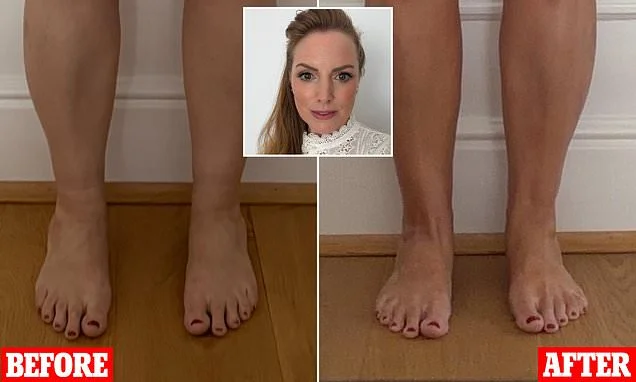
I didn't notice a huge difference in my cankles at first, but after using the trousers three times a week for a month, then twice a week for another month, my ankles definitely looked trimmer (Left: Bethan's ankles before trying the trousers, Right: after the trouser treatment)
After two pregnancies in my 30s, my ankles never quite returned to normal and I'm firmly in the 'cankle' camp these days despite trying to do all the right things, writes Bethan King
Just when I thought I'd tried it all, a pair of high-tech compression trousers landed on my desk, promising to promote lymphatic drainage... all while I recline on the sofa
'Fluctuating oestrogen and progesterone in our 40s can make this process less efficient, or we may move less, meaning our muscles don't pump fluid back up the legs as effectively and then, unfortunately, gravity does the rest – the fluid naturally travels downwards collecting around the ankles.'
In the past, I've tried full-body lymphatic drainage massages – the gold standard in beating water retention – and found them very effective at getting rid of swollen ankles.
But, from upwards of £100 a session (and given they need to be done once or twice a month to maintain results) they're a considerable commitment.
Then, a pair of high-tech compression trousers landed on my desk, promising to promote lymphatic drainage and improve post-workout muscle recovery... while I recline on the sofa.
The trousers, called Skinvity's PressTech, resemble oversize black ski trousers that go from your feet up to your waist. This is what sets them apart from other trousers on the market, as the groin, abdominal area and glutes are all massaged as well as the legs, supposedly boosting the lymphatic drainage.
Once inflated, they use 'pressotherapy' – air-pressurised squeezing – to encourage lymph flow by squeezing your legs in a special sequence to drain excess fluid and reduce puffiness.
But do they work, or are they just a gimmick?
'Compression boots and trousers work because they inflate in waves, starting at the ankles and moving up the legs, helping push fluid upwards, supporting both lymphatic and venous circulation,' explains Rebecca. 'The effect is similar to the natural pumping action of our muscles when we walk, but in a more regular, repetitive way, so after use, you notice your legs feeling lighter, with less puffiness.'
The first time I donned them at home, I realised the biggest challenge was going to be surviving ridicule from my husband, whose help I needed to zip into them. Once he'd stopped laughing and I was lying on the sofa, I adjusted the control panel to the appropriate mode and sat back.
They vary from mode one (for lymphatic drainage and fluid retention), to six (for massaging muscles post-exercise). You then choose a pressure setting, from a low 30mmHG (millimetres of mercury, the measurement for pressure), to a more intense 260mmHG. I went for mode two, which is best for drainage, and a pressure of 40mmHG, and tried to relax. A tough call, because the trousers quickly inflate to Michelin Man proportions and stay inflated, squeezing very firmly up your legs in sequence; a little like having your blood pressure taken, but on your whole leg.
They then hold the 'squeeze' around the waist for a few seconds, before releasing a little pressure again. It was quite meditative, and I noticed an immediate difference in how my legs felt: lighter and slightly tingly.
I didn't notice a huge difference in my cankles at first, but after using the trousers three times a week for a month, then twice a week for another month, my ankles definitely looked trimmer. Even better, if I spend all day on my feet the sock indents are no more.
But how do gadgets like this compare to a professional lymphatic drainage massage?
'Compression devices work on the areas they cover, whereas manual drainage is much more adaptive; the hands can feel the tissues, adjust pressure and work more precisely beyond the legs too, to the abdomen, arms, neck and face,' explains Rebecca.
'But I don't see them as in competition; compression devices are a great, accessible way to support fluid movement at home.'
I'm hooked, providing my marriage survives the mocking. At £1,000 a pair, there is no denying they're a considerable investment – but if you use them twice a week, the cost-per-wear quickly outruns professional treatments.