Singapore, India agree to deepen cooperation in telecommunications, food safety
AI generated
SINGAPORE - Singapore and India have agreed to cooperate more closely in the telecommunications and broadcasting sectors, and to exchange best practices relating to food safety.
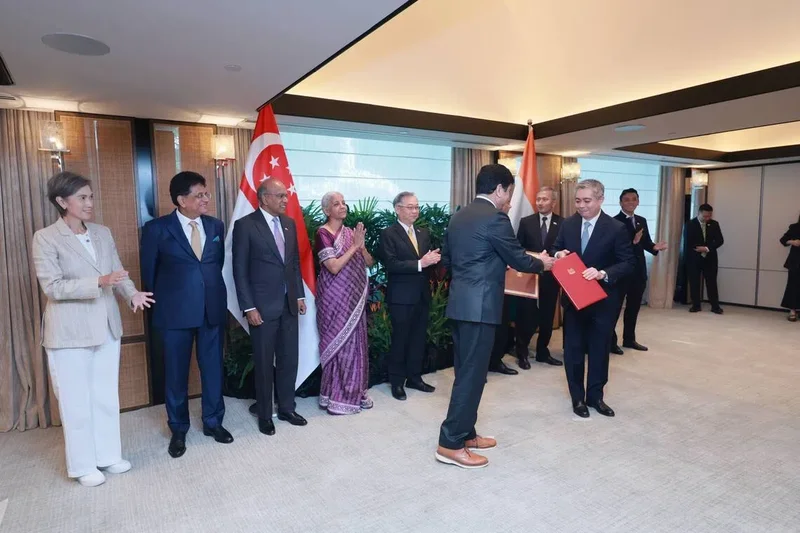
These were part of two memorandums of understanding (MOUs) and a letter of intent that were exchanged between the two countries following the fourth India-Singapore Ministerial Roundtable (ISMR) held at Shangri-La Hotel on Aug 20.
The roundtable is a regular high-level dialogue mechanism started in 2022 to deepen bilateral cooperation between the two nations, and to identify and explore mutually beneficial collaboration in new and emerging areas.
The two countries take turns to host the meeting, and the previous one took place in New Delhi in August 2025.
Singapore was represented at the meeting by Deputy Prime Minister Gan Kim Yong, Senior Minister K. Shanmugam, Foreign Minister Vivian Balakrishnan, Minister for Digital Development and Information Josephine Teo and Minister for Transport Jeffrey Siow.
The Indian delegation comprised Minister of Finance and Corporate Affairs Nirmala Sitharaman, Minister of External Affairs S Jaishankar, Minister of Commerce and Industry Piyush Goyal, and Minister of State for Ministry of Commerce & Industry and Ministry of Electronics & Information Technology Jitin Prasada.
Speaking to local media after the meeting, Gan said it was very productive and that the ministers’ discussions covered all six pillars of the ISMR. These are advanced manufacturing, connectivity, digitalisation, healthcare and medicine, skills development, and sustainability.
One area of particular interest to both sides was skills upgrading and training of India’s workforce in sectors such as advanced manufacturing and aviation maintenance, repair and overhaul, said Gan.
Since the two countries signed an MOU on semiconductors partnership in 2024, a number of manufacturers have invested in India. This has created a lot of opportunities for Singapore SMEs in this space, he noted.
To support the sector’s growth, Singapore is hoping to establish training centres in India, particularly where semiconductor companies are investing in, he added.
The two sides also noted the good progress made by ITE Education Services (ITEES), which is setting up a center of excellence for advanced manufacturing in Chennai.
Gan said the intention is for this project to be a pathfinder and a “strong structure and framework for skills training and upgrading, which is very important for the industrialisation of India”.
Another area of discussion was on how to smoothen Singapore firms’ entry into India, so as to create an ecosystem there for semiconductor manufacturing. There is also potential for further investment in India’s food processing sector, Gan added.
The agreements that were exchanged on Aug 20 will see Singapore’s Infocomm Media Development Authority (IMDA) and the Telecom Regulatory Authority of India deepen their cooperation in areas such as spectrum management.
Radio frequency bands, or spectrum, are invisible airwaves that carry wireless signals. They make everyday communications possible, including radio and TV broadcasts, aviation and maritime satellite communications and mobile cellular transmission.
The two national agencies also agreed to exchange perspectives and best practices on safeguarding the interests of consumers in relation to telecommunications services and broadcasting regulation, and to coordinate their engagement at international regulatory bodies.
Meanwhile, Singapore’s Ministry of Culture, Community and Youth and India’s Ministry of Ports, Shipping and Waterways will aim to facilitate information and training exchanges between each country’s heritage institutions, and encourage their participation in international engagements.
The Singapore Food Agency (SFA) and the Food Safety and Standards Authority of India separately agreed to strengthen bilateral technical cooperation in food safety, such as through exchanges on labelling, product recalls, emergency notifications, and import procedures.
SFA and its Indian counterpart also agreed to support safe and resilient agri-food trade between the two countries.
Gan noted that the Republic had worked with India during crises such as the Covid-19 pandemic to ensure that food supplies, such as rice, were not disrupted.
The two sides have been discussing a supply chain resilience arrangement for food, similar to the ones Singapore has with countries like Australia and New Zealand, he noted. Other areas of potential collaboration in food supplies include research and development to strengthen the technology for crop yields and quality.
Gan said the most important value of the ISMR is that it has become very easy for minister from both sides to call their counterparts, so as to iron out any issues in the way of deeper cooperation.
“We develop trust and relationship with one another (and) that will help to strengthen bilateral collaboration between the two countries,” he said.
During their visit to Singapore, the Indian ministers called on Prime Minister Lawrence Wong. They were also hosted to lunch by Gan.