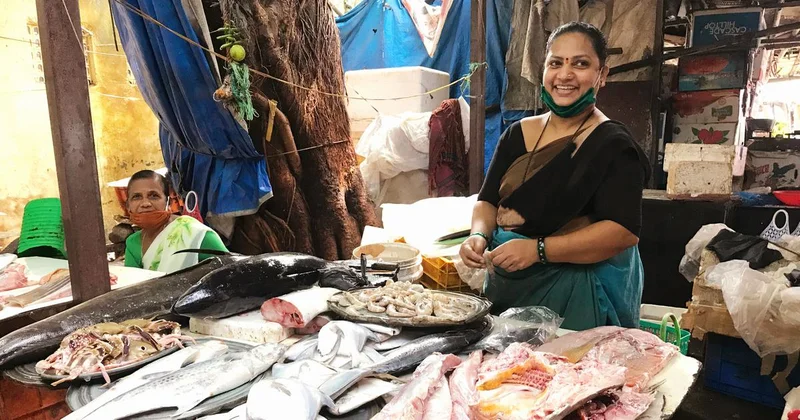
The Son Koli, a fishing community, are original inhabitants of Greater Mumbai, Navi Mumbai and Thane, in western Maharashtra. They witnessed the rise and fall of great empires, invasions, imperialism and colonialism, fight for freedom, the birth of a republic, and the hurtling of the region into hyper-urbanisation. Over centuries, the Koli fished and mended their nets in quiet fishing villages that dot the coast but in the last few decades the world around them irrevocably changed. The number of Koliwada (a traditional fishing village) are rapidly shrinking, now down to just over 275 neighbourhoods in the Mumbai megalopolis. Several Koliwadas are surrounded by high-rises and modern infrastructure, but the fisherfolk community is struggling, much like the ocean they depend on. The megalopolis is unstoppable, encroaching on fishing grounds and villages, and the ocean as well as the once-rich estuaries are now choking with pollutants. As a result of unprecedented climate change crises, rapid urbanisation and industrialisation, water bodies are polluted and the natural thriving environment of marine species and mangrove forests are ruined. In the last decade and a half, there has been a forced shift of occupation in fishing villages in and around Mumbai.
Forced to desert the estuary, where they traditionally worked, fisherwomen of Mumbai have started selling rice-roti to the restaurants of Mumbai. On average, five to 15 women in each Koliwada, produce between 200 and 400 handmade rotis every day. Ek Bagal Mein Chand Hoga, Ek Bagal Mein Rotiyan launches by gazing at two phases of the moon, referencing the Koli (fishing) community"s literal dependence on the moon, and its allegorical significance. In an effort to reverse the profound sense of loss of social and cultural traditions, and the drying of indigenous resources, trades, and ecosystems in the present, the women of Chendani fishing village and we wrote a dry seafood recipe book. Drying infers loss, yet the action itself suggests the need to preserve. Taking a spin on the word and the action, we revived recipes that are no longer in use because the diversity of fish needed are almost extinct.
We worked with 11 Koli women from Chendani Koliwada in Thane. The social fabric of this Koliwada was precarious, having lost their local language only a decade ago. Choosing a socially engaged and performative research method, we collected evidence in the form of rooted intangible and tangible narratives around the ecology and daily life of these indigenous people. We brought women together by running a contest to make the largest rice-roti and reviving old and lost dried fish recipes.
Roti – a humble flatbread – is a basic, staple food that is had at breakfast, usually with a dry fish preparation. In the afternoon, the Koli eat rice and fresh fish ambot (curry), as the women are busy segregating and drying fish that need to be cooked quickly, and dinner is rice, roti and ambot. In the last century and a half, rice replaced ragi, sorghum, and Patni rice as the main ingredient of the roti. Conducting a roti-making contest was crucial, as selling rice-roti to earn a living is seen as an inferior job in the community, and the activity encouraged the morale of women, as well as impacted public opinion in the community regarding this new line of work. Isn't moulding and shaping of minds the whole point of public art? It is important to see this shift of occupation as beneficial, and the ritual of roti making as another means of livelihood for the community.
Alongside the roti, 13 dry-fish dishes that were once cooked by grandmothers returned to Koli kitchens. Participants, all of them women, brought handwritten recipes and their stories. I, a formally trained artist, mapped visuals in the form of diagrams from the collected oral narratives, and documented the loss of the ecology of the estuary for each recipe. We forged an archive of recipes, creating a manuscript that recorded the survival of these dishes and carried personal narratives and memories, along with illustrations of a landscape that has succumbed to pressures of uncontrolled growth.
The research performance concluded with our 11 participants coming together to “mummify” dry fish that were used in each recipe, as preserved evidence of what has been lost. Participants were asked to make dried fish dishes and bring the same raw dried fish which was cooked for the dry fish competition. Together, we applied natural neem resin and lacquer; the coating was dried and then wrapped with linen like the Egyptian mummification process. The Egyptian mummification process is influenced by the ancient fish drying technique; the primary process of drying a mummy is by using salts to remove moisture, a process that is still used in the kippered fish technique. For our project, mummification of fish was a way to preserve memory and the DNA as evidence of past knowledge.
Women collected “treasures” from their nearby river estuary, as proof of the dead water bodies. It is an old Koli ritual to collect and preserve dry fish food before the rains, as fishing stops in the monsoon. A dry fish repository serves as food security, and the Koli believe that dry fish tastes best in the monsoon, only when fishing is restricted (we stop fishing for a few weeks because the seas are stormy and to allow for fish stock to replenish). Additionally, there are some recipes of dried fish that are traditionally cooked as a part of funerary rituals, symbolically to provide food for the afterlife. Delicious and a part of a regular diet, dry fish preparations are found only in Koli homes, and despite a plethora of seafood restaurants, these recipes aren’t on menus – I still haven’t found any restaurant exclusively serving dried fish, surely because of its overpowering odour!
As Mumbai and the megalopolis grow, the lives of the Koli are under threat. Neel Kranti or the Blue Revolution introduced bottom and mid-water trawling, which is fast replacing artisanal and sustainable fishing practices. Problems of urbanisation, especially waste management, and the loss of traditional jobs have forced migration of the Koli, and threatened our traditional way of life. Koliwadas are under threat for their location and real estate value. Once self-sufficient and with a strong identity, the Koli community is being pushed away from the coast, in favour of prime sea-facing property. Will we have to imagine the fishing community without an oceanfront?
Excerpted with permission from ‘Ek Sagal Mein Chand Hoga Ek Sagal Mein Rotiyan (One Side Lies the Moon, on the Other, Bread)’ by Parag Tandel in Practices of Hope: A Reader for the Future, edited by Ravi Agarwal, Ranjit Hoskote, and Amruta Nemivant, Niyogi Books and Goethe Institut Max Mueller Bhavan.
We welcome your comments at letters@scroll.in.