Sign in. It’s quick, free and it’s up to you.
An account is an optional way to support the work we do. Find out more.
*The Housing Essay is a weekly deep dive from a rotating variety of voices into issues impacting the property crisis in Ireland. Are there potential solutions that may be currently overlooked or traditionally ignored by policymakers? *
TWO WEEKS AGO, we wrote about the urgent need for public luxury in Irish towns and cities. We argued that in a fair society, public luxury would be prioritised in areas that need it the most, like our dense urban areas with smaller homes and little or no gardens, or areas that are financially deprived. But often it seems we do the opposite in Ireland, with wealthier areas receiving more public investment.
When poorer areas do receive ‘regeneration’, ‘redevelopment’ or ‘urban renewal’ intervention it is often viewed as gentrification, as a way to attract new wealthier residents. Even the #DerelictIreland movement has been accused of contributing to the gentrification of our towns and cities by making them nicer places to live.
Reinforcing the belief, clearly held by many in Ireland, that only the rich people deserve nice things.
This results in public luxury becoming a double-edged sword. Who doesn’t want their local area to get better? But at what stage does this progress become gentrification?
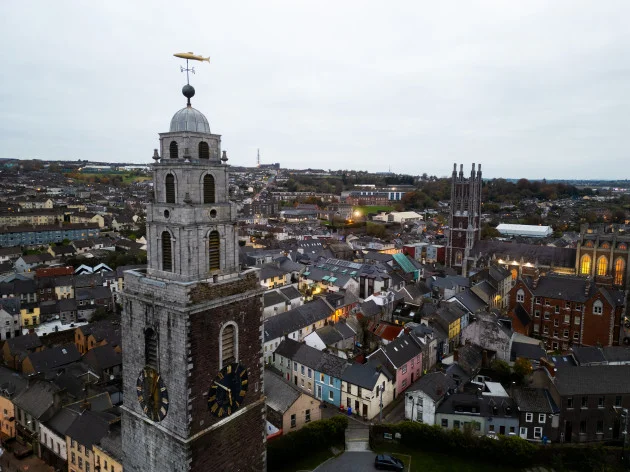
Is it when a new children’s playground goes in? Or is it when the majority of existing homes are bought up by private landlords to extract eye-watering rents that only high earners can afford. Such as happened to historic working class Shandon in Cork city where 58% of all homes are now private rentals and where rents for a two-bedroom home will cost you €2,300 a month.
However, Shandon is a prime example of where gentrification does not need public luxury. The area is plagued with vacancy and dereliction, there is limited public seating or bins, there is no playground and the only green space is a graveyard. But since public luxury can become the gateway to gentrification, these rents might rise even further when Cork City Council completes their proposed regeneration of Shandon.
Although there’s no official gentrification policy in Ireland the reality is, it is rampant. Gentrification doesn’t happen overnight, but instead it jumps and spurts over years and sometimes over decades. It can be considered ‘organic’ following market shortages or an unofficial ‘official’ redevelopment strategy that follows brown envelopes, case in point the Mahon Tribunal.
This redevelopment approach often begins with deliberate decay and dereliction by speculators.
This vandalism can go on for a prolonged period of time in the hope that the area becomes less attractive as a location, so people fall out of love with it or even forget that it exists. Sometimes suppressing prices in order to buy up more land while also using this intentional dereliction as an excuse to demolish heritage buildings, many of which are irreplaceable, further negatively impacting the sense of place and identity of the area. Sadly, there have been numerous examples of this in recent years.
This drawn-out approach destroys the heart of the community well before the wealthier people move in. Which in turn hinders a community’s ability to fight back against private profit-driven developments, many of which result in the scenarios such as co-living or a proliferation of student accommodation and hotels. The Liberties in Dublin is sadly another example of gentrification without sufficient public luxury.
However, this protracted ‘dereliction to development’ is not a typical gentrification process across Europe. Traditionally European gentrification firstly replaces lower-income residents with creatives and students who make neighbourhoods ‘feel safer’ for the middle classes. However, some European cities do it differently yet again.
Two weeks ago, we wrote that Rotterdam was a model example of how well public luxury can be implemented to benefit everyone. But when it comes to gentrification, Rotterdam should be an example of precisely what not to do.
Rotterdam isn’t leaving it to the market to reduce the amount of poor people living in the city. It’s first explicit gentrification policy turned 20 years old this year. The 2006 ‘Rotterdamwet’ law restricted those depended on social welfare from moving into poorer neighbourhoods. Then in 2016, local politicians voted to “replace 20,000 affordable homes with 36,000 properties for middle- and upper-income households”.
While cycling around the city we happened to stumble upon what could be considered the poster child of Rotterdam’s gentrification policy. Maybe not the one the city would like to promote but one that symbolises the cold-hearted community destruction caused by gentrification.
Tweebosbuurt was first earmarked for gentrification in Rotterdam’s 2016 Woonvisie. It is ideally located just south of Rotterdam centre, roughly a 20-minute cycle to the central station and just five minutes from the famous Erasmus bridge.
The area has a long history of being home to working class families and of welcoming many international families to settle there. Prior to gentrification the area had a mix of buildings from different periods, with some properties pre-dating World War 2 (when 25,000 homes in the port city were destroyed by the Nazi’s Luftwaffe in just 15 minutes). But over the last few decades the area gained a reputation for high unemployment, poverty and criminality. It was prioritised for regeneration in 2019 with most of the buildings, close to 600, demolished by 2022.
In stark contrast to most urban regeneration projects, Rotterdam’s approach often leads to less homes not more.
Tweebosbuurt is no exception. We calculated that the area is losing over 20% of homes. And it gets worse as the homes being built will contain more private rental and owner-occupied homes than originally, meaning an estimated two-thirds of social homes are being lost. This is significant community displacement with many families having lived there for generations.
Unlike in Ireland, tenants subject to urban renewal evictions in the Netherlands have a right to relocation and financial compensation. But uprooting and relocating streets and streets of neighbours, when it takes years to build up good relationships and community is extremely destructive. There are many negative social impacts from gentrification identified at Tweebosbuurt.
The reason we noticed Tweebosbuurt is because the regeneration has been marked with major delays that has left former street blocks as empty, dusty fields, pocketed with a few defiant derelict buildings and one defiant homeowner refusing to leave. A combination of bad management and bankruptcy of the owners, Vestia Housing Association, as well as legal objections and protests have meant what was to happen in just two to three years is now taking five to six years. Delays like this are not typical in Rotterdam.
But before we pat ourselves on the back that Ireland doesn’t undertake a similar
harsh regeneration approach, it’s important to remember that our own regeneration
processes are also cruel, albeit through different slow mechanisms that often feel
like death by a thousand cuts.
O’Devaney Gardens in Dublin is a great example of this. Social tenants were evicted 20 years ago yet new private expensive homes are only planned for completion next year.
While the tiny amount of social homes being built are in huge demand with 1,000 applications for just 99 available units.
Many will argue that gentrification is natural, and the only alternative to gentrification is urban decay, stagnation and squalor. We don’t agree.
We believe it is possible to have a form of urban renewal that puts existing communities first; refurbishing homes, ensuring affordable rents, improving public services and providing vital resources for everyone irrespective of address, wealth or status. We live with Dóchas that this shift in mindset happens so everyone benefits.
Jude Sherry and Dr Frank O’Connor are founders of anois.org, ffud.art and #DerelictIreland. They are part of a series of writers, academics and economists penning a weekly essay delving into the housing crisis and potential solutions.
To embed this post, copy the code below on your site