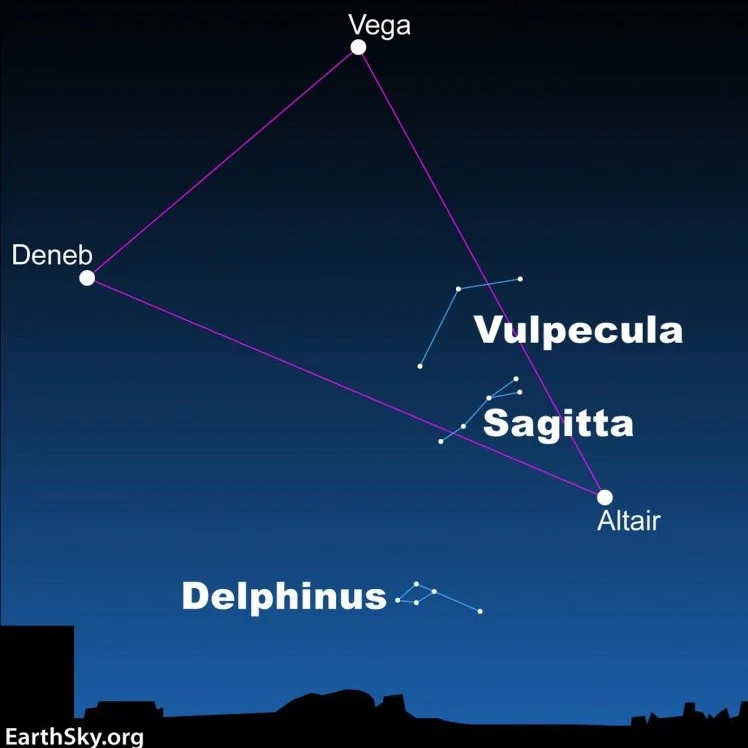
The constellation of Sagitta the Arrow contain only dim stars, and it’s the third smallest of the 88 constellations. But its position within the famous Summer Triangle makes it a great constellation to pick out in a dark sky.
People understandably relate Sagitta the Arrow to Sagittarius the Archer, although the two do not lie next to each other in the sky. Sagittarius lies low on the southern horizon during northern summer, while Sagitta is farther north. It almost appears as if Sagittarius has shot his arrow at Aquila the Eagle and missed, and the arrow now lies on the other side of the Eagle from Sagittarius.
Locating Sagitta
Sagitta may be small and dim, but its position inside the Summer Triangle makes it easy to locate.
Sagitta and Vulpecula are the two constellations that take up residence between the constellations Cygnus the Swan, Lyra the Harp and Aquila the Eagle. Each of those constellations has one bright star that marks a corner of the Triangle: Cygnus’s star is Deneb, Lyra’s star is Vega, and Aquila’s star is Altair.
Sagitta lies north of Altair, inside the pointy end of the Summer Triangle. It consists of a line for the arrow’s shaft, and then it branches off on one end. Does it look like an arrow to you?
Stars of Sagitta the Arrow
Because of Sagitta’s small size, it contains few observing targets. Its brightest star is Gamma Sagittae, shining at magnitude 3.5 from 274 light-years away. About 3 degrees west is Delta Sagittae, a magnitude 3.8 star lying 448 light-years away. Then just a bit less than 2 degrees west of Delta are two stars, both at magnitude 4.3. The one slightly north is Alpha Sagittae and the one slightly south is Beta Sagittae. Alpha lies 620 light-years from Earth, while Beta lies 470 light-years away from us.
Sagitta’s Messier object
The one notable deep-sky target in Sagitta is also its only Messier object: the globular cluster M71. You can find M71 halfway between the stars Gamma and Delta. At magnitude 6.1, you’ll need binoculars or a telescope to spot it. Because of M71’s appearance, astronomers long thought that it was an open cluster with a rather dense center. Astronomers now believe it’s a young globular cluster that is smaller and looser than typical globular clusters. M71 lies about 13,000 light-years distant.
Bottom line: Sagitta the Arrow is a dim constellation that lies inside the Summer Triangle. It contains one Messier object, a small globular cluster.