[Today’s Iran war post launched before complete because I had to go out. Please return or refresh this page at 8:30 AM EDT for a final version]
The level of sloppy and hyperbolic reporting, both by the press and YouTubers, is getting louder and louder as pressures on both side of the Iran impasse rise. One major frustration on the markets/economics front is that many of the soi-disant experts are asset managers. They are not proficient in financial plumbing or bank operations, save a very few who run focused funds that invest in that arena. They are pretty much without exception true believers in fiscal orthodoxy, as in they commit the sin described in MMT as treating governments that issue their like a household, that they must live within their means. I used to think that way, as some of my early posts on this site attest, and had to revamp my thinking.
The big object lesson on that front today is the widespread misreading of the practical significance of Bessent intervening in the long end of the Treasury market.1 Yes, high interest rates are bad because they signal high and here probably well-founded inflation expectations. Yes, it is bad for the US to spend a lot on unproductive interest payments….just as we do on a porky, underperforming military and an extortionate health care system.2 Yes, the Fed will probably wind up “printing” as in monetizing debt. But “printing” does not cause inflation, as massive monetary expansion for very long periods in Japan shows. Japan was in borderline deflation for nearly three decades despited concerted efforts to change that. What does cause inflation is too much net fiscal spending (budget deficits) when the deficit is not increasing productive economic capacity.
And yes, the role of the dollar is set to diminish as the US economy and financial markets become less and less important on a relative basis. And Trump does seem to be doing his best to accelerate that propensity with the great damage he is inflicting on the US economy. But Europe has terrible fundamental prospects due to their economies de-industrializing due to their repudiation of cheap Russia energy even as they double down on funding Project Ukraine and sincerely intend to arm up to arm up to protect themselves from the evil marauding bear. They may suffer even more damage if the present trend, of being particularly exposed to global warming, continues. China’s domestic economy is not in great shape. It needs the lift it gets from exports more than usual but global demand is weakening due to the Iran conflict. And despite its ambitions, it is not yet willing to take the measures needed for China to become a successor reserve currency, as in running trade deficits and credibly ending capital controls.
The more likely bad outcomes than the overhyped dollar crash is either a financial market meltdown, with the AI debt and equity bubbles the most likely detonators. There is too much private debt relative to GDP in many economies (recall that it is private debt excess that cause financial crises), so contagion into other types of debt is likely. The other option (to prevent said crisis) is Japanification, of managing to avoid a lot of overt debt writedowns at the cost of economic strangulation. Richard Koo described this pathology long-form in his classic, Balance Sheet Recession: Japan’s Struggle with Uncharted Economics and its Global Implications.
We’ll unpack this hot topic further when we discuss the Treasury intervention later in this post.
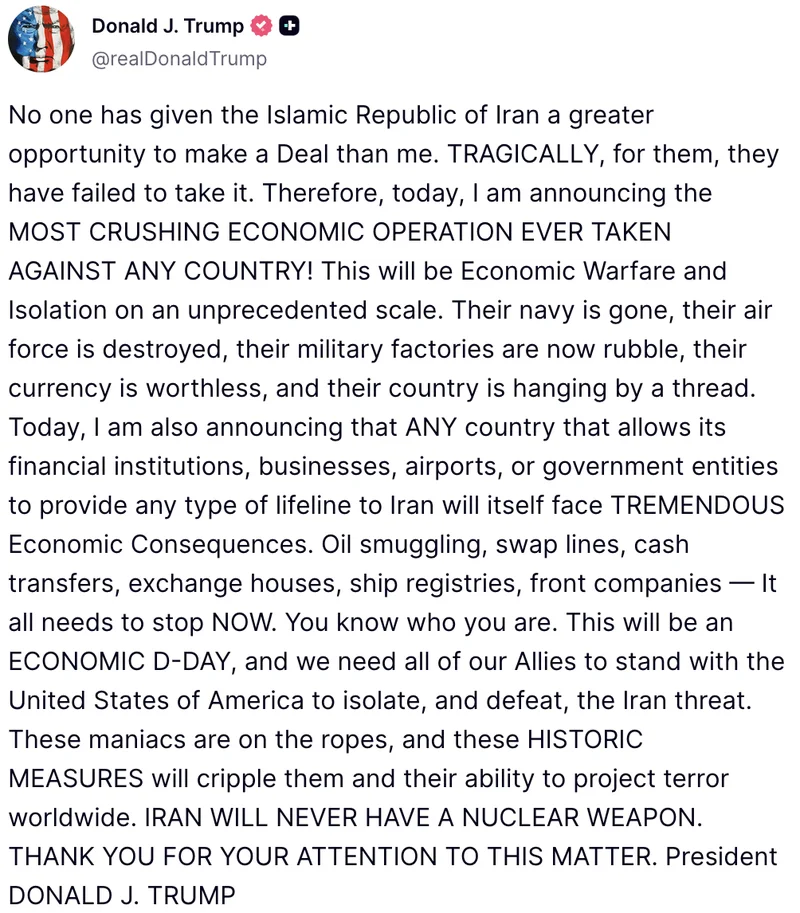
But first we’ll turn to Trump’s latest move in the “gotta be dominating” front, as in his new economic threat against Iran:
This is pathetic. It’s far less credible than the times Trump threatened Iran with devastating bombing and actually did have forces lined up by which the US could have inflicted a great deal of damage to critical civilian infrastructure in Iran. Trump and Bessent promised before the MOU expired to impose economic measure that would pound Iran into bloody pulp. But there is no concrete action so far, merely more bluster.
When Russia moved to launch its Special Military Operation, the US, UK and EU imposed their shock and awe sanctions * before the invasion*, right after Russia recognized the breakaway republics and entered into a mutual defense pact with them. Mind you, kinetic action was expected shortly but had not actually begun when the sanctions, most importantly, the seizure of Russian assets, were launched. In other words, to resort to Trumpian imagery, the Collective West was not just locked and loaded but also pulled the trigger as soon as they had a pretext.
Not surprisingly Iran and independent observers are not impressed. From Aljazeera in Trump announces ‘most crushing economic operation ever’ against Iran:
Iranian Foreign Minister, Abbas Araghchi, dismissed Trump’s latest threats of economic sanctions, calling it a “diversion from America’s own crisis: unprecedented debt & surging interest costs.”…
State media also dismissed Trump’s announcement as nothing new.The IRIB state broadcaster said it followed “the failure of military aggression” while the semi-official Tasnim news agency said the announcement was “not a new development”. It said the US “has been trying for years to block any financial and economic ties with Iran” but that Tehran has “learned how to circumvent these restrictions and has become very skilled at doing so”.
The semi-official Fars news agency also dismissed Trump’s claims as “delusional”, saying that the US had repeatedly voiced assertions of Iran’s “imminent collapse” and military destruction without delivering concrete results.
Al Jazeera’s Mike Hanna, reporting from Washington, DC, said Trump’s latest move showed “a degree of frustration” over the deadlock in the five month old conflict.
Hanna said the first question was what economic pressures Trump could exert on Iran that are already not being exerted and said the announcement may look like “another shouting threat” to the Iranian officials.
Larry Johnson highlighted that the new focus on economic punishment is the result of military impotence. From The Confession in the Escalation: If Iran Is Beaten and Hormuz Is Ours, Why the “Unprecedented” Sanctions?:
Trump is making three victory claims at once. Iran, he says, is “
being very badly defeated.” The Strait of Hormuz, he says, is effectively American — “we own it,” the US has “total control,” the waterway is open and the mines cleared. And the naval blockade, he says, is total and biting, strangling Tehran’s economy. Set those three claims down next to a fourth fact — that his own Treasury is scrambling to invent a financial weapon “like have never been seen,” and that he is again threatening “a harsh new attack” if the strait doesn’t reopen “soon” — and they cancel each other out. You do not need an unprecedented new sanctions campaign to defeat a country you have already defeated. You do not need to threaten fresh bombing to open a strait you already own.The escalation is the confession.Each new demand for pressure is an admission that the last claim of victory wasn’t real.
Now to some information hygiene. Both the media and YouTubers are hyping the bogus idea that the UAE has cut off Iran economically. For instance, from the Bloomberg landing page:
This, following Chas Freeman, is more accurately called “Sanctions with Middle Eastern characteristics.” Recall when Erdogan loudly said he was cutting of trade with Israel, and then did no such thing?
Here, it gets even better. As we pointed out yesterday, the UAE had already supposedly cut off all trade with Iran. Its announcement was simply a restatement of its existing official policy…which it has not been observing. Hoisting from our post yesterday:
And a debunking of the assertions that the UAE had changed its posture regarding economic ties to Iran as a result of the attacks, from Esfandyar Batmanghelidj on Twitter:
I don’t believe there has been a change in UAE policy towards Iran, at least not overnight. Iranian flights are landing at DXB, vessel traffic is unchanged, and the underlying logic of renewed economic engagement remains sound.
There is a lot of confusion about yesterday’s ballistic missile incident and the subsequent MFA statement refuting economic engagement with Iran. The UAE MOD first assessed that two ballistic missiles fired from Iran were heading towards the UAE. It later revised its assessment, stating that the missiles were targeting vessels in the Gulf. For its part, Iran has now denied targeting the UAE.
In any case, the MFA statement was not linked to the missile attacks. It was simply issued on the same day. The statement does not mention the missiles and instead states that in light of “regional escalations… all trade, commercial exchanges, and financial transactions with Iran have been halted until further notice.” This is not actually a description of a shift policy because the UAE never formally announced it was resuming trade ties with Iran….
In other words, the MFA was restating the policy adopted at the outset of the war, pushing back on the recent media reporting that the UAE and Iran have resumed economic relations as part of a narrow détente…
The UAE has been under pressure from the US in light of the Trump administration’s plan to rely on economic pressure to undermine Iran….
In reality, the UAE will maintain this public stance, but will continue to protects its interests by insisting on its own economic sovereignty.
Today, theres no evidence that this reaffirmation amounts to a change. Its a gambit to please the US and allow the Administration to pretend that it is succeeding in imposing new sanctions on Iran:
Spoke to @ismaeelrn about the optics of UAE-Iran trade relations.
I emphasized that whatever the public statements, the UAE has agency. It’s not a country that will allow its core national interests to be determined by policy choices made in Washington.https://t.co/WFpu8BbIuO
— Esfandyar Batmanghelidj (@yarbatman) August 19, 2026
To the Israel attack on Turkiye military operations in Syria. Douglas Macgregor provides excellent one-stop shopping in a new talk with Mario Nawfal. Recall that Macgregor is a serious military historian and has repeatedly admired the Turks as a nation with a strong martial tradition, and currently a very accomplished fighting force. Macgregor provides detail on how the Israel strike was essentially a warning shot, killing no Turkiye soldiers and perhaps not even damaging any assets. But Macgregor seems to believe that Turkiye has also not meaningfully bulked up at that base, as in Israel was trying to ward that off. Macgregor regards that as destined to fail.
Macgregor regards the Israel move as reckless, particularly now when Israel is clearly overextended. He also sees an escalation to direct confrontations as risking a much bigger regional war.
[quotes from machine transcript to follow].
Now to the Beseent invention. Apparently Bessent had not gotten the memo that the Pentagon received decades prior, that the US is not constrained in its ability to spend in its own currency. It can, however, generate too much inflation with that spending. As a tax maven noted many years ago, “No one ever worried about where the money for the next bombing run in Iraq was coming from.”
First, an overview from the Financial Times:
The US Treasury said it would “at least double” purchases of long-term government debt as policymakers seek to contain a sell-off that has sent borrowing costs soaring in the world’s most important bond market.
The more aggressive buyback operation affects Treasury securities maturing in 10 to 20 years and 20 to 30 years, increasing from $2bn to “at least” $4bn, the Treasury said on Wednesday.
The move comes at a time of growing strains in the $32tn US Treasury market as investors fret over the burst of inflation triggered by Donald Trump’s Iran war and Washington’s mounting public-debt burden.
“The administration is getting nervous about the long end of the curve and wants to try to stem the decline,” said Daniel Murray, deputy chief investment officer at EFG International.
Robert Tipp, chief investment strategist at PGIM, said the move to boost buybacks was “an important signal to the market that the Treasury is concerned about the sell-off in the back end of the yield curve”….
In an early sign of the limits of the buyback strategy, the Treasury’s $16bn auction of 20-year bonds on Wednesday afternoon drew only modest appetite. The debt was sold at a yield of 5.204 per cent, a small premium to the 5.199 per cent on the secondary market, Bloomberg data shows.
The so-called bid-to-cover ratio, a measure of demand relative to the amount of debt sold, was 2.53, compared with this year’s average prior to the sale of 2.66.
“The auction wasn’t especially weak or especially strong, it was pretty middle of the road,” said Gennadiy Goldberg, head of US rates strategy at TD Securities.
Let us stress the detail at the end of this extract. Treasury set the yield only a bit over current prices, which it had manipulated lower. That means investors purchasing Treasuries at these yields were getting less in terms of expected returns than Mr. Market had just said they ought to.
So the auction, despite Treasury offering a sub-par yield given the current givens, still went adequately well. This is not consistent with the picture of Treasury repudiation you hear all too often on YouTube.
Mind you, it is hard to fathom what Bessent is trying to achieve here, save pander to Trump. It is unlikely, since Treasury is not the central bank and the Fed wants higher rather than lower rates, that Bessent can keep his manipulation shenanigans going even as long as the mid-terms.
Ipek Ozkardeskaya, Senior Analyst at Swissquote, gives a conventional reading of why this gambit is at best a short-term expedient. Via e-mail:
Yesterday was marked by a coup from the U
S Treasury, which suddenly announced that it will ‘at least double’ the maximum size of its buyback operations for longer-term debt, hoping to ease pressure on long-term yields and borrowing costs. Phoah!The markets reacted heavily to the news. The US 10-year yield fell sharply, while the 30-year yield dropped from its highest levels since 2007. The latter helped support equity valuations: the S&P 500 eked out a small 0.21% gain but remained short of reversing the chip rout. VanEck’s semiconductor ETF lost 1.55% regardless. The US dollar tanked, letting the majors rally aggressively against the greenback.
This morning, we see US bonds and FX consolidate, as investors question what the Treasury announcement really means and what its longer-term impact could be.
First, it’s important to note that
US national debt has crossed the $40 trillion mark. Interest payments have become one of the biggest items in the federal budget, while persistent deficits mean that the US continues to add debt as its interest bill grows. And fiscal policy under Trump is not improving the picture. Instead of restricting policy and raising taxes, the Trump administration favours lower taxes and tries to fill the gap through spending cuts and tariff revenues.As such, the
US fiscal picture today remains as murky (if not murkier) as yesterday, but the way the government is willing to manage its debt – and the weight of the Federal Reserve (Fed) in the picture – has changed.In the
short run, the impact is relatively straightforward. Buying back more long-dated debt should ease pressure on longer-term yields, helping households through lower mortgage rates and corporations through lower borrowing costs. That’s positive.For the dollar, lower long-term yields are initially negative, as they reduce the attractiveness of US assets to international investors. That’s partly why the dollar sold off so aggressively yesterday.
But the operation
changes neither the amount of US debt nor the underlying fiscal problem. And if Treasury increasingly relies on shorter-term borrowing, that would mean more frequent refinancing.If rates remain high – uh-humm, there you’ve got to get the Fed to play along – the government’s interest bill adjusts more quickly.
And that’s where the longer-term risk lies. If
investors conclude that Washington is increasingly trying to manage long-term borrowing costs rather than addressing the fiscal deficit itself, they could eventually demand a higher term premium to hold long-dated Treasuries. That could push long-term yields higher again.
As Cbot noted in the comments section of the Financial Times:
Another way to say this is, the Executive Branch is interfering in the Fed’s interest rate policies.
Supporting that view:
Fed officials saw need for rate hike if inflation doesn't cool, minutes show https://t.co/Eb8qsezSEI
— CNBC (@CNBC) August 19, 2026
Yet one of the oldest rules of investing is “Never fight the Fed”. And it is the central bank, and not Treasury, that can expand the monetary supply.
[more in the update, do please refresh and re-read when the final launches]
1 This move is part of Iran war news since inflation around the world, which is goosing Treasury yields, is increasing due to the Strait of Hormuz closure. Extra spending to prosecute the war is adding more fuel to the fire.
2 The Federal government pays for at least roughly 30% of total healthcare spending. Some estimates put the proportion markedly higher.