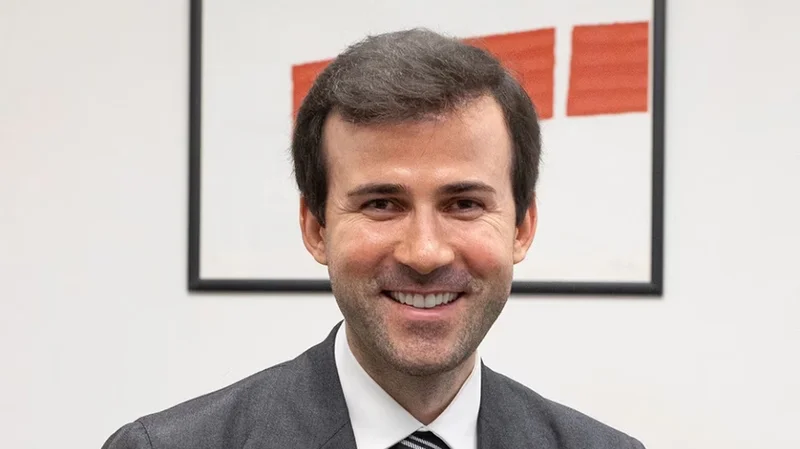
Domyn has raised more than $1bn, which makes it one of the largest financings a European AI company has ever announced, yet only about a tenth of it is equity.
The Milan company took roughly $1.1bn in total, split about 10% equity and 90% debt, according to Sifted. That structure is the story, because it is what you raise when you are buying hardware rather than hiring researchers.
Mistral did the same thing on a smaller scale when it took $830m from seven banks to build its own data centre outside Paris. European AI companies have discovered that lenders will finance a building full of GPUs on terms no venture fund would offer for a model.
What Domyn is building is Colosseum, a supercomputer in southern Italy assembled with Nvidia and Vertiv. It runs 80 Nvidia GB200 NVL72 systems, close to 6,000 Grace Blackwell chips, drawing about 7MW and rated at 115 exaflops, which the company describes as purpose-built for models above a trillion parameters.
The company was founded in Milan in 2016 as iGenius by Uljan Sharka, who still runs it, and rebranded to Domyn last year. It sells to banks, insurers, pharmaceutical companies, defence contractors, and governments, on the argument that those buyers want to own the model rather than rent access to somebody else’s.
“We saw a white space not just enabling regulated industries to adopt AI, but to actually own and be an AI company in their market,” Sharka told Semafor in April.
Customers get access to the codebase and can pre-train on their own data, and the models are distributed through Microsoft’s Foundry platform.
Domyn has shipped two models, a small one aimed at general enterprise work and a larger mission-critical system it has benchmarked against GPT-4o and Claude 3.5 Sonnet. Those are the company’s own comparisons and have not been independently reproduced.
The ambitions attached to all this are not modest. Domyn has said it wants to invest $10bn over three years and reach €1bn of revenue in the same window, from a base that trade reporting has put in the tens of millions of annual recurring revenue.
Sharka has been candid about the scale of the framing. “$1 trillion is the new unicorn right now,” he told Semafor. “If you don’t talk about $1 trillion, you are out of touch.”
The timing sits inside a European buildout that has been more announced than delivered. Brussels opened bidding on seven AI gigafactories in a €30bn programme, French consortia have bid $10bn for one site, and the scheme has since run into delays that alienated partners.
Italy has been moving separately, with a €1bn national AI fund and a set of penalties for misuse legislated alongside it. Domyn is the most visible private beneficiary of that positioning, and it has been working with Nvidia and the Abu Dhabi group G42 on the Italian supercomputer.
Scepticism about the wider European push is not hard to find, and some of it is well argued. Renting capacity through a GPU-as-a-service layer reinforces the illusion of sovereignty rather than delivering it, which is one reason Domyn’s decision to own the metal is more interesting than the headline number.
Owning it also means carrying it. A supercomputer depreciates on a schedule set in Santa Clara, and the useful life of a Blackwell rack is shorter than the term of most infrastructure debt.
Several things about the round were not published. The investor list, the valuation, the identity of the lenders, and the terms attached to the debt are all undisclosed, and Domyn has not issued an announcement of its own.
That last omission matters more than it usually would. Debt-financed compute is a bet that the machines will be busy enough to service the loan, and the repayment schedule is the part of the deal that tells you what the company thinks demand looks like.
Domyn last raised in 2024, taking about €650m of project financing at a reported €1.7bn valuation after a €70m Series A. The new round is more than that entire history, and it has been raised against a machine rather than a market.
Get the TNW newsletter
Get the most important tech news in your inbox each week.