Sign in. It’s quick, free and it’s up to you.
An account is an optional way to support the work we do. Find out more.
A YOUNG WOMAN living with Friedreich’s Ataxia (FA) doesn’t want her parents “to bury another child” because she can’t access a disease-modifying drug that is available in other countries.
Pressure has been mounting on government leaders to intervene and reverse an HSE decision recommending against funding the treatment, which costs €288,000 per patient per year.
Friedreich’s ataxia is a progressive, neuromuscular disease that mainly affects the nervous system and the heart. It is a hereditary disease caused by a gene mutation.
While there is no cure for the disease, Skyclarys has been found to slow the disease progression and improve neurological function.
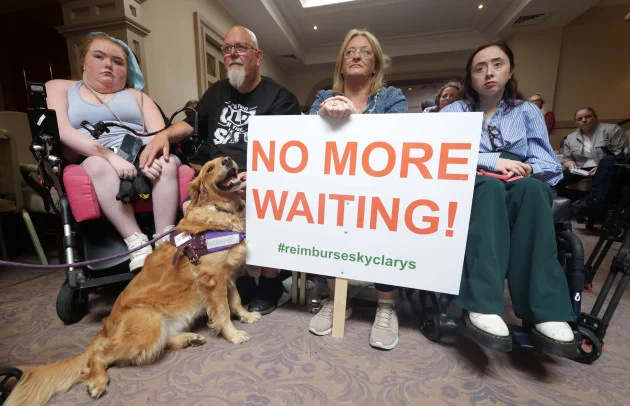
An event was held today in Buswells Hotel beside Leinster House, where politicians, doctors and people living with FA stressed the urgency of funding the drug.
Emma O’Shea (26) from Cork was diagnosed when she was nine years old. Her brother Timmy also had FA, and died in 2016 due to health complications.
“My brother had Friedreich’s Ataxia, so I know what’s coming,” she said.
“This is why I’m here – so that my parents don’t have to bury another child.”
Dr David Lynch, a US-based FA specialist, joined today’s meeting via Zoom, telling attendees that he has seen patients stall their deterioration and, in some cases, reverse symptoms because of Skyclarys.
Emily Felix (28) from Kilkenny is working full-time and studying to be a solicitor while living with FA.
She says her speech and her ability to swallow are gradually deteriorating, and she now needs help with basic tasks, limiting her independence.
“Two years ago I could go out partying with my friends. Now I’m lucky if I can go for coffee with my friend for an hour, and my mum or dad has to sit outside in the car because I may need help to go to the toilet,” Felix said.
She said she takes anti-depressants to help deal with the “overwhelming lack of control” she feels due to the disease.
She finds it “profoundly dehumanising” that the cost of Skyclarys is preventing her from living a better life.
The HSE’s senior leadership team is to meet on 25 August to make a final decision on whether patients will be reimbursed.
The treatment was approved by the European Medicines Agency in February 2024 and has been made available to patients in other European countries, but it is not available to around 200 patients in Ireland.
Another woman who spoke today has a daughter starting school in September.
“I’m begging, absolutely begging to be able to watch my child grow,” she said.
“I just want this drug to be able to keep me going and keep my voice.”
Patients and advocates are to hold a demonstration this Sunday at 12pm at the Garden of Remembrance in Dublin.
To embed this post, copy the code below on your site