This post is part of Global Voices’ August 2026 Spotlight series, “Indigenous Rights.” This series offers insight into the lives and experiences of Indigenous peoples to build connections across regions, center Indigenous experiences, and share the stories of leaders, activists, community members, and more. You can support this coverage by donating here.
The majority of the world’s languages are primarily spoken, not written. So, the knowledge of the speaker communities is oral, yet Wikipedia and other Wikimedia projects require written citations.
The OpenSpeaks Archives is developing a process for Wikimedians to cite oral knowledge from Indigenous and other low-resourced language communities, including nearly 20 language communities from India, Nepal, and Sri Lanka. This process includes audio-visual documentation, creating technological and educational resources, and community capacity building.
This interview series captures the stories of some of our collaborators documenting oral knowledge through audio-visual means. The first one is with Kshetrabasi Juanga, an educator, writer, and speaker of the Juang language. Juang is a vulnerable, Indigenous language with around 30,000 speakers from the eastern Indian state of Odisha.
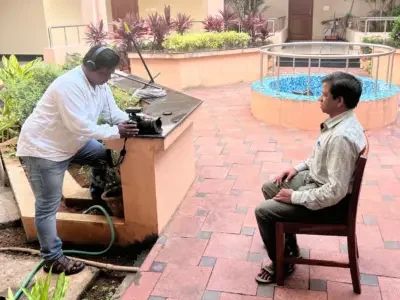
Opino Gomango and Subhashish Panigrahi interviewed Kshetrabasi Juanga on behalf of Rising Voices, in person and by phone, respectively. The following is a video interview with Kshetrabasi Juanga by Opino Gomango for OpenSpeaks Archives and is public via a Creative Commons license.
Kshetrabasi Juanga (KJ): Some work has been done. The Odisha government has worked on the language through the MLE program. The Academy of Tribal Language & Culture (ATLC) has published tri-language books. The Eastern Regional Language Centre (ERLC) has published a primer and a grammar book. The Central Institute of Indian Languages (CIIL) conducted a significant research programme on Juang. But our people, society, and culture — our festivals, marriage ceremonies and songs — are rarely documented.
Rising Voices (RV): How useful is audio-visual documentation for your language?
KJ: This is helpful and a welcome step. Juang is shifting. But while globalisation is bringing more languages to people through technology, our language and culture risk becoming stagnant. Documentation is essential, and that is why this work matters.
Imagine someone from the next generation doing their PhD on tribal languages and cultures. When they do, they will find a great deal of information waiting for them. It will also be invaluable for young speakers. Today’s children are tomorrow’s young people, and if they one day watch videos in Juang, they will feel that some effort has been made to preserve what is theirs. Those videos will remain on Wikipedia and beyond.Suppose a recording is made today, in 2026. When someone listens to it decades from now, they will be able to understand how the language was gradually changing, how a culture was being challenged, and how it survived. I think of it like a bitumen road. In some places, the surface has cracked, the bitumen risen, and green grass has pushed through. I see our language like that green grass surviving despite countless vehicles crushing it every day. No matter how globalised the world becomes, Indigenous languages and cultures are surviving, and will continue to survive.
RV: How will audio-visual documentation help Juang speakers?
KJ: It will be very helpful, especially for those interested in our language and culture. It will mean a great deal to young children aged three to twelve. From a child psychology perspective, children in that age range can learn multiple languages and cultures simultaneously. What we are building now will serve them directly.
And how about subtitling/captioning documented audio/video?
Consider two groups of Juang speakers. There are those who have moved away from rural areas due to urbanisation — perhaps one per cent live in cities today. If a Juang person living in a city comes across this documentation, it will feel like history to them. They will find self-respect and feel proud.And then there are those who remain in their communities, holding on to a way of life that carries deep moral value. In the Juang tradition, if four or five people are walking together, holding bows, arrows, and spears, it signals that sad news is coming—that someone in a village has passed away. Such traditions carry meaning that cannot easily be written down. Or consider how our mothers collect firewood: They go out, gather dry wood and twigs, stack them, and break branches piece by piece. No one else takes those branches — everyone knows someone has kept them there. That trust, that unspoken moral code, is something a society outside our community can learn from. The subtitles help them understand. To me, documenting these traditions will create an invaluable resource for the entire humankind.
OG: How have you contributed to addressing gaps in documenting the Juang language and culture?
KJ: I’m documenting our traditional knowledge through my YouTube channel, Majang Studio Vlogger. It has videos on how to ignite a fire with stones and how to take shelter under palm leaves during the rainy season. It’s so hard to record these in books. I couldn’t record as well as expected, but I’m trying. People are moving away from many traditional techniques. I continue to share my identity as an Adivasi through whatever means are available. More documentation needs to be done on a scale.