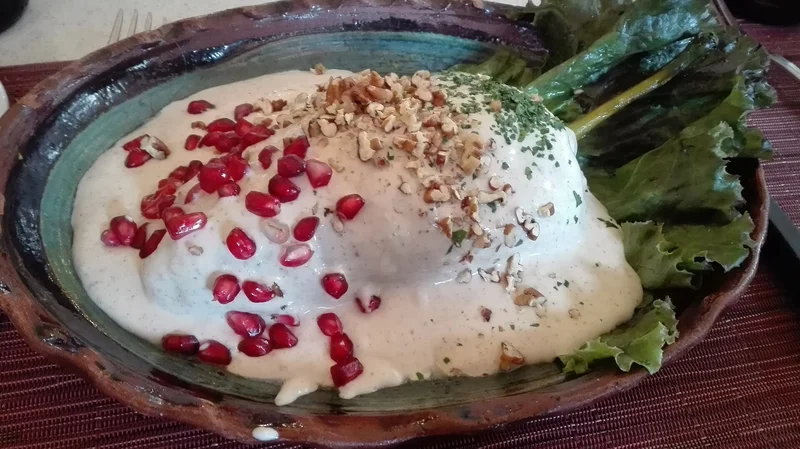
The Chiles en Nogada Origin Story Historians No Longer Accept
Mexico · Puebla
Key Facts
- The museumMuseo de Arte Religioso Santa Mónica, 18 Poniente 103, Centro Histórico, Puebla.
- Entry145 pesos general, about US$8.55; 80 pesos for nationals and foreign residents with ID.
- Sundaysfree for Mexican nationals and foreign residents, plus students, teachers and seniors.
- HoursTuesday to Sunday, 10am to 5pm, at the former Augustinian convent.
- The congressINAH’s first national chiles en nogada congress, 28 to 30 August 2026.
- Oldest documenta 1714 manuscript records stuffed chiles in white walnut sauce, without meat.
- First in printEl cocinero mexicano, 1831, made the dish with almonds rather than walnuts.
Order chiles en nogada anywhere in Puebla this month and you get the same story. The chiles en nogada origin, as the menus tell it, runs through a convent, some Augustinian nuns and an emperor.
What the Legend Says
The version everyone repeats is tidy. Agustín de Iturbide passed through Puebla in 1821, shortly after independence.
The Augustinian nuns of Santa Mónica are said to have built him a dish. They gave it the three colours of the new flag.
Green from the poblano chile, white from the walnut sauce, red from the pomegranate. A nation on a plate.
It is a good story and it sells a great deal of food. Puebla’s summer season runs on it.
The trouble is that the specialists have stopped believing it. So, quietly, has the convent.
What the Documents Say About the Chiles en Nogada Origin
Start with the earliest paper. The archaeologist Eduardo Merlo has documented a manuscript from 1714.
It records stuffed chiles in a white walnut sauce, made without meat. That is a century before Iturbide.
Then there is the first printed appearance. It comes in El cocinero mexicano, published in 1831.
That recipe used almonds rather than walnuts, and it makes no mention of Iturbide. The flag reading is absent too.
Convent recipe collections do contain stuffed chiles and nut sauces. The INAH researcher Celia Vázquez Ahumada has reviewed them and found a different composition from the modern dish.
The Date Does Not Work Either
The specialist Lilia Martínez y Torres has looked hard at the 1821 reception. Her finding is narrower than a debunking, and more damaging.
The event was a refresco, a light refreshment. It was not the banquet the legend requires.
It also fell on 8 August rather than 28 August. The saint’s-day framing collapses with the date.
Most tellingly, the surviving record of what was served contains nothing that points to the dish. No ingredient in it indicates chiles en nogada were made.
Her own summing up is that this is a dish of three centuries. It accumulated rather than being invented.
Nobody Is Defending the Legend
This is not a two-sided argument, which is worth saying plainly. No historian appears to be defending the Iturbide account.
The writer Enrique Ortiz calls it a romantic construction with no documentary support. Alberto Peralta de Legarreta, a historian at Universidad Anáhuac, goes further.
He argues the recipe cannot be traced further back than the 1930s in cookbooks. That would make the dish younger than the legend claims by more than a century.
The convent museum itself does not assert the story. Its own material calls it a legend.
It frames the dish instead as the product of layered cooking traditions. Indigenous, Spanish and African techniques met in convent kitchens over generations.
A Congress at the Convent
INAH is holding an academic meeting on exactly this. It is billed as the first national congress on chiles en nogada as intangible heritage.
The dates are 28 to 30 August 2026, running 9am to 5pm. The venue is the Santa Mónica museum itself.
The programme lists keynote papers by historians and archaeologists, panels and temporary exhibitions. Workshops cover desserts, nutrition and cocktails.
Tastings are on the final day only. Workshops and tastings both require registration by email in advance.
One caution on this item. The congress has been reported by a single Puebla newspaper, and INAH has not published its own announcement.
Visiting the Convent, and What It Costs
The museum sits at 18 Poniente 103, in Puebla’s historic centre. It occupies a former Augustinian convent.
Opening hours are Tuesday to Sunday, 10am to 5pm. Note that the congress start time is an hour earlier than the museum normally opens.
General admission is 145 pesos, about US$8.55. Mexican nationals and foreign residents pay 80 pesos, roughly US$4.72.
Sunday entry is free for both groups with identification. Students, teachers, INAPAM seniors and visitors with disabilities also enter free.
There is no restaurant on site. This is a museum in a convent, not a place to eat the dish.
Why This Is Worth a Foreigner’s Attention
Residency changes the price of the visit. A foreign resident with a card pays the national rate rather than the tourist one.
The wider point is about how food history gets made. A story repeated on enough menus starts to function as a fact.
Puebla’s season is short and it is running now. Eating the dish is easy, and understanding it is not.
The congress is the rare chance to hear the second part argued. INAH researchers rather than restaurant marketing.
The season’s own prices are unchanged. Restaurants across Puebla list the dish from around 250 to 600 pesos.
The chiles en nogada origin argument matters more than a food anecdote usually would. The dish is sold on the strength of the story, in Puebla and well beyond it.
What is not in dispute is the season. The chiles en nogada origin may be uncertain, but the walnut and pomegranate harvest that dictates the window is not.
The chiles en nogada origin question is being examined at an INAH congress rather than settled in a kitchen. That is where the documentary evidence sits.
Restaurants will keep telling the nuns story regardless. It is a good story, and the chiles en nogada origin tale sells the dish.
Frequently Asked Questions
Did nuns really invent chiles en nogada for Iturbide?
Specialists say no. A 1714 manuscript records stuffed chiles in white walnut sauce, and the convent museum itself describes the Iturbide account as a legend.
What is the earliest printed recipe?
El cocinero mexicano, published in 1831. It used almonds rather than walnuts and made no reference to Iturbide.
How much does the Santa Mónica museum cost?
General admission is 145 pesos, about US$8.55. Mexican nationals and foreign residents with identification pay 80 pesos, and Sunday entry is free for both.
What is the INAH congress?
A first national congress on chiles en nogada as intangible heritage, held at the museum from 28 to 30 August 2026. Tastings run on the final day only.
Sources
This article was produced by The Rio Times’ automated newsroom system. How we use AI · Report an error