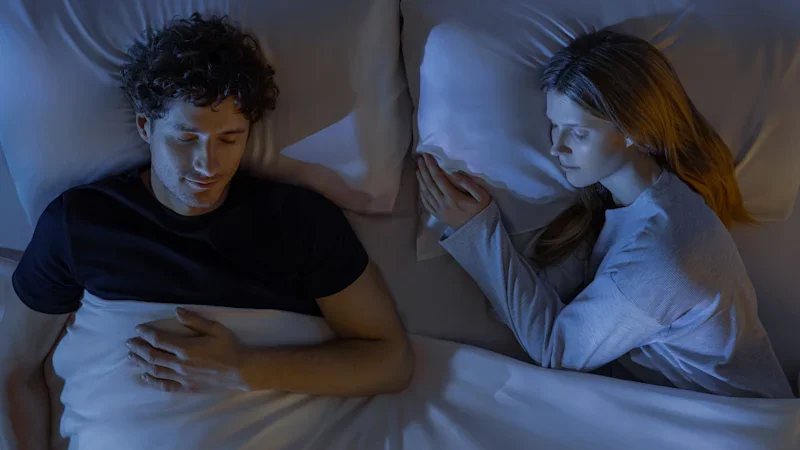
Are you a hot sleeper or a cold sleeper? In my household, it would only take one look at my partner and me to know which of us is which: me in socks and long-sleeved pyjamas and him in nothing but a pair of boxer shorts, going to sleep in the same room. As is the case with many couples, this temperature difference has long been a point of contention that’s led to strategically pointed fans in summer and stolen covers in winter.
But despite what many of us believe – and argue about with our bed partners – according to Sean Drummond, professor of clinical neuroscience at Monash University, there is no perfect temperature for sleep. Instead, there’s a range most people sleep best within, and the key is finding where you’re most comfortable in it. And finding that comfort point matters, as long as we’re focusing on the right kind of temperature.
“People often focus on the room being the right temperature, but the reality is that it’s your body that needs to be the right temperature,” says Drummond. “The air that’s right next to your skin – you in bed, under the covers – is called the ‘microenvironment’, and that’s what’s much more critical than [the temperature] outside next to your dresser.”
But if your ideal microenvironment differs from that of the person you’re sleeping next to, what’s the solution? Well, it’s one smart bed company, Eight Sleep, aims to offer the answer – at a premium price.
What is an Eight Sleep?
Have you ever wondered how Elon Musk sleeps at night? How about Lewis Hamilton and, perhaps, by extension, girlfriend Kim Kardashian? The answer: on an Eight Sleep.
But for those not yet acquainted with the smart bed system – which has a starting price of $4299 for its hero product, the Pod – you soon might be, as the brand focuses on growth in Australia.
The Eight Sleep Pod is essentially an intelligent, hydropowered electric blanket, which can be bought to fit your existing mattress. In addition to tracking your sleep, it also works to heat and cool your bed throughout the night. The system is connected to Wi-Fi and requires a subscription to function.
For couples, each side of the bed operates independently, meaning your side’s temperature can differ to your partner’s. In addition to the Pod, Eight Sleep offers an adjustable bed base, pillow cover and blanket.
But who exactly is splurging this much for a good night’s sleep?
Alexandra Zatarain, Eight Sleep co-founder and VP of brand and marketing, says that while people assume their customers are all Silicon Valley biohackers and athletes (and many are), the brand’s audience is actually made up of normal people – who, yes, have money to spend – including doctors, teachers, dancers and new parents.
“We see a lot of couples with mismatched sleep needs – one runs hot, one runs cold – and that alone can quietly wreck a relationship’s sleep,” says Zatarain. “And increasingly, we hear from people who already track their sleep on a wearable and know something is off but have no way to actually fix it.”
Most of us want more sleep, but at what cost? How much can sleep trackers tell us about ourselves and, at the end of a long day, how important is temperature when it comes to our rest? We asked the experts.
The benefits of sleep data
When Matthew Flinders Professor Danny Eckert from Flinders University attended the World Sleep Congress in Singapore last September, he noticed that the conversation around sleep tracking devices had shifted dramatically since the last conference in 2023. Sleep experts around the world, he says, are now much more likely to embrace these gadgets than they were in the past, when they were perceived as a kind of sleep “black box”.
And it’s not just sleep experts getting on board.
Today, sleep trackers are easy to spot in the office or on your commute, whether it’s an Oura ring, Whoop band or Apple Watch. But for those who aren’t looking for another accessory, under- and over-mattress sleep trackers are another option.
While Eckert hasn’t used the Eight Sleep, primarily due to its expense, he says his sleep tracker of choice, the $219 Withings Sleep Analyser, can provide sleep data that’s around 80 per cent as accurate as a formal sleep study in a laboratory. And such data can be incredibly valuable.
Around 5 per cent of the Australian population – including an estimated one in four men over 30 – have some degree of sleep apnoea. Suspected sleep disorders, including this one, can be a reason why people want to start tracking their sleep.
“It’s a screening tool – it’s not perfect – but if your Apple Watch says that you’ve got sleep apnoea, there’s a very good chance you do,” says Eckert.
While the Eight Sleep, like many sleep trackers, doesn’t tout itself as a diagnostic health tool, insights like your time spent snoring, and resting heart rate, breath rate and heart rate variability trends can help explain low energy levels or provide early warning signs of health conditions, including sleep apnoea. The app also alerts users to any respiratory and cardio disturbances.
But unlike wearables and other under-mattress trackers, the Eight Sleep also works to improve your sleep by adjusting the temperature of your bed.
Five things I learnt trialling the Eight Sleep Pod
- Temperature does make a difference.While I mostly just found my bed to be extra cosy thanks to the well-utilised warming settings, my partner (a self-described and professionally diagnosed terrible sleeper) has found the cooling settings to be a game-changer. He claims to be getting an hour more sleep most nights now that he’s not overheating.
- Sleep tracking is good but not perfect.While the tracker doesn’t seem as accurate as my Oura ring (the Eight Sleep app thought I stayed in bed for hours longer than I did one morning, accidentally picking up my dog’s sleep) it’s nice not having to rely on a wearable.
- The Pod isn’t as bulky as I expected.In fact, the mattress cover adds a thin but plush layer to our mattress, which both I and my partner have enjoyed.
- Being able to control the Pod from your phone makes life easy.As the parent of a toddler, I’ve often found myself re-heating my side of the bed from my daughter’s room at 2am, hoping I will be able to return there soon.
- It’s difficult to put a price on sleep.The king-sized Pod 5 retails at $5098. As a “good sleeper” I’d find that price hard to justify. However, my partner says it would be worth every cent.
Not too hot, not too cold, but just right
Just as the Eight Sleep Pod tracks health metrics, it also adjusts the temperature of your mattress based on what stage of sleep you’re in, how hot or cool your room is that evening and your sleep metrics from the night before.
In one night, the Pod could make 30 temperature adjustments as you sleep.
The Pod also relies on personal preferences, allowing users to set whether they’d like their bed warmed or cooled – and to what extent – before they get into bed, when they fall asleep and four hours after they fall asleep.
Drummond believes when people say they “run hot” or “run cold”, what they really mean is that they’re sensitive to hot or cold. The exception to this rule, however, are health conditions like poor circulation, which leave people’s hands and feet cold, along with hormonal fluctuations that happen during menopause, causing hot flashes.
“There’s a number of things you can do that are fairly low cost,” says Drummond. “Experiment with what you’re wearing to bed, how many blankets you do or don’t have and, at least to some extent, what the room temperature is.”
As for whether the Eight Sleep is worth it, well, that’s a decision for you and your bank account.
The writer trialled an Eight Sleep Pod 5 for the purpose of this story.
Read more about sleep:
- Exactly how bad is it to sleep with your pet? Experts weigh in
- Five things to try next time you wake up at 3am
- What sleep experts do when they can’t fall asleep
- To stave off dementia, should you sleep an extra 30 minutes or exercise?
Make the most of your health, relationships, fitness and nutrition with our Live Well newsletter. Get it in your inbox every Monday.