- Published
**An "enormously important" 18th Century painting by the Scottish artist Katherine Read has been uncovered by the BBC's Fake or Fortune. **
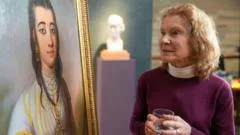
The portrait was brought to the programme's team wrapped in a sleeping bag, and is now thought to be worth more than £100,000.
Retired accountant Mary-Louise Wedderburn explained the painting was left to her in her uncle's will two decades ago.
Wedderbern said she had always believed the portrait may have been painted by Read, a distant relative of hers who specialised in portraying women and children.
The portrait features an Indian woman in a formal pose, wearing a string of pearls, a large emerald pendant and a nose ring.
Speaking in the episode, broadcast on Thursday, art historian Charles Greig described it as "one of the trickiest paintings I've ever had to consider".
"On the basis of all the evidence put together, I am entirely certain that this painting is by Katherine Read."
After being told of the work's authenticity and the projected value, Wedderbern said: "It's wonderful, it's unbelievable. Thank you so much.
"It's just so important to me that it's by Katherine Read, because of the family connection, but also because of who she was."
She added: "The more that we find out about Katherine Read, the more I think she was just a wonderful woman, she was just super."
Read, a well-known portraitist at the time, studied in Europe, moved professionally in elite circles and was so successful that she was paid more handsomely than her better-known contemporaries, including Gainsborough.
However, like many other female artists, she was largely forgotten, as fashions changed and some of her portraits were re-attributed to male artists.
The Fake or Fortune team authenticated the painting by trying to find other Read works to compare it to, trawling through family archives, speaking to experts and gathering letters and wills that brought fresh insight into Read's life in India.
They pieced together the story of the people she may have painted in Chennai in India, known then as Madras, including the Nawabs of Arcot, the local Mughal rulers.
Explaining his analysis, Greig said: "The evidence from the dossier that to me was the strongest was the technical analysis done by the Courtauld.
"The similarity of the portrait of [her niece] Helena Beatson: the pigments, the modelling of the figures, the brushwork, were very conclusive."
The work is thought to be the earliest recorded painting of an Indian sitter by a European female artist.
Greig noted: "One of the most interesting things about this painting is that I'm pretty certain that she [the sitter] is a member of the Nawab's family in Madras.
"That is extremely unusual because most of the other portraits of Indian ladies are a companion, or sometimes a wife, of a European.
"But I can't think of another portrait of an Indian lady of this period that is actually part of a royal court rather than a European's household. That makes it enormously important."
Art dealer and presenter Philip Mould said: "What a wonderful result, I'm sure we're going to see more works by this pioneering woman artist in India coming out of the woodwork."
Presenter Fiona Bruce added: "If, as Mary-Lou wants, it can be in an exhibition, in a gallery, where the whole world can see this picture, Mary-Lou will have given this woman not only a voice, but she will be seen.
"In a sense she will be brought to life and I think that's just a brilliant result."