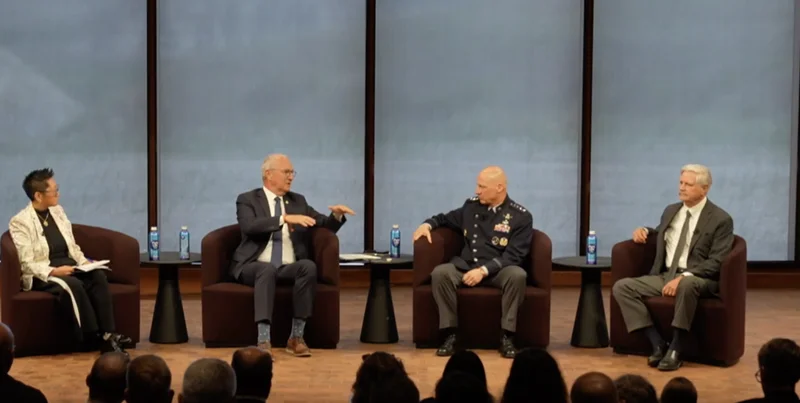
WASHINGTON — Gen. Michael Guetlein brought the Pentagon’s case for Golden Dome to North Dakota, headlining an event Aug. 20 hosted by two of the missile defense program’s strongest Senate advocates.
“The main reason I wanted General Guetlein to come out here and do this is I want to socialize the knowledge about Golden Dome,” Sen. Kevin Cramer (R., N.D.) said in introducing Guetlein at the Theodore Roosevelt Presidential Library.
The event, organized by Cramer and fellow North Dakota Republican Sen. John Hoeven, comes less than three months before the midterm elections and as the Pentagon and Congress confront an unresolved question over how to finance Golden Dome in fiscal 2027.
Cramer argues that existing U.S. missile defenses are too limited to address the range of threats now facing the homeland. He is also positioning North Dakota’s military infrastructure for a role in the Golden Dome architecture, including the Perimeter Acquisition Radar Attack Characterization System, or PARCS, at Cavalier Space Force Station.
Golden Dome is the Trump administration’s proposed layered system for defending the U.S. against ballistic, hypersonic and cruise missiles, drones and other aerial threats. The architecture would combine sensors and interceptors across land, sea, air and space through a common command-and-control network.
Cramer said he is trying to dispel what he sees as a misconception that Golden Dome is “all new stuff.” Much of the architecture involves connecting and expanding missile defense systems that already exist or are under development, he said, while adding new capabilities to fill gaps. Guetlein has similarly described Golden Dome as a “system of systems,” with his office funding capabilities across the military services and defense agencies and integrating them into a broader network.
Congress provided $22.5 billion for Golden Dome in 2026 through budget reconciliation, but its next major funding installment remains uncertain. That has put advocates such as Cramer and Hoeven in the position of making the public case for sustaining the effort as lawmakers prepare for another budget fight.
In his remarks, Guetlein offered an expansive account of the threats Golden Dome is being designed to counter, portraying the system as considerably broader than a shield against nuclear-armed intercontinental ballistic missiles.
He said the architecture is being developed to counter conventionally armed ICBMs, ballistic missiles launched from aircraft and submarines, larger drones, low-flying cruise missiles, maneuvering hypersonic weapons and fractional orbital bombardment systems that could approach the U.S. from unexpected directions.
Guetlein also provided new details about a recent integrated missile defense test, expanding on remarks he made Aug. 11 at the Space & Missile Defense Symposium. He said Golden Dome took hardware representing elements of the architecture into a test “about three or four weeks ago” and “shot down everything that we put in the air in a matter of 34 minutes.”
He declined to identify the weapons or targets involved, but said the exercise demonstrated that capabilities being purchased with Golden Dome’s initial funding would be effective against the threats the program is intended to counter.
Guetlein also cast Golden Dome as an effort to give U.S. leaders more options for responding to an attack on the homeland. He argued that the current posture largely leaves policymakers choosing between striking an adversary conventionally and relying on the threat of nuclear retaliation. Golden Dome, he said, is intended to add the ability to defend U.S. territory against a large conventional attack, broadening the rationale for the program beyond traditional defenses against nuclear-armed missiles.
Guetlein pushed back on criticism that Golden Dome has made little progress since Trump signed the executive order launching the initiative in January 2025. He noted that the program office wasn’t established until July of that year, meaning the effort has been up and running for only about 12 months. In that time, he said, Golden Dome has moved to turn its initial funding into contracts.
Since Congress provided the initial $22.5 billion, roughly 90% has been obligated, Guetlein said.
“We’re kind of leading the department in our ability to get things on contract,” he said. “We have radars on contract. We have space-based interceptors on contract. We have interceptors on contract. We have sites on contract.”