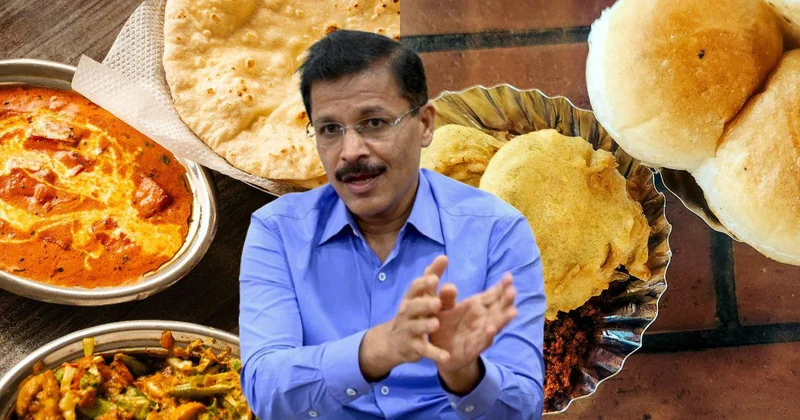
On August 8, a packed auditorium in Pune rose to applaud Tukaram Mundhe. Some took videos of the bureaucrat walking up to the stage. Others shouted out compliments. The event itself was titled “Unstoppable Tukaram”.
Rarely has any bureaucrat appointed Maharashtra’s food and drug administration commissioner met with such public adulation.
Since Mundhe took over in May, his crackdown on unhygienic practices in the food industry in the state has won him truckloads of admirers – and inspired social media memes.
“He is going viral on social media,” said B Shami, who owns Crown Bakery in Mumbai. “And it has caused panic in our industry.”
Under the bureaucrat’s instructions, food inspectors have scaled up surprise inspections. Not just that, they are handing out immediate suspension notices for serious violations, a departure from previous practices, officials told Scroll. “He is not afraid to go after big influential players,” said Omprakash Sadhwani, a retired joint commissioner of drugs in the food and drug administration.
In the last three months, Domino’s and Pizza Hut outlets have been temporarily shut down after inspectors found cockroaches and expired products in their kitchens. Many of Mumbai’s legacy food businesses, from the K Rustom ice-cream parlour to Parsi Dairy and restaurants like Shalimar and Rehmania had their licences suspended for a few days for a range of violations – fungal growth on walls, presence of rats and cockroaches, food not covered by insect-proof meshes and failure to test drinking water for pathogens.
All four businesses had their licences restored after they met hygiene standards.
The FDA, under Mundhe, has not shied away from turning the scrutiny on dark stores of quick commerce giants like Blinkit, Zepto and Instamart. Several were suspended after lizards, cockroaches and expired products were found on their racks.
The series of crackdowns have made Mundhe a household name, so much so that actor Paresh Rawal took to social media platform X to urge Chief Minister Devendra Fadnavis to ensure that the bureaucrat is not shunted out of his department.
The 2005-batch IAS officer has a reputation for being an honest bureaucrat, unafraid to ruffle feathers. He has been transferred 25 times in over two decades. In some posts, he has spent only a few months.
The Maharashtra FDA’s drive appears to have prodded similar action in neighbouring Karnataka, where inspection of five-star hotel kitchens and high-end restaurants also revealed shocking sanitary standards.
While Mundhe has found a huge fan following, the food industry is unnerved. Several business owners have approached courts asking for relief. Many say that by handing out immediate suspension notices, he is skipping standard procedures.
On August 18, the Bombay High Court said the food and drug administration was going “overboard” and directed it to pay Rs 5 lakh fine to a Pune sweet shop for not reinstating its licence despite a 98% adherence to hygiene.
But former joint commissioner for food in Maharashtra, CB Pawar, told Scroll that the slew of strict measures were “not harsh”.
Pawar added, defending Mundhe’s style of functioning, “The provisions under the Act allow FDA to suspend outlets. If a restaurant is unhygienic and not shut down, who will be responsible if people get food poisoning?”
In the Pune outlet particularly, a complaint of food poisoning had been filed with the FDA and its food samples were found unsafe.
At a press conference on Thursday, Mundhe said, “If there are observations made by the HC, we take it seriously. At the same time we make sure to follow the law. We are not exceeding our jurisdiction, we are following due process.”
From people buying breakfast on the street to those ordering groceries on quick commerce apps, consumers are cheering Mundhe.
In Sion, Vilas Singh, aged 24, first read about Mundhe on Instagram when the bureaucrat began suspending a few famous restaurants. Over the last few weeks, he has begun to see changes in local food stalls.
“I usually have breakfast outside,” Singh said. “Earlier I would get vada pav or idli in a newspaper. Sometimes the newspaper ink would stain the food if it was too hot. Now they wrap it in butter paper.”
‘No hesitation’
‘No hesitation’
Mundhe began his career in 2005 as an assistant collector in Solapur, and was later posted as the collector of the district in 2014. He is remembered for initiating multiple water conservation projects in Solapur to remove the dependence of several villages on water tankers.
In 2016, Mundhe was given charge of the Navi Mumbai Municipal Corporation, where he cracked down on illegal construction and unauthorised hawkers. While his work was appreciated by local residents, several politicians campaigned for his transfer and a no-confidence motion was passed by corporators against him. He was eventually moved out in less than a year without being assigned another posting.
In 2020, the Uddhav Thackeray-led government posted Mundhe as Nagpur commissioner, where he cancelled several major tenders awarded by the previous commissioner. His method of working irked union minister Nitin Gadkari who complained to the Prime Minister’s Office against him.
In an interview to The Hindu, Mundhe maintained that he followed three principles before he took any action – legality, public interest and whether his decision is morally correct. “If any two conditions are met – including legality – I act. There is no hesitation, no gradual approach, no negotiation with what is wrong simply because it is powerful,” he said.
A new regime
A new regime
The food industry in Maharashtra has been taken aback by the new-found aggression in the food and drug administration’s methods.
A food inspector told Scroll that before Mundhe took over, inspections were less frequent due to staff shortage. “We are working overtime now,” he said.
The official said that Mundhe has instructed them to adhere to “zero-tolerance” for unsanitary conditions.
On June 29, a food inspector conducted a surprise inspection in Pawan Bar and Restaurant in Navi Mumbai.
According to the Indian Hotel and Restaurant Association, earlier food inspectors would “usually notify a restaurant before an inspection”. Now, most inspections are conducted without intimation.
The inspection in Pawan Bar and Restaurant found hygiene-related lapses. The restaurant had a__63% compliance__ with requirements under the Food Safety and Standards Act, 2006. The next day the FDA issued a suspension notice to the restaurant.
Two weeks later, in a re-inspection the restaurant had 100% compliance with all requirements. Even then, the FDA did not revoke its suspension.
The restaurant finally approached the Bombay High Court, which revoked the suspension. The hotel’s kitchen remained shut for over 25 days. The lawyer representing the restaurant owner, Sagar Shetty, told Scroll that their main grievance was that the officials did not issue an improvement notice. Instead, they chose to immediately suspend the license.
Under the Food Safety and Standards Act, 2006, a food inspector can inspect a food outlet and issue an ‘improvement notice’. The notice points out violations and gives a period of two weeks to comply. In cases where a food operator fails to comply, the inspector can suspend their license after a showcause notice.
The Act also gives the FDA power to immediately suspend a licence “in the interest of public health”.
It is this provision that Mundhe’s team has opted for in several cases.
Across Maharashtra, the licences of at least 10 hotels have been suspended in the last three months immediately after inspection, said Vijay Shetty, president of Indian Hotel and Restaurant Association, or AHAR.
Ashwini Ranjane, assistant commissioner for food, said it was well within the rights of the food inspector to suspend licences. “A food inspector can immediately make out if a place is unsanitary by just looking at a restaurant’s kitchen,” she said.
Ranjane added that the FDA gives improvement notices in 70% to 80% cases of minor violations – if record keeping is poor, if employees’ medical records are not maintained, or if minor hygiene lapses are seen.
“Immediate suspension is issued when during our visits, we see dirt everywhere,” she said. “If there are major issues and multiple violations that the operator needs to work on and that is not possible to achieve in a few days, we have to suspend them.”
In July, food inspectors found expired flavouring agents and essence, rats and houseflies in K Rustom’s ice-cream parlour. In the century-old Parsi Dairy, fungus was found on the walls and raw materials found lying on the floor. Despite the presence of rats and flies, the food was left uncovered.
The licences of both outlets were suspended temporarily. Parsi Dairy was able to reopen after about 10 days after a re-inspection was undertaken. K Rustom decided to renovate its over 70-year-old store. An FDA officer said their licence has also been reinstated.
“If the food can directly harm the health of customers, then we can suspend the licence immediately,” a retired joint commissioner of food from Maharashtra told Scroll.
Several bakery owners protested against a blanket suspension of licence following “minor violations” during inspections. In July, the FDA issued stop-business notices to four bakeries after finding “hygiene related lapses”, expired raw materials and unsanitary cooking conditions. In videos that FDA shared, the New Maharashtra bakery in Chembur had fungus on baking trays and its walls.
An owner of a well-known brand of bread in Mumbai told Scroll that several small players use artificial flavours in khari, or do not label their loaves with an expiry date or display the nutritional content. “We welcome action in such cases,” he said, requesting anonymity.
“But the problem is pests,” he said. “It is difficult to totally prevent it.”
B Shami, who owns Crown Bakery, agreed. “Mumbai city’s hygiene levels are questionable,” he said. “We have open drains that allow rats everywhere. No baker wants to have a filthy kitchen.”
Responding to the allegation that FDA has gone overboard, Mundhe said that when FDA suspends any licence, “it is after multiple violations”.
He added, “In some cases, improvement notices and enough time was given. If these outlets have grievance they can appeal to me.”
Dark stores
Maharashtra has amongst the highest number of so-called dark stores run by quick commerce services, with Mumbai and Pune leading the list. For a city starved for time, the delivery services have become a lifeline for many users.
But Mundhe’s drive has made consumers think twice.
On August 14, the FDA released details of a month-long inspection of 86 dark stores. According to Ranjane, assistant food commissioner, they found minor to major violations in almost all stores.
The FDA issued improvement notices to 60 stores and suspended 14 others, including five operated by Blinkit, five by Zepto and two by Swiggy Instamart.
In the video shared by FDA, cockroaches could be seen moving amongst packaged items in a Bandra West store of Instamart. The same store had rodent droppings and lizard infestation. In another video, chocolate was infested by worms, and stale lettuce was stored in a Blinkit store in Ghatkopar. Both these outlets’ licences were suspended.
“On our visits, we found racks full of cockroaches,” Ranjane said, pointing out that faulty cold storage and hygiene lapses in dark stores were rampant.
‘Good practices’
Food business owners, too, admit that Mundhe has forced the industry to shape up.
“Hygiene is important, and he is bringing in good practices,” Shami added.
An employee from a Chembur-based self-help group, which sells chapatis and vegetarian dishes, said small outlets like theirs have switched from wrapping chapatis in newspapers to food-grade butter paper after the FDA began to inspect the area. “That has slightly increased our cost, but food operators are willing to comply,” the employee said. “Otherwise we will have to shut too.”
Ordinary customers are even more grateful. Ganesh Sonawale, who drives an autorickshaw, eats his lunch outside every day. “Roadside dhabas have become cleaner,” he said. “Food is now wrapped in brown paper. These two changes I am seeing everywhere.”
Sonawale said he hoped the drives would not stop in a few months. “It feels nice to eat food in a clean place now,” he added.
We welcome your comments at letters@scroll.in.