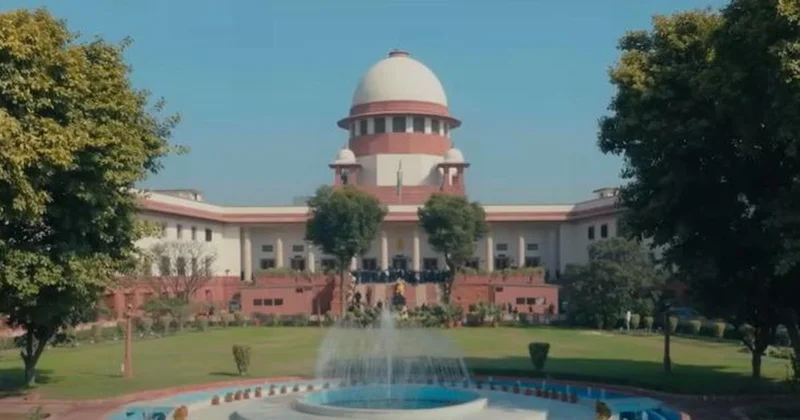
The Supreme Court on Thursday said that it would have to examine whether English can be classified as a “non-indigenous” language under the Central Board of Secondary Education’s three-language policy, Bar and Bench reported.
“That perhaps requires a constitutional analysis, having regard to our historical experience and the fact that states have English as an official language,” said a bench of Chief Justice Surya Kant, and Justices Joymalya Bagchi and V Mohana.
The bench was hearing a batch of petitions challenging the CBSE’s decision to make three languages compulsory for students from the 2026-’27 academic year. Among the three languages, at least two must be Indian, the board has said.
On Thursday, the petitioners’ counsel told the court that English could not be equated with foreign languages, considering its longstanding presence in India.
He also argued that students were being forced to abandon subjects they had studied for years to start learning Indian languages from scratch.
“Is it not in national integrity that Indian languages are taught?” Kant was quoted as asking by Bar and Bench. “Is it not going to be good for the nation if a North Indian student learns South Indian languages?”
The petitioners said their only objection was that the policy was being implemented in the middle of a student’s schooling. They argued that the policy would be acceptable if introduced prospectively, rather than requiring Class 9 students to give up languages they had already been studying.
Kant observed that there was no need to scrap the policy altogether, suggesting instead that changes could be made to the manner of its implementation. He asked CBSE to revisit the policy.
Bagchi also suggested that the rules should be relaxed for Class 6 students. He said that exempting students already in Class 6 and introducing the revised system for the subsequent batch will allow students to make an informed choice.
CBSE’s three-language policy
In a circular released on May 15, CBSE said that studying three languages would be mandatory for Class 9 students from July 1. It said that those who had been studying two Indian languages can either take up a foreign language or a third Indian language.
Class 9 students who had one Indian and one non-native language could choose any Indian language as the third language. Those who were studying two foreign languages had been given a “special one-time relaxation” under which they could add an Indian language as the third one.
There will be no board exams for the third language for the current batch of Class 9 students, and there will instead be an internal school-based assessment.
Class 7 and Class 8 students who have already chosen two foreign languages can continue studying them. However, the students will have to study an additional Indian language till Class 10. The CBSE said that the third language for these batches will also be assessed by the school through an internal evaluation.
The three-language policy will apply in full to the batch of students currently in Class 6, who will not be given a transitional relaxation.
Edited by Sneha.
We welcome your comments at letters@scroll.in.