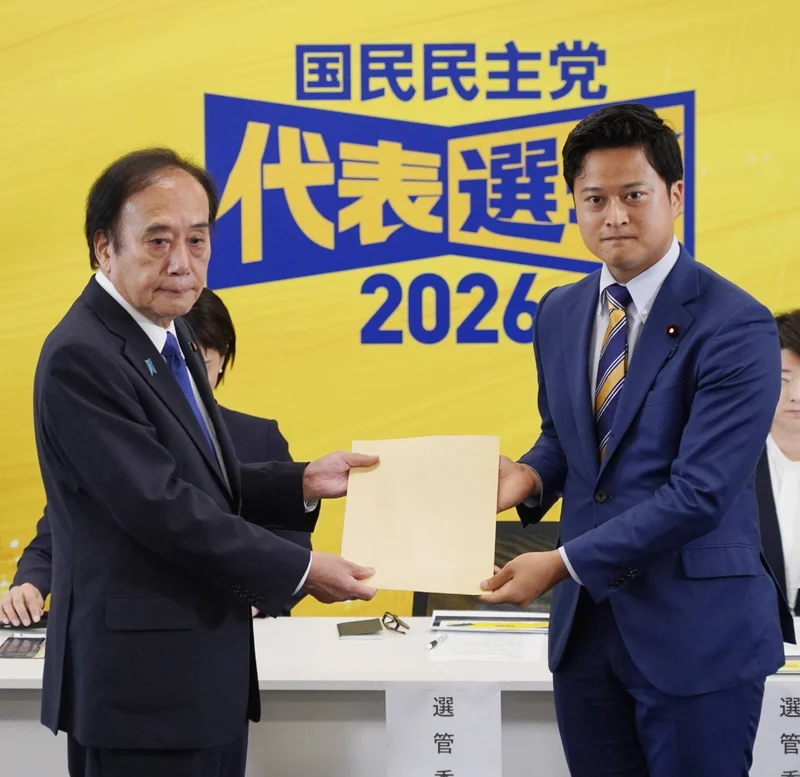
The opposition Democratic Party for the People will kick off a two-week leadership race on Saturday, pitting incumbent Yuichiro Tamaki against 30-year-old Lower House lawmaker Mikihiko Hashimoto.
Hashimoto, a former Air Self-Defense Force officer first elected to parliament in 2024, faces an uphill battle against the veteran Tamaki, who is seeking a third term.
The clearest fault line is organizational rather than ideological or even policy.
During a joint appearance Thursday on the nightly show Abema Prime, Hashimoto said he was running to make the DPP “a governing alternative to the Liberal Democratic Party.”
His sharper criticism of Tamaki, however, is that too much depends on one person.
“There are limits to having Tamaki Yuichiro handle policy, party organization and everything else,” he said, arguing that leadership responsibility should be shared across generations.
Although he has praised Tamaki’s policy knowledge and communication skills, Hashimoto says that the DPP could struggle after Tamaki’s eventual departure. He proposes a clearer national vision, more open policymaking and stronger systems for training candidates and party personnel.
Tamaki’s platform implicitly concedes some of the concern. Campaigning under the slogan “Take the DPP to the next stage,” he wants to give younger and regional members larger roles.
On the same show, Tamaki said the DPP must become “an organization that can continue to grow sustainably even without me.”
The race follows a disappointing Lower House election in February, when the DPP won 28 seats — a net gain of just one and well short of its 51-seat target.
Tamaki later acknowledged that Prime Minister Sanae Takaichi’s adoption of some of the DPP’s proposals had blurred distinctions between the two parties and drawn some supporters to the ruling LDP.
The setback also underscored the DPP’s broader dilemma: how to cooperate with the government on individual policies and claim credit for gains while preserving an identity distinct from the LDP.
Both candidates favor continuing such policy-by-policy cooperation. But Hashimoto says the race should include debate over how the DPP deals with the ruling bloc, while Tamaki has pledged to retain his “solutions over confrontation” approach.
The winner will be chosen Sept. 6 through a 159-point vote, with 53 points each allocated to national lawmakers, local assembly members, and party members and supporters.