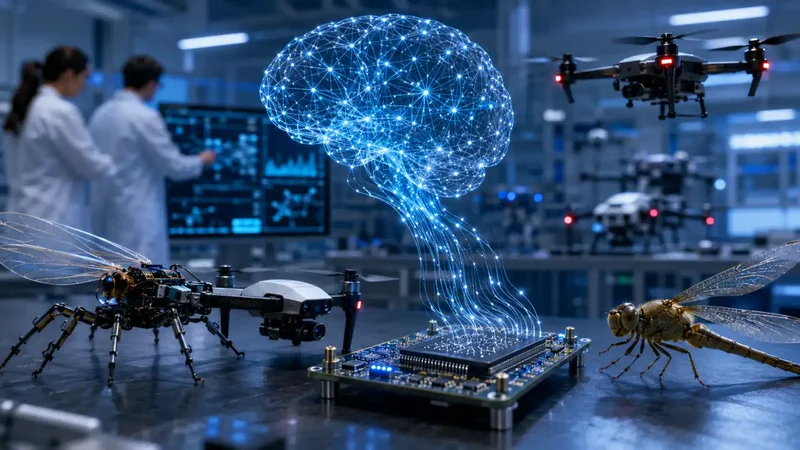
A $12 million research project at Penn State is trying to give drones a new way of making decisions, drawing inspiration from the small brains of insects and other animals. Funded by the US Armyâs Army Research Laboratory, the project aims to develop an onboard sensing system that can pick out useful information without sending large amounts of data to external computers. The team, led by Saptarshi Das, is studying how animals such as locusts and owls filter sensory information despite having tiny brains. Their proposed system would use analogue computing, graphene-based components and memristors to process signals while using less power. A cochlea-inspired structure would help filter information before it reaches conventional digital processing. The researchers also plan circuits that mimic coincidence-detecting neurons, allowing drones to respond to combinations of signals rather than processing everything they encounter. Annual demonstrations will gradually move from individual prototypes towards larger drone swarms.
How insect brains could help drones process sensory information
The researchers are looking at animals such as locusts and owls because their brains can deal with sensory information despite being extremely small. Instead of treating every sound, movement or visual signal as equally important, biological systems can filter out background information and focus on patterns that matter.
The Penn State team wants to reproduce some of that behaviour using electronic circuits, creating a sensing system capable of making decisions closer to where the information is collected.
The project is led by Saptarshi Das, an engineering science professor at Penn State, with researchers from several universities. According to
Penn State College of Engineering, the proposed system is intended for edge devices such as drones and ground robots and operates without a connection to cloud computing. Das explained that a drone could be working in a remote location where communication is unavailable or where transmitting data would reveal its position. The proposed technology is therefore designed to give the machine computing capability directly onboard.
Image AI generated
Analogue computing could help drones process signals using less power
One of the biggest changes in the proposed design is the decision to process some information in the analogue domain. A drone's sensors initially collect physical signals, but conventional systems often convert those signals into digital information before computers can analyse them. That conversion and subsequent processing can require substantial power, particularly when the incoming information is broad and continuous.
The researchers plan to use a sensing structure inspired by the human cochlea to deal with signals before they reach conventional digital processing. The design would combine graphene-based components with silicon semiconductors and memristors, using electrical currents to carry out aspects of the computation. The idea is to reduce unnecessary conversion between analogue signals and digital data, while allowing the system to process a larger amount of information using less energy.
How coincidence-detecting neurons could help drones identify important signals
The proposed system would also imitate the way certain neurons respond when multiple signals arrive close together. The researchers plan to use graphene-based field-effect transistors to reproduce the behaviour of coincidence detectors, which only produce a response when two or more inputs occur at the same time or in quick succession. That could help the sensing node distinguish meaningful combinations of signals from isolated or irrelevant information.
The same principle is intended to make autonomous machines more selective about what they process. Instead of constantly handling every signal detected by their sensors, drones could concentrate computational resources on patterns that trigger the appropriate response. The researchers are also developing a communication method based on noise-like signals for drone swarms. Messages would be embedded within broader electromagnetic activity, making them resemble background noise while allowing cooperating machines to identify the intended information.
Researchers plan annual demonstrations to test the $12 million technology on autonomous drones
The $12 million project will not be tested as a complete swarm system immediately. The researchers plan to hold demonstrations each year as the technology develops, with testing expected to progress from an individual prototype towards larger-scale experiments involving multiple autonomous drones. This will allow the team to examine whether the sensing, computing and communication components can work together while remaining within strict limits on size, weight and power.
The proposed technology could eventually have uses beyond airborne drones and ground robots. The team believes similar low-power sensing and processing could support groups of autonomous machines that need to operate together without relying heavily on external infrastructure. For now, however, the project remains under development, with the planned demonstrations set to show whether the biological principles can be translated into practical hardware. As Das explained, the challenge is bringing several capabilities together in one compact system while keeping its energy requirements low.