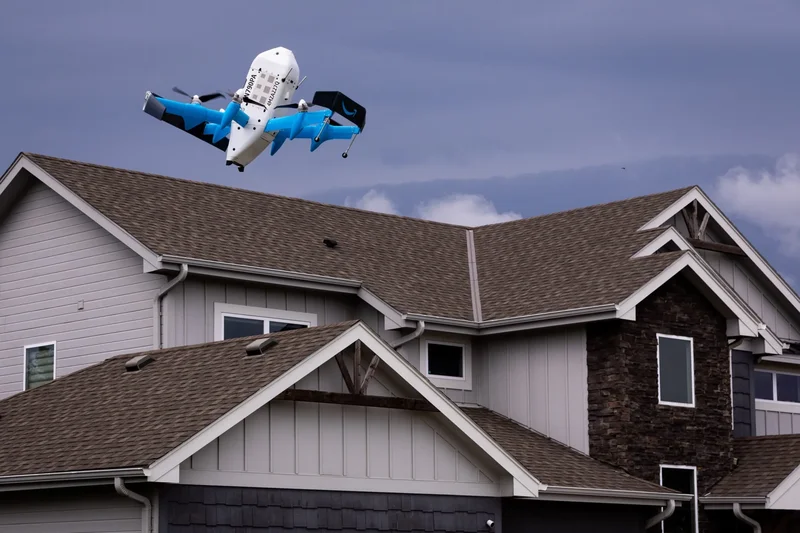
Forget raining cats and dogs: In America’s increasingly crowded skies, it may soon be packages and takeout food falling from above.
For one Texas woman, the future has already arrived, though perhaps not exactly as Amazon intended. Lindsey Austen was expecting an Amazon delivery by drone Monday when she heard it approaching her home in Richmond, Texas, and ran outside to record the delivery. Instead, she watched as the package dropped straight into her backyard pool.
“When it went into the pool, I was shocked,” Austen told Storyful. “I don’t think I’ll be wanting drone deliveries anymore.”
The mishap comes at an awkwardly fitting moment for an industry that has spent years promising packages, takeout, and everyday essentials would eventually descend from the sky. After more than a decade of experiments, regulatory hurdles and technical setbacks, some of America’s biggest delivery companies are now making much bigger bets that drones are finally ready for prime time.
Amazon said Wednesday its Prime Air service will expand to nearly 500 U.S. cities and towns by the end of 2026, a sixfold increase from its current footprint. The company currently operates drone delivery from 11 locations and plans to add markets including Chicago, Atlanta, Cleveland, and Syracuse, N.Y.. The company says its drones can deliver millions of eligible products weighing up to five pounds in as little as 30 minutes.
The expansion is the latest attempt to make good on a vision Jeff Bezos laid out more than a decade ago. The Amazon founder unveiled the company’s delivery drones on 60 Minutes in 2013 and predicted drone deliveries could arrive within four to five years. Instead, the program faced regulatory hurdles, technical setbacks, and noise complaints from residents.
Amazon has delivered hundreds of thousands of packages by drone this year, Prime Air Vice President David Carbon said Wednesday. That remains a sliver of the nearly 20 million packages Amazon delivers each day in the U.S., according to market research firm ShipMatrix, as Fortune reported Wednesday.
But now, Amazon isn’t flying alone.
The drone delivery race takes off
DoorDash recently launched DoorDash Air after receiving a Federal Aviation Administration certification allowing it to operate its own commercial drone delivery service rather than relying solely on outside partners.
The company isn’t positioning drones as a replacement for the people delivering most of its orders. DoorDash told Fortune that Dashers still handle the vast majority of its millions of daily deliveries, including large orders and trips that require navigating apartment buildings. Drones instead join a network that also includes DoorDash’s Dot delivery robot and other autonomous delivery partners.
DoorDash has completed tens of thousands of drone deliveries to date, compared with more than 10 billion orders across its broader network.
“We want drone delivery to work for any merchant, anywhere,” Harrison Shih, head of DoorDash Air said in a statement provided to Fortune. “Advances in hardware, compute, and AI are creating extraordinary new capabilities for local commerce, and becoming a certified air carrier accelerates everything we’re building.”
Uber is taking a different route into the skies. Rather than building the aircraft itself, it’s turning to Zipline, a drone delivery company most recently valued at $7.6 billion. The companies announced a strategic partnership Monday that will bring drone delivery to Uber Eats later this year. Uber is investing an undisclosed amount in Zipline, and the partnership comes with an ambitious target: 1 million drone deliveries per day by the end of 2029.
Under the partnership, drones would become one option within a delivery network that can also dispatch human couriers and sidewalk robots depending on the order, according to an announcement from Uber shared with Fortune.
Zipline, meanwhile, told Fortune the number of businesses offering delivery through its service grew 13-fold in the first half of 2026. The company now operates in Dallas, Houston, Cleveland, and Northwest Arkansas, with Phoenix and Austin expected to follow later this year. Zipline says it currently makes a delivery somewhere in the world every 20 seconds.
The company estimates there are already 5.5 billion instant deliveries annually in the U.S., excluding deliveries from Amazon, UPS, and FedEx. If the demand it is seeing in Dallas-Fort Worth were replicated nationwide, Zipline projects that could translate to demand for 55 billion deliveries a year.
“We don’t have enough people to make that many deliveries, and we don’t want to add more delivery trucks to the roads, increasing traffic and clogging our streets to move small packages,” Zipline said in a statement provided to Fortune. “Zipline’s drone delivery is the answer.”
The company is betting its new Uber partnership can help take that model nationwide.
Walmart is approaching 2 million drone deliveries, the company told Fortune, up from the 1 million milestone it announced in May. Customers are increasingly using the service for everyday purchases including eggs, ground beef, phone chargers, and ink cartridges, according to the company.
Drone delivery is one piece of Walmart’s broader push to give customers more control over how quickly orders arrive. Its delivery options now range from scheduled window and three-hour on-demand service to one-hour Express delivery and a 30-minutes-or-less option for more immediate purchases.
“Drone delivery gives customers another choice when speed matters, complementing our broader suite of same-day delivery options so they can choose what works best for each shopping mission,” a Walmart spokesperson said in a statement provided to Fortune.
Working with Wing, Alphabet’s drone delivery company, Walmart plans to build a network of more than 270 drone delivery locations in 2027 capable of reaching more than 40 million Americans. Wing and Walmart have since announced seven additional markets, including Philadelphia, Phoenix, San Diego, and the San Francisco Bay Area.
The sudden push toward scale marks a shift for a technology that spent years looking more like a Silicon Valley experiment than a serious alternative to putting a package in a car. Plenty of obstacles remain: Companies still need federal and local approvals, drones have limited carrying capacity and range, and residents have raised concerns about noise, privacy, and safety.
But the numbers companies are now putting behind their ambitions are getting harder to dismiss as experiments: Amazon is targeting nearly 500 cities and towns, Walmart and Wing want to reach more than 40 million Americans, and Uber and Zipline are aiming for one million deliveries a day.
For customers like Austen, there’s still at least one part of the technology that could use some work: the landing.
breaks the traditional barrier between audience and newsroom. The show transforms
Fortune DailyFortune’s trusted reporting into actionable, conversational, and entertaining insights for an emerging class of business leaders.
Watch here.