The row over Vande Mataram intensified on Thursday (August 20, 2026) with Union Home Minister Amit Shah launching a sharp attack on the Congress, alleging that its decision to sing only two stanzas was “anti-national” and intended to appease its vote bank in defiance of the law.
The Congress strongly rebutted Mr. Shah’s charge that the party had insulted the National Song, asserting that it has always respected the song and accused the BJP of attempting to manufacture a political controversy. Senior Congress leader Jairam Ramesh described BJP leaders as “fraudulent nationalists”.
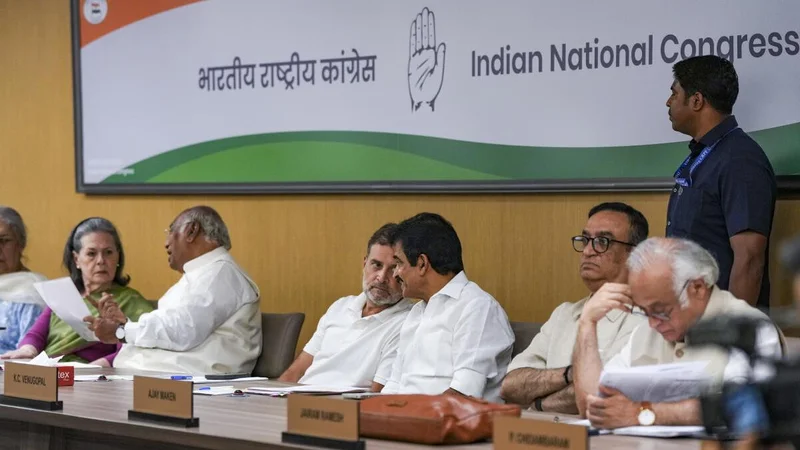
The war of words escalated after the Congress Working Committee (CWC) on Wednesday (August 19, 2026) decided to abide by the 1937 resolution of its highest decision-making body on Vande Mataram, stating that only two stanzas of the National Song would be sung at all party events henceforth.
What is the Vande Mataram row involving Congress?
A controversy erupted during Independence Day celebrations at the All India Congress Committee (AICC) headquarters in New Delhi, where Congress Parliamentary Party chairperson Sonia Gandhi was seen gesturing towards party president Mallikarjun Kharge while Vande Mataram was being sung.
While the BJP leaders accussed Ms. Gandhi of gesturing to organisers to stop playing Vande Mataram, Congress dismissed these charges and claimed the National Song was sung in full. A few days later, the Congress Working Committee (CWC) decided only the first two stanzas of Vande Mataram will be played at party events.
The issue was discussed in detail at the CWC meeting on Wednesday (August 19), with senior leaders Anand Sharma, Tariq Anwar and Digvijaya Singh arguing that the party should adhere to the 1937 AICC resolution on the song.
Congress president Mallikarjun Kharge read out an order issued by former President Rajendra Prasad to reinforce the party’s position, reiterating that the first two stanzas had been adopted for rendition at its functions following consultations with Rabindranath Tagore.
“Vande Mataram and the National Anthem are emotional issues for us. For the BJP, it is a political issue. That is the difference between us and them,” the Congress said.
Congress’ 1937 resolution
Defending the party’s decision, Congress general secretary Jairam Ramesh said the 1937 resolution recommending that only the first two stanzas of Vande Mataram be sung at national gatherings reflected the considered view of several leading figures of the freedom movement.
Mr. Ramesh recounted the CWC meeting held in Kolkata from October 26 to November 1, 1937, and said those present included Mahatma Gandhi, Jawaharlal Nehru, Sardar Vallabhbhai Patel, Netaji Subhas Chandra Bose, Rajendra Prasad, Maulana Abul Kalam Azad, Sarojini Naidu, J.B. Kripalani, Bhulabhai Desai, Jamnalal Bajaj and Narendra Deva, among others.
In 1937, the Congress adopted a shortened version of Vande Mataram as the country’s National Song, retaining only the first two of the original six stanzas. Mr. Ramesh cited The Collected Works of Mahatma Gandhi (Volume 66, Page 46) to support his claim, noting that the CWC had issued a statement on Vande Mataram on October 28, 1937, which was “profoundly influenced” by Rabindranath Tagore’s advice.
Mr. Tagore had recommended that the song be limited to its first two stanzas to ensure inclusivity, as the later verses contained religious imagery that could alienate sections of society, the Congress said.
Congress cites historian to back resolution
The Congress also cited historian Sugata Bose’s remarks that it was on Rabindranath Tagore’s advice that the party decided in 1937 that only the first part of Vande Mataram would be sung at national meetings.
“It was on Rabindranath’s advice that the Congress decided at this AICC meeting that, from then on, only the first part of the song, which is a beautiful evocation of the country’s splendour, would be performed at national meetings,” the historian said in a video shared on X by Jairam Ramesh.
“That was because Tagore felt that our nationalist movement needed unity and good sense, and he did not want rivalry between different religious communities,” Prof. Bose added.
On January 24, 1950, the Constituent Assembly adopted it as the Republic of India’s National Song.
PM Modi’s ‘fragmented’ Vande Mataram remarks
Prime Minister Narendra Modi had earlier said that the Congress removed “crucial” verses of Vande Mataram in 1937, fragmenting the song and sowing the seeds of the country’s Partition. He said that Vande Mataram remained relevant in every era of India’s history.
“The spirit of Vande Mataram illuminated the entire nation during the freedom struggle. But unfortunately, in 1937, crucial verses of Vande Mataram, a part of its soul, were severed. Vande Mataram was broken; it was torn into pieces. This division of Vande Mataram also sowed the seeds of the division of the country. This great mantra of nation building, why was this injustice done to it?” the Prime Minister said.
Bankim Chandra’s descendant seeks apology
Vande Mataram was written by Bankim Chandra Chattopadhyay on November 7, 1875. It was first published in the literary journal Bangadarshan as part of his novel Anandamath.
BJP MLA Sumitra Chatterjee, a descendant of Bankim Chandra Chattopadhyay, demanded an apology from Sonia Gandhi over the Congress’s decision to sing only two stanzas of Vande Mataram at party events.
Mr. Chatterjee wrote to Ms. Gandhi, saying that Vande Mataram was “not the ancestral property” of any political party. “It is part of the nation’s collective memory, the eternal legacy of Bankim Chandra, and a sacred national symbol earned through the blood and sacrifice of millions of martyrs. To honour this song is to honour the history of India’s freedom struggle,” he wrote.
BJP leaders also lodged a formal complaint against Ms. Gandhi at the Urwa police station in Karnataka over the events during the rendition of Vande Mataram at the Congress headquarters. A separate police complaint was filed in New Delhi.
Published - August 21, 2026 01:33 pm IST