“Speak only if it improves on the silence” is a quote I think about a lot. I don’t know where I first read it. Probably, embarrassingly, on some cheesy Instagram reel. It’s not clear who said it first. Sometimes it’s attributed to Mahatma Gandhi; other variations are linked to Jorge Luis Borges or Pythagoras.
But the sentiment lives on in my head because I’m always looking back on past conversations and wishing I had said less. And because I often find myself in situations where I wish it were acceptable to say less. My long-term ambition is to become a semi-silent old lady, emitting infrequent gnomic truths from a Jason recliner.
Right now, though, the world feels pretty noisy with chatter, and not just my own. Years before AI-generated podcasts flooded streaming apps, there were memes about how there are more podcast hosts on the planet than podcast listeners. Our social feeds, too, are busy with people talking to camera, desperate to hold our attention.
I’ve been listening to the audiobook of Algospeak by Adam Aleksic, also known on TikTok as Etymology Nerd. Algospeak is about the ways in which social media has sparked linguistic innovations and speech tics. It’s a fun and fascinating book, full of internet trivia, examples of linguistic ingenuity and reflections on how other technologies (the printing press, the phone) shaped language and speech in their time.
In the book, Aleksic reflects on the tricks he and other content creators use to keep audiences engaged. Silence is to be avoided and creators talk fast to keep our attention. Aleksic cites estimates that Mr Beast, the world’s most famous YouTuber, speaks at 200 words per minute in his videos. (The average English-speaker uses about 150 words per minute.) Algospeak is a great read, but the world of speech it describes – rapid-fire, endless, depressingly attuned to retention metrics – is exhausting.
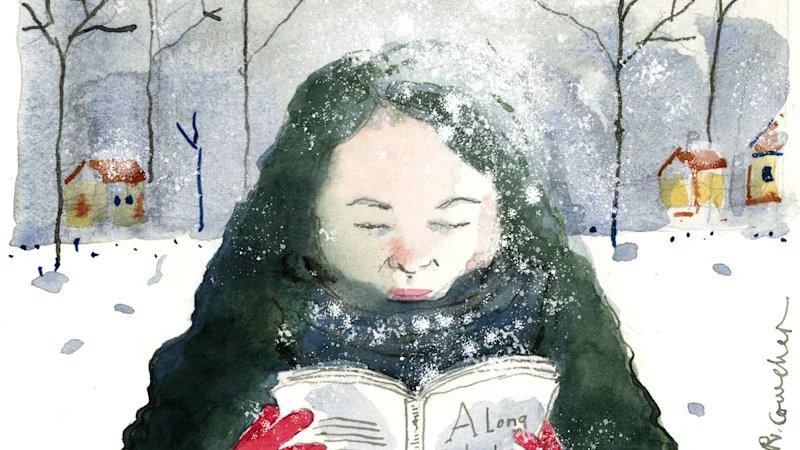
A couple of weeks ago I spent an afternoon reading Colm Tóibín’s 2006 short story A Long Winter, and it was like a soothing, silencing blanket of snow on my overheated brain. A Long Winter is, in fact, about a silencing blanket of snow in the Catalan Pyrenees, but silence is a theme across a lot of Tóibín’s writing. He is interested in the gaps between public and private selves.
Many of his stories, including his most famous novel, Brooklyn, are set in the mid-to-late 20th century. There are technological and social constraints on speech that don’t exist in the same way today. His characters are always warning themselves and each other not to speak, and they are highly conscious of each other’s silences.
A Long Winter is an especially great example of this because the setting is so isolated and because it doesn’t have much direct speech. It’s the late 1950s and the main character, Miquel, lives on a farm that’s not connected by phone. One afternoon, his mother walks away from the farm into a blizzard and the snow makes the search almost impossible. The story is about Miquel’s attempts to find her and the beginnings of a romantic connection with another young man as he comes to terms with the upheavals in his life.
It’s a masterclass in many of the things Tóibín is renowned for: extreme restraint and control in his prose, unspoken longings and resentments. I read it in a single sitting, and it had the odd effect of making me nostalgic for a harsh time and place I (thankfully) haven’t lived through. Perverse, I know, but it was so quiet inside Tóibín’s story – so bleak and sad and beautiful – and such a contrast to the noisy world described in Algospeak.
Tóibín’s new novella, The Bridge, picks up Miquel’s life where A Long Winter left off. Miquel and his father are now small-time smugglers. As the story progresses, Miquel enters a community where information is currency and silence is valuable.
With The Bridge, as with so many of his books, Tóibín explores human paradoxes: how transactional relationships can be tender, how we are sometimes attached to difficult memories, and how we both crave and dread silence. Discretion is necessary in The Bridge for survival. Yet sometimes silence is painful and there’s a low bar for speech that improves on it.
This is, I think, the point of reading fiction. It’s to explore our mysterious inner lives in ways that can’t be done with other art forms. Well, it’s one of the reasons for reading fiction – at least, for me personally. It’s also to move closer – through meditations on silence and mystery – to the quiet, enigmatic and comfortably reclined legend I hope to become.