Worker dies 3 days after arriving in Korea, highlighting inadequate training amid labor shortages
The death of a seasonal worker from Laos just three days after arriving in Korea has exposed shortcomings in local governments' oversight of foreign workers on farms, with the case highlighting a recurring practice of sending workers into the field with little time to adjust or receive adequate safety training.
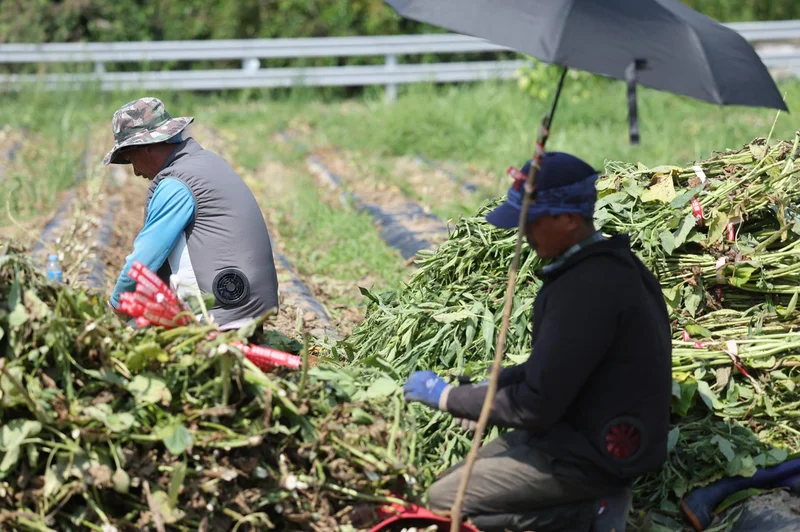
The worker, a Lao national in her 30s, went missing on Aug. 7 after complaining of heat-related discomfort while working in a pumpkin field in Yeoju, Gyeonggi Province, under a severe heat wave warning. She was found dead in nearby bushes the following day.
The case has highlighted gaps in how seasonal workers are deployed to farms, with workers often put on the job soon after their arrival.
The Lao worker arrived in Korea on the morning of Aug. 5 and reached Yeoju City Hall at around 11 a.m., where she completed immigration registration and underwent drug screening and a medical examination. She then received about three hours of orientation on living in Korea before her employer picked her up from the city hall that evening and took her to the farm.
Without a separate adjustment period, she reportedly began physically demanding farm work at 6 a.m. the next day.
On Aug. 7, her second day on the job, she continued working into the midday heat as temperatures in Yeoju reached 36.7 degrees Celsius under a heat wave emergency warning, before she went missing and was found dead the following day.
“Yeoju relies heavily on agriculture and takes in more seasonal workers than any other local governments in Gyeonggi Province,” said Kim Jin-hee, head of the Gyeonggi regional branch of the Korean Confederation of Trade Unions (KCTU). “Yet workers are being sent to farms without adequate safety training.”
Around 1,900 seasonal workers have been assigned to work in Yeoju, but the city has only four officials responsible for overseeing them. Awareness about migrant workers' rights among farms employing foreign laborers also remains lacking.
During a meeting with KCTU, Yeoju city officials repeatedly said they had distributed guidelines on preventing serious heat-related accidents.
At the provincial level, Gyeonggi Province established a bureau dedicated to immigration and introduced related ordinances following the deadly Aricell factory fire, in which 18 of the 23 people killed were foreign workers.
“We need more fundamental changes to safety measures and inspection systems to prevent another migrant worker from dying under the same conditions,” Kim said.
The government has also moved to address structural gaps, designating the Korea Agency of Education, Promotion and Information Service in Food, Agriculture, Forestry and Fisheries as the national coordinating body for the seasonal worker program in March. The two agencies were tasked with curbing illegal broker activity, protecting workers' rights and strengthening oversight.
Local governments were also given the legal basis to operate their own specialized agencies, but no timeline has been set for establishing regional counterparts and coordination between provincial and municipal authorities on the ground remains insufficient.
Meanwhile, Yeoju city officials said they are discussing new guidelines aimed at preventing similar incidents and are reviewing all requests raised by labor representatives following meetings with the KCTU and the Yeoju Labor Rights Center.
Experts say the recurring practice of sending seasonal workers to farms with little or no proper training because of labor shortages remains a fundamental problem.
“Training may be provided, but in many cases, it is little more than a formality,” said Choi Jeong-gyu, an attorney at Wongok Law Firm who advocates for migrant workers’ rights. “It should also be properly delivered in a language the workers understand, but that often does not happen.”
Choi also pointed to restrictions that leave migrant workers with few options to leave or change workplaces when they believe their working conditions are unsafe. Such mobility has been tightly restricted over concerns including unauthorized stays and potential disruption to the labor market.
“Unless fundamental measures are put in place to give workers the right to stand up for themselves and protect their own safety, the same problems will continue to occur,” Choi said.
Explore More
- Q.
- Q.
- Q.