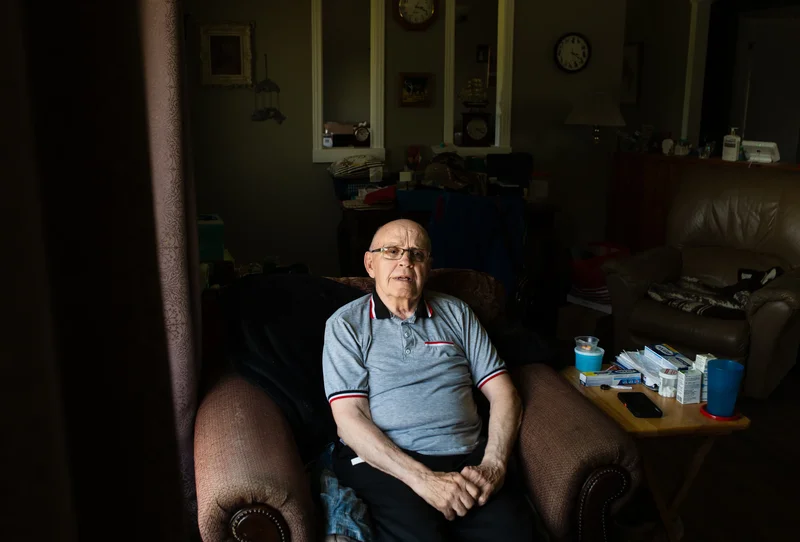
For years, David McKillop had nightmares about his time at the Rideau Regional Centre.
He remembers scrubbing floors with a toothbrush, and cleaning classrooms at night for no pay. He was forced to carry heavy buckets of water with his arms held out to the side. He was made to wear ill-fitting shoes and nightgowns all day long.
He recalls dozens of children sleeping in large rooms, their beds crowded together. They waited in line for a shower, naked and cold.
Mr. McKillop was often afraid.
At the age of four, in 1955, doctors advised his family to send him to the Smiths Falls facility, 80 kilometres outside Ottawa, due to his disability. The centre, which opened in 1951 as the Ontario Hospital School, was one of the largest provincially run institutions for developmentally disabled individuals.
By the 1970s, the government ran 16 such institutions in rural areas of the province. Children and adults were admitted by parents, guardians or the Children’s Aid Society, often because they were told by medical professionals that it was for the best.
After a class-action lawsuit, a government apology and the demolition of other institutions, the buildings of the former Rideau Regional Centre still stand.
The Globe and Mail spoke to several former residents and family members of people who were institutionalized in an effort to understand the legacy of the system.
When the centres were opened, the thinking was that they could provide safety, health care, education and training for people who needed help. Parents had few alternatives and society’s view of disability was influenced by stereotypes, prejudice and misconceptions.
But the institutions quickly became overpopulated and understaffed. At its most overcrowded, Rideau housed 2,600 residents.
Mr. McKillop says it wasn’t all bad. He learned to play euchre, participated in sports and enjoyed socializing with other kids. He liked his music teacher, who would take him home to her place for the holidays.
But far from his family, at times Rideau felt cruel. Mr. McKillop says he was beaten and sexually assaulted at the institution by staff and fellow residents.
He was the lead plaintiff in a 2010 class-action lawsuit against the province on behalf of former Rideau residents, alleging physical and mental abuse as well as unnecessary administration of medication. In 2013, the lawsuit reached a settlement of $20.6 million, and the provincial government delivered a public apology.
Joe Clayton was also part of the lawsuit and received a settlement for the harms done to him.
Mr. Clayton, born in Pembroke in 1953, was put into foster care in 1958, moving between homes until his Children’s Aid worker took him to Rideau in 1966, at age 12.
He enjoyed art classes at Rideau and remembers staff members there who encouraged him. But he also recalls the humiliation of mopping the floors of the institution’s long hallways in his nightgown. He says he was sexually abused by fellow residents.
Children with Down syndrome were institutionalized particularly young.
One of them, Martha Freeman, was sent to Rideau at 20 months old, in 1960. Her family rarely visited or brought her home. Her sister, Victoria Freeman, was four years old at the time and says she was traumatized by her sister disappearing from their day-to-day life.
Martha lived at Rideau until 1973, before being sent to an approved boarding home, and then moving in with the family of the woman who ran the home.
After previously being diagnosed with “severe mental retardation” and an IQ of 27 when she lived at Rideau, Martha thrived in her new environment.
In 1975, a worker from the social work department of the Rideau Regional Centre wrote a letter to a speech therapist, who had been asked to assess Martha and provide speech therapy.
The social worker’s letter gave a summary of all Martha’s previous IQ tests and language training, noting: “In view of Martha’s progress since her community placement, it is the worker’s opinion that the above results were perhaps an under-estimation of her potential.” Martha died in 2002 at 44.
Bill McKercher, born in 1956, was sent to Rideau when he was just two-and-a-half years old. He had Down syndrome, and his parents were pressured by doctors and their community to send him away so that he could receive specialized care and his siblings wouldn’t resent him or feel held back.
As his sister Catherine McKercher wrote in a book about her brother’s experience, “Shut Away: When Down syndrome Was a Life Sentence,” their parents would say that sending their child away was the best thing they could have done for him.
She says that “there was remarkably little outrage and remarkably little questioning” about the institutions.
The family would go see Bill once a month, but they never brought him home for a visit. After each trip to Rideau, she recounts, their mother would hide away in her bedroom, upset and filled with guilt.
Around the age of nine or 10, Bill began pulling out his hair, eyebrows and eyelashes. He also had chronic hepatitis B, which he contracted at Rideau when he was a child. He died of liver failure at age 38, having lived at the institution for his entire life. A 1970s study found many cases of hepatitis B in the Down syndrome population at Rideau.
Journalist Pierre Berton visited one of the institutions, Huronia Regional Centre in Orillia, Ont., in December, 1959, and reported on severe overcrowding, understaffing and uncleanliness in the Toronto Star.
His article made the front page on Jan. 6, 1960. “Remember this: After Hitler fell, and the horrors of the slave camps were exposed, many Germans excused themselves because they said they did not know what went on behind those walls: no one had told them,” Berton wrote. “Well, you have been told about Orillia.”
Beginning in the 1960s, society began questioning the institutional system in earnest. In the 1970s, the deinstitutionalization movement began to gain more traction. In 1971, Ontario’s Minister of Health asked lawyer Walter Williston to investigate the current care and supervision of individuals with developmental disabilities.
The request was prompted by two tragic incidents involving former residents of Rideau. In 1971, Frederick Elijah Sanderson, a Cree 18-year-old with a supposedly low IQ, died by suicide in a barn at the farm where he worked. Jean Marie Martel, who had been discharged from Rideau in 1968 at age 21, was found running away from his foster home on Feb. 18, 1971. He survived, but suffered from frostbite on his nose, ears, fingers and toes.
Mr. Williston’s report that year urged the province to gradually close the institutions, citing overcrowding, unsafe conditions, understaffing and inexperienced staff, among other factors. He recommended increased funding for support services for disabled individuals, so they could live within their own communities. A year later, a report by an Ontario cabinet minister, Robert Welch, similarly urged: “Wherever feasible, services should be provided in a community setting as an alternative to institutionalization.”
Nonetheless, it would take decades to start closing them down.
Over the years, the non-profit organization Community Living protested government plans to open new institutions and advocated for alternatives. In 1977, they objected to plans to build a 150-bed facility in Etobicoke. Instead, they proposed the government build one small, specialized residence and a network of small community residences.
The Ministry of Community and Social Services, which had taken over operations of the institutions from the Ministry of Health, agreed to implement the plan. It launched the first multiyear strategy to close one institution and begin downsizing others. The Nipissing Regional Centre in North Bay was the first to close in 1978.
In 1982, the government announced a plan to close five more institutions over a five-year period. Community Living released a report in May, 1987, advocating for the government to close all remaining institutions and replace them with community supports. The government agreed, committing to closing all the institutions within 25 years. However, the closure of the five institutions announced in 1987 took 10 years to complete.
As the 25-year deadline drew closer, progress stalled. But in the fall of 2004, in response to a petition, the Liberal government elected in 2003 promised to close the final three institutions – including Rideau and Huronia – by 2009, three years ahead of schedule.
After their closure, the buildings remained standing for years.
Then, in 2020, Southwestern Regional Centre in Chatham-Kent, Ont., was demolished. Starting this January, Huronia also began to be demolished in stages, to the relief of former residents. Up to 49 buildings and 11 tunnels are being torn down to make way for a new Ontario Provincial Police academy.
Survivors are reportedly planning a celebration to witness the demolition of the final and main administration building. A monument honouring those who lived and died at Huronia was installed in 2019 and remains on the grounds.
On the outskirts of Smiths Falls, the walls of Rideau Regional Centre still stand. The property is now privately owned. Some of the buildings contain apartment units. Others sit vacant.
Mr. McKillop wants people to know about Rideau, but he also wants it torn down.
“There’s too much memory in that place.”
This story was made possible by funding from the News Photographers Association of Canada Community Storytelling Grant.