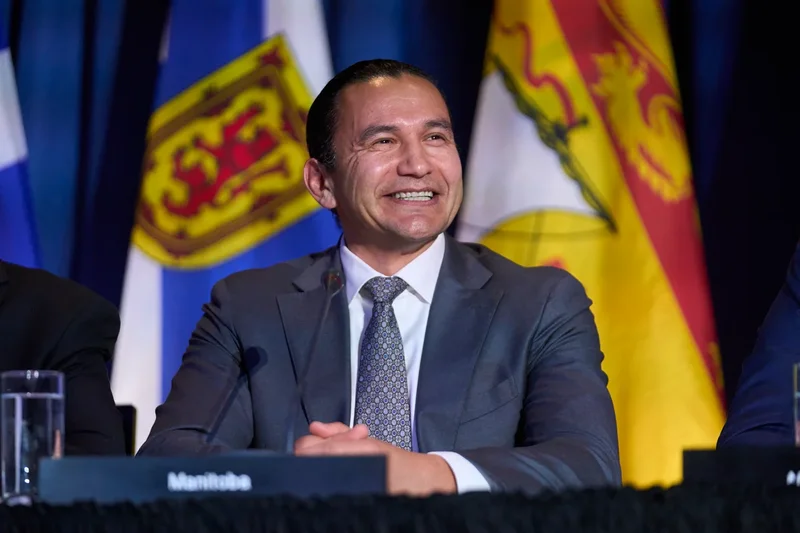
A Canadian provincial premier launched a sharp attack on President Donald Trump on Thursday, calling him a "bad person" and "not to be trusted" while urging Canada to keep fighting rather than rush trade concessions with Washington.
Manitoba Premier Wab Kinew said Canada holds leverage in talks even as his province considers restoring U.S. alcohol sales at Prime Minister Mark Carney’s request to avert threatened 50% U.S. tariffs.
Kinew also predicted that Trump would be “slaughtered” in the midterm elections.
"Everybody knows the American president by now, he’s erratic, he’s irresponsible, and he’s not to be trusted. And this is the person that we were supposed to make a deal with, and we’re going to make additional concessions for it. That’s why I say you can't make a good deal with a bad person, because who’s to say it’s not going to be undone?" Kinew said.
Dominic LeBlanc, the federal minister responsible for Canada-U.S. trade, said Thursday both nations are nearing a final agreement after returning to Washington to meet U.S. Trade Representative Jamieson Greer.
"We’re very close. We continue to make progress," he said, adding Canadian officials will remain in Washington working on the deal. Trump called the agreement "very fair" to both sides, while tariffs on roughly $20 billion in Canadian imports are delayed until 12::green-background[01] a.m. Saturday. Full terms remain unreleased.
Despite criticizing Trump, Kinew said Manitoba might join Carney’s "Team Canada" approach, though he urged consumers to buy Canadian if U.S. products return to shelves. Other provincial leaders, including the premiers of Saskatchewan and Nova Scotia, publicly backed Carney’s negotiating direction.
Newfoundland and Labrador Premier Tony Wakeham said all premiers agreed during a Wednesday call with Carney to restock U.S. alcohol, though not all have publicly confirmed that position.
"I think we should fight. I think Donald Trump is very weak. I think America is weaker around the world today than it was a year ago. He’s about to get slaughtered in the midterms and the cost of living is the number one issue and he’s completely out of touch with the cost of living of Americans," Kinew said.
"We’ve got the upper hand. They are back on their heels right now. They are coming to us for a deal right now."
Reinstating alcohol sales remains a key sticking point.
Kinew said he understood Carney’s request meant restoring U.S. alcohol sales was essential to complete the deal. Provincial bans have annoyed the Trump administration, which pressed Canada to lift restrictions that severely reduced American liquor sales.
Provincial governments lack veto power over the broader Canada-U.S. agreement, but control liquor sales and procurement rules involved in negotiations.
Eight of Canada’s 10 provinces restrict U.S. alcohol—measures imposed over Trump’s previous tariffs and his comments about making Canada the 51st U.S. state.
Kinew said Carney pressed premiers to restore U.S. alcohol sales while other details were finalized. "I wouldn’t say that he was begging us, but what is the step before begging?" Kinew said.
Ontario, Canada’s most populous province, is crucial. Its government-run LCBO, among the world's largest alcohol buyers, imported nearly 1 billion Canadian dollars ($723 million) in U.S. products annually before pulling them last year.
Ontario Premier Doug Ford, who previously clashed with Trump, has not commented on the deal.
Kinew said Canadians should avoid American goods even if returned.
"When we put the American booze back on the Liquor Mart shelves, Canadians, leave it there. Spend your money on Canadian products that are going to employ people in our country and that have an administration that respects Canada," Kinew said.
Kinew said Manitoba could remove formal restrictions on U.S. companies and products, including procurement preferences, while still favoring Canadian suppliers in provincial purchasing.
Preferring to keep fighting, Kinew noted the U.S. Republican president’s habit of levying heavy tariffs before retreating. He cited the "TACO" acronym coined by Financial Times writer Robert Armstrong: "Trump Always Chickens Out."
"Do we expect that this is going to be the end of Donald Trump?," Kinew said.
Meanwhile, Quebec Premier Christine Fréchette said Carney answered many questions about the agreement, though she withheld endorsement while assessing its economic impact. She said Quebec could restore U.S. alcohol at the SAQ, the state enterprise controlling provincial liquor sales, but stressed the decision remains Quebec’s.
Robert Bothwell, a professor emeritus of Canadian history and international relations at the University of Toronto, said Kinew’s comments reflect widespread Canadian sentiment. "Kinew speaks for Canada," Bothwell said. "The majority of the Canadian people hates Trump."