One Miner Plans to Spend US$8.2 Billion in Peru. A Mudslide Has Arequipa Cut Off
Peru · MINING
The long-run numbers are excellent. The short-run ones are a reminder of how easily a single road can shut a region down — and that road is still shut.
Southern Copper Peru investment runs to about US$8.2 billion through 2033 across three mines and a smelter expansion, aimed at lifting the company’s output to 1.6 million tonnes of copper a year by 2033. That is the decade-long story. The week’s story is 300 metres of highway in Caraveli province that has been under mud since Sunday, and was still closed on Friday.
Where the Southern Copper Peru investment goes
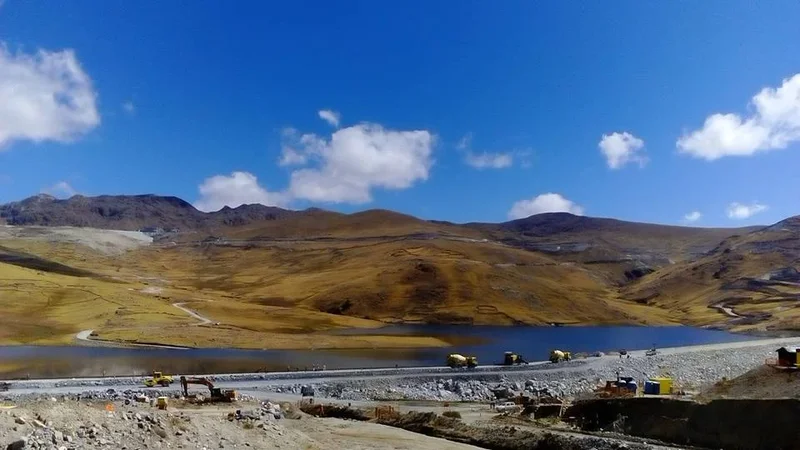
Four projects account for the headline figure. Tía María in Arequipa is the one under construction, at about US$1.8 billion. The company reported it 42% complete at the end of June, with US$693 million of the US$1.101 billion committed already executed. It is due to start up in 2027 and to produce around 120,000 tonnes of copper a year over its first five or six years.
Los Chancas in Apurímac is larger at about US$2.6 billion and could add roughly 130,000 tonnes of copper plus 7,500 tonnes of molybdenum, with completion pencilled in for 2031. Its progress depends on clearing illegal mining from the deposit, which is a slower problem than engineering.
Michiquillay in Cajamarca is the prize. At about US$2.5 billion and scheduled for 2032, the company rates it at 225,000 tonnes of copper a year over a mine life of more than 25 years.
The fourth is not a new smelter, as it is sometimes described. Southern Copper has smelted at Ilo for decades, and the plan is a brownfield expansion of that plant at about US$1.26 billion, with a US$280 million refinery expansion beside it. Whether it gets built depends on the international market for copper concentrates — which is to say, on whether it is cheaper to smelt at home or ship the concentrate to Asia.
Those four are not the whole picture. The company’s own roadmap to 2033 totals roughly US$9 billion once a US$680 million Cuajone concentrator expansion and technology projects are added, and it has told the SEC its Peruvian investment could surpass US$10.3 billion over the next decade.
Why Tía María being 42% built matters
Tía María is the project Peru spent a decade not building. It was suspended twice under sustained opposition from farming communities in the Tambo valley, who argued it would compete for water and damage agriculture.
That it has now passed 40% completion, with a 2027 start date and a record quarter of execution behind it, is the clearest signal that Peru’s permitting environment has changed. It is also why the other three projects are being discussed with dates attached rather than as aspirations.
The caution is Los Chancas, where illegal mining sits on the deposit itself. That is a security question rather than a regulatory one, and Peru has not solved it anywhere else.
The labour market is quietly good
Formal employment in May was 251,000 positions higher than a year earlier, a rise of 4.2%, on central bank figures drawn from tax-authority payroll data. Separately, and on a different measure, the national statistics institute put Lima’s employed population within about 11,000 of six million in the May–July moving quarter — the closest it has come.
The word doing the work is “formal”. Around seven in ten Peruvian workers are informal — no contract, no pension contribution, no health cover through work. Adding a quarter of a million formal jobs shifts that ratio a little, and the ratio is the country’s central economic problem.
Mining is a small direct employer and a large indirect one. A project like Michiquillay employs thousands during construction and hundreds thereafter, but the supply chain and the regional tax transfers reach much further.
What the Arequipa road closure shows
The Panamericana Sur is not one route among several. For southern Peru it is effectively the only one, and the Atico–Ocoña stretch in Caraveli province, around kilometres 725 to 731, has been under mud and debris since Sunday 16 August. On Friday it was still closed, with clearing crews talking about reopening at the end of the week if the weather allows. Arequipa’s chamber of commerce estimates losses so far at around S/100 million, roughly US$30 million, in stalled freight, spoiled cargo and lost trade.
It is worth being precise about the cause: this was weather, not a protest. Huaicos — fast, debris-laden flows — came off the slopes after heavy rain associated with a cut-off low pressure system that forecasters named DANA Aníbal. Peru is also under a coastal El Niño, but that is the background condition, not this week’s trigger.
The mining connection is looser than it first looks, and worth stating carefully. Tía María is in Islay province, several hundred kilometres from the closure, and is not cut off by it. What the closure demonstrates is regional, not project-specific: the corridor that southern Peru’s economy runs on has single points of failure, and a region expected to host billions in new copper capacity has to move that output to port along it.
For anyone doing business in southern Peru, the practical lesson is redundancy. If your supply chain has one road in it, you do not have a supply chain, you have a hope.
Frequently Asked Questions
How much is the Southern Copper Peru investment?
About US$8.2 billion through 2033 across four projects: Tía María at about US$1.8 billion, Los Chancas at about US$2.6 billion, Michiquillay at about US$2.5 billion and the Ilo smelter expansion at about US$1.26 billion. The company’s full roadmap to 2033 is closer to US$9 billion.
When does Tía María start producing?
The company expects start-up in 2027. It reported the project 42% complete at 30 June 2026 and expects around 120,000 tonnes of copper a year in its first five to six years.
Is the road to Arequipa still closed?
As of Friday 21 August the Atico–Ocoña stretch of the Panamericana Sur remained blocked, a sixth day. The cause was mudslides after heavy rain, not a protest. Arequipa’s chamber of commerce estimates losses at around S/100 million, roughly US$30 million.
This article was produced by The Rio Times’ automated newsroom system. How we use AI · Report an error