DevOps transformed software delivery by introducing automation, collaboration, and continuous delivery. As organisations adopted Kubernetes, microservices, multi-cloud architectures, and increasingly complex security requirements, the operational burden on development teams grew significantly. Developers are now expected to manage infrastructure alongside application code, while platform teams often become bottlenecks for provisioning environments, enforcing governance, and maintaining deployment workflows.
To address these challenges, organizations are increasingly adopting Internal Developer Platforms (IDPs). Rather than replacing DevOps, IDPs build on its principles by providing standardized, self-service workflows that abstract operational complexity, reduce developer cognitive load, and enable engineering teams to deliver software consistently at scale.
In this blog, we'll explore why traditional DevOps practices begin to struggle as organisations grow, how Internal Developer Platforms evolved to solve these challenges, how they work under the hood, and why they're becoming a foundational component of modern platform engineering.
Where Traditional DevOps Starts to Break Down
DevOps was built on the idea of fostering collaboration between development and operations while automating software delivery. For years, this approach helped organisations ship applications faster and more reliably. However when technologies matured, the complexity of managing modern infrastructure grew far beyond what traditional DevOps workflows were designed to handle.
1. The Growing Cognitive Load
One of the biggest challenges highlighted by the Platform Engineering movement is developer cognitive load.
While automation has reduced manual effort, developers are now expected to understand an ever-expanding ecosystem of infrastructure technologies in addition to building business features. This growing operational responsibility has significantly increased developer cognitive load, shifting their focus from writing software to managing the platform that runs it.
Reducing Cognitive Load in Practice: Platforms like ** Devtron r**educe cognitive load by abstracting
Kubernetes-nativeoperations into standardized workflows. Instead of manually managing Helm charts, Kubernetes manifests, RBAC policies, deployment strategies, and GitOps synchronization across multiple tools, developers interact through a unified interface that automates these operational tasks while adhering to platform-defined guardrails.
2. When Every Team Builds Its Own Platform
Traditional DevOps also tends to encourage autonomy. While autonomy enables teams to innovate, it often leads to every engineering team solving the same infrastructure problems independently.
Although each solution works locally, the organization gradually accumulates operational inconsistency.Rather than eliminating operational work, DevOps shifts much of that responsibility toward centralized platform engineers, who become responsible for enabling every engineering team simultaneously.
3. Standardization Becomes Difficult
Another challenge emerges as organizations scale: maintaining consistency.
Without standardized workflows, every engineering team develops its own conventions for infrastructure provisioning, deployments, monitoring, security, and compliance. While these decisions may appear minor individually, they collectively increase operational risk.
Maintaining consistency across deployments, enforcing organizational standards, and reducing the operational burden on developers can no longer rely solely on traditional DevOps practices. This growing need forstandardization, self-service, and scalable automation ultimately paved the way for the rise of Internal Developer Platforms, where developers interact with a unified platform while the underlying infrastructure complexity is managed automatically.
The Rise of Internal Developer Platforms
Traditional DevOps solved the problem of automating software delivery, but it didn't standardize how engineering teams consume infrastructure. As organizations scaled to hundreds of developers and thousands of Kubernetes workloads, platform teams found themselves repeatedly solving the same operational problems creating namespaces, provisioning cloud resources, configuring CI/CD pipelines, managing secrets, applying RBAC policies, integrating monitoring, and ensuring every deployment complied with organizational standards.
Although these tasks were automated individually using tools like ** Terraform, Argo CD, Helm**, or
, developers still had to understand when and how to use each of them. Automation existed, but consuming that automation required significant operational knowledge.GitHub Actions
Considering a developer creating a new order processing service and the application code might be ready within a few days, deploying it into production is an entirely different challenge. Every step is necessary to ensure reliability and governance, but repeating the same workflow for every application quickly becomes unsustainable. Platform teams become overwhelmed with repetitive requests, while developers spend more time understanding infrastructure than building products.
This growing operational overhead gave rise to Platform Engineering, a discipline focused on treating the internal platform as a product rather than an operational support function. Instead of manually fulfilling infrastructure requests, platform teams began building reusable capabilities that developers could consume independently.
Standardized service templates, self-service provisioning, opinionated deployment workflows, and built-in security guardrails became the foundation of this approach. Rather than asking developers to understand every infrastructure component, the platform encapsulates organizational best practices into reusable workflows that can be consumed consistently across teams.
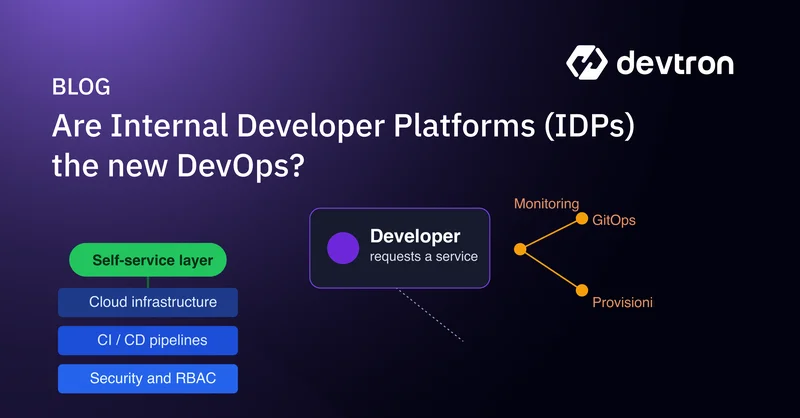
This is where Internal Developer Platforms (IDPs) come in. Providing a unified layer that orchestrates existing tools behind a simplified, self-service interface. Developers request outcomes such as creating a new service or deploying an application while the platform automatically provisions infrastructure, generates deployment pipelines, applies organizational policies, configures observability, and deploys the workload using standardized workflows. The underlying tools remain the same, but the developer experience changes dramatically: instead of assembling infrastructure, developers consume it as a product.
How an IDPs Works Under the Hood
Although an Internal Developer Platform presents a simplified interface to developers, it orchestrates a sophisticated ecosystem of tools behind the scenes. When a developer creates a new service through an IDP, they typically provide only a few high-level inputs, such as the application name, runtime, environment, or deployment configuration. The platform then translates these inputs into infrastructure and deployment operations using predefined templates and automation workflows.
Behind the scenes, the platform provisions cloud resources through Infrastructure as Code tools like Terraform or Crossplane, generates standardized Kubernetes manifests, configures CI/CD pipelines, synchronizes deployments using GitOps controllers such as Argo CD or Flux, manages secrets, applies security policies, configures RBAC permissions, and integrates monitoring and logging platforms. Every deployment follows the same organizational standards without requiring developers to manually configure each component.
Rather than replacing existing tools, an IDP acts as an orchestration layer that brings them together into a unified developer experience. This abstraction reduces operational complexity while preserving flexibility, allowing platform teams to evolve infrastructure independently without disrupting developer workflows.
Internal Developer Platforms vs Traditional DevOps
Traditional DevOps and Internal Developer Platforms share the same objective of delivering software reliably and efficiently but they approach the problem differently.
DevOps emphasizes culture, collaboration, and automation between development and operations teams. Internal Developer Platforms extend these principles by providing developers with standardized, self-service capabilities that reduce operational complexity without sacrificing governance.
The comparison table given below is not about choosing one over the other , it’s about understanding how engineering practices evolve as organizations scale.
|
|
|
|
|---|---|---|
|
| Collaboration between Development and Operations | Self-service developer experience |
|
| Shared ownership | Platform as a Product |
|
| Direct interaction with infrastructure | Infrastructure abstracted through platform |
|
| Manual scripts or infrastructure requests | Automated self-service provisioning |
|
| Team-specific implementations | Standardized reusable templates |
|
| Required across teams | Encapsulated by platform workflows |
|
| Enforced manually | Built into platform policies |
|
| Configured by individual teams | Automated and standardized |
|
| Environment-specific | Consistent and repeatable |
|
| DevOps Engineers | Platform Engineering Team |
|
| Operational effort grows with teams | Platform scales through reusable automation |
|
| High | Significantly reduced |
|
| Varies between teams | Organization-wide standardization |
|
| Infrastructure-dependent | Product-focused development |
As organizations continue to grow, the distinction becomes increasingly important. DevOps remains the cultural foundation for collaboration and automation, while Internal Developer Platforms provide the operational framework that enables those practices to scale across hundreds of developers and thousands of services.
Traditional Workflow vs IDP Workflow
In a traditional DevOps environment, deploying a new service often involves multiple manual interactions across different teams. Developers request infrastructure, configure deployment pipelines, provision cloud resources, integrate observability tools, configure security policies, and wait for approvals before reaching production. While each step ensures reliability and governance, the overall process introduces operational friction that slows software delivery.
An Internal Developer Platform simplifies this experience by exposing a standardized workflow. Developers select a service template, provide a few configuration parameters, and allow the platform to automatically provision infrastructure, generate deployment pipelines, apply security policies, configure observability, and deploy the application through GitOps.
The operational best practices remain unchanged, but the developer experience becomes significantly faster and more consistent.
|
|
|
|---|---|
| Raise infrastructure request | Select service template |
| Provision infrastructure manually | Automated infrastructure provisioning |
| Configure CI/CD | Pipeline generated automatically |
| Configure Kubernetes resources | Standardized templates applied |
| Configure monitoring and secrets | Platform provisions integrations |
| Security review | Policies applied automatically |
| Production deployment | GitOps deployment |
| Continuous maintenance | Platform manages operational standards |
IDPs become even more effective when paired with AI-assisted operations. For example, ** Devtron Atlas** helps developers and platform teams troubleshoot deployment failures, analyze Kubernetes resources, and identify operational issues directly within the platform. This reduces context switching and enables teams to move from deployment to resolution faster without manually inspecting multiple Kubernetes resources and logs.
Real-World Use Cases
The impact of IDPs becomes most apparent in organizations where operational complexity directly affects software delivery. A common use case is developer onboarding, where new engineers can create production-ready services within minutes using predefined templates instead of spending days learning deployment processes and infrastructure conventions.
-
Similarly, organizations operating hundreds of Kubernetes workloads use IDPs to standardize microservice creation, ensuring every service automatically includes deployment pipelines, monitoring, logging, security policies, and compliance checks without manual configuration.
-
IDPs also play a critical role in managing multi-cluster environments, where applications are deployed consistently across development, staging, and production clusters using the same standardized workflows.Securityandgovernancebecome easier to enforce because policies are embedded directly into the platform rather than implemented independently by individual teams. Infrastructure provisioning, secrets management, RBAC, and deployment approvals can all be automated while maintaining organizational compliance.
-
Cloud cost optimizationis another growing use case. By exposing standardized deployment templates with predefined resource limits, autoscaling configurations, and environment-specific defaults, platform teams can prevent overprovisioning and ensure workloads follow organizational best practices. Instead of relying on individual developers to make infrastructure decisions, the platform guides them toward optimized and compliant deployments by design.
Challenges of Building an Internal Developer Platform
While IDPs simplify the developer experience, building one comes with its own set of challenges. Organizations need to balance developer autonomy with governance while ensuring the platform continues to evolve with changing business and infrastructure requirements.
Some common challenges include:
- High implementation effort: Designing and integrating an IDP requires significant engineering investment.
- Platform ownership: The platform needs continuous maintenance, documentation, and iteration.
- Balancing flexibility and standardization: Too much standardization restricts developers, while too much flexibility creates inconsistencies.
- Keeping workflows up to date: Templates, policies, and automation must evolve with the technology stack.
- Driving adoption: The platform should improve the developer experience , otherwise, teams may bypass it.
Instead of building every capability from scratch, organizations can adopt platforms like **built-in Kubernetes management, GitOps workflows, deployment automation, and governance capabilities.
Conclusion
DevOps fundamentally transformed the way organizations build and deliver software, but the rapid growth has introduced a level of operational complexity that traditional workflows were never designed to manage at enterprise scale. As infrastructure ecosystems continue to expand, developers need a simpler and more consistent way to consume platform capabilities without becoming experts in every underlying technology.
Internal Developer Platforms address this challenge by bringing together infrastructure automation, deployment workflows, governance, security, and observability into a standardized self-service experience. Rather than replacing DevOps, they extend its principles by making automation reusable, scalable, and developer-centric. The result in an environment where developers spend less time managing infrastructure and more time delivering business value, while platform teams can enforce consistency, security, and operational excellence across the organization.
As Platform Engineering continues to mature, Internal Developer Platforms are becoming a foundational component of modern software delivery. Organizations that invest in well-designed platforms today are not simply adopting another tool they are building the operational foundation required to support the next generation applications.