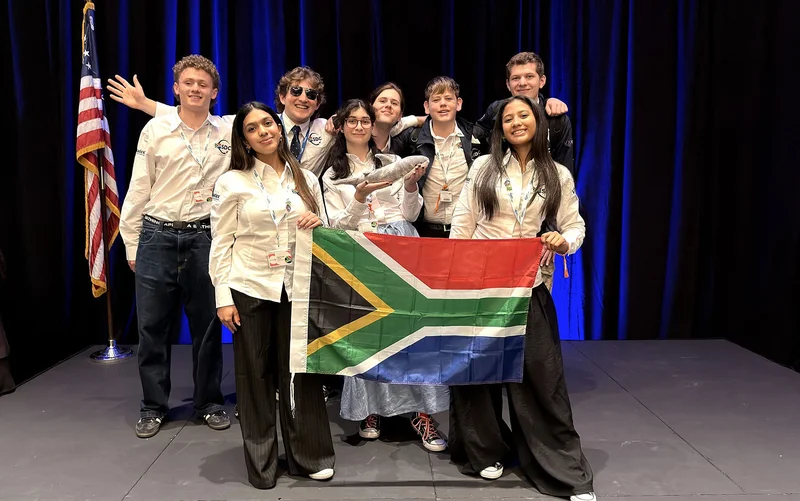
For a tense moment inside Nasaâs Kennedy Space Center in Florida, Benjamin Honigwachs thought the judges were playing a practical joke.
The volunteers announcing the winners began by celebrating nearly everyone else before his multinational coalition, a simulated aerospace company named âRockdonnellâ, was finally announced as the world champions. In that moment, his initial disbelief turned to pure joy.
âI was just filled with joy and relief that all of our hard work paid off,â recalled Honigwachs, a student at Bishops Diocesan College.
Honigwachs is one of seven Western Cape teenagers who made history on South Africaâs first-ever entry into the prestigious International Space Settlement Design Competition, the worldâs longest-running space engineering competition for schools. Selected through the inaugural national competition at the University of Cape Town, Team ZA was the only African team on the global stage.
The historic squad included:
- Zayaan Abdurahman from Mondale High School
- Joseph Allderman from Westerford High School
- Ethan Schoombee from Fairmont High School
- Alaya Kaplen and Qayalah Omar from Cannons Creek Independent School
- Dean Weich from Bishops Diocesan College.
Together, the learners joined participants from the United Kingdom, Australia, Brazil, China and the United States to form Rockdonnell, the first team in the competitionâs history to include representatives from every inhabited continent. Their winning proposal, Hermes, was a futuristic spacecraft designed to transport 3,000 people across the inner Solar System.
The long journey to Florida
Earning a ticket to Florida was a gruelling journey of its own. During the national round at UCT, they competed against 109 learners from nine schools, enduring an intense two-day simulation under real-world pressure. Throughout that weekend, moderators quietly observed who put in the most work to handpick the final roster.
âThe selection process to go to the competition was almost like winning the lottery... I still cannot believe that I received the privilege to go,â said Ethan Schoombee.
To prepare, they spent every Friday training intensely under competition founder Jagger Cooper-Doubell, learning how to pitch, design and defend complex engineering ideas under pressure.
The weight of representation was both daunting and electrifying.
âBeing a member of the first South African team and the only African team was a blessing,â Zayaan Abdurahman reflected. âWe werenât only representing our schools, we were representing the entire continent.â
Joseph Allderman echoed similar sentiments, admitting the pressure was intense.
âIt made me a little bit stressed with the gravity of it all, but it also filled me with a sense of determination... to show the world the talent that our country has in STEM (science, technology, engineering and mathematics).â
Inside the Nasa pressure cooker
That determination was put to the ultimate test the moment their wheels touched down in Florida. Throwing the group straight into the deep end, organisers merged the South Africans into a 60-student aerospace giant called âRockdonnellâ for a sleepless, high-pressure weekend sprint.
Their goal was to design Hermes for a journey to Mercury. Almost overnight, these teenagers had to navigate a maze of unfamiliar accents, clashing design philosophies and intense corporate pressure.
âWe had a team from every continent, so there were a few language and cultural differences,â explained Dean Weich.
âPeople from different places also thought in different ways, which helped us look at the problem from different perspectives and cover all our bases.â
To manage the monumental task, the company split into specialised corporate divisions. In Structures, Honigwachs conceptualised the overall design of the ship before calculating its physical dimensions.
Allderman and Schoombee were handed a staggering assignment as the only two students in the entire company responsible for propulsion and navigation.
âMaking the craft able to get to Mercury was rather challenging because getting there requires a lot of fuel,â Allderman recalled.
As they calculated engine specifications, Schoombee waged a fierce campaign to power the ship with realistic nuclear fission energy instead of theoretical fusion.
âFusion power was a pipe dream; a design based on reality is far better than one that is just theoretical,â he argued.
Meanwhile, in Human Factors, Abdurahman designed life-support systems to keep 3,000 human beings alive and sane in deep space, all while navigating the loud debates echoing across the room.
In Business and Marketing, Weich and Qayalah Omar had to prove the multibillion-dollar vessel was economically viable. But because they couldnât budget until other teams finalised their designs, they faced a race against the clock.
âWe couldnât finalise our costs until we knew what they were designing,â Omar explained. âWe were therefore working with very limited time and had to adapt quickly.â
Proving they belong on the global stage
After a chaotic final sprint, all the debates, calculations and financial models were bound into a single, massive proposal. Following a rigorous defense before Nasa judges and a retired astronaut, Rockdonnell won first place globally, with Allderman receiving the Anita Gale Creative Genius Prize.
âTeam ZA worked so cohesively together that we all deserved this award,â Allderman insisted. âI was just the one who got picked to represent it.â
The experience reshaped how the students view their own futures. For Honigwachs and Allderman, it cemented lifelong dreams of aerospace engineering. For others, it charted new paths: Weich shifted toward practical engineering, Omar discovered a passion for deep space, and Abdurahman realised she could blend biomedical engineering with astrobiology.
Their triumph is already opening doors back home. The South African Space Design Competition is planning a massive national expansion to give thousands more local students a chance to stand on the global stage.
âWe hope that we showed people around the world, as well as people across our continent and in SA, that we are good enough to compete at that level,â Omar said. âWe belong on that stage.â DM