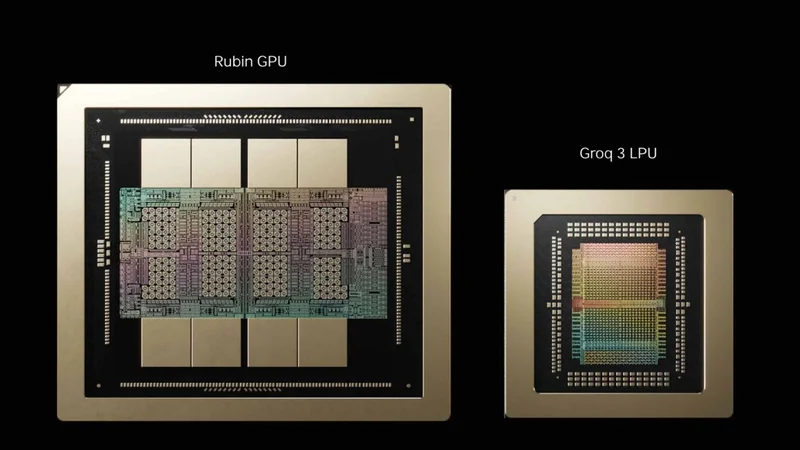
Nvidia has rejected a report claiming that it plans to begin small-batch shipments of a language processing unit tailored for Chinese customers by the end of 2026, with several Chinese orders already placed. "The reporting in The Information on NVIDIA's LPU is incorrect. We have no LPU sales in the China market today, and no China-specific LPU product in our roadmap," an Nvidia spokesperson told Tom's Hardware on Thursday. The Information's story, which cited two Nvidia employees, said the chip is a variant of the Groq 3 LPU Nvidia announced at GTC in March, and that its silicon is unchanged because it already falls within U.S. export rules.
The LPU was designed as a decode co-processor for the Vera Rubin platform, and Vera Rubin can't be sold in China. The Information's sources said Nvidia rewrote the software that splits work between the GPU and the LPU so the accelerator can run alongside processors that are available in the country.
The publication said Nvidia didn't respond to requests for comment over several days before publishing, and that it's unclear whether Beijing would allow the orders to proceed. Chinese officials blocked purchases of the H20 last year and only recently told companies they'd permit some H200 imports, so U.S. compliance alone doesn't guarantee the chips can be delivered.
Back in March, it was reported that Nvidia was preparing LPUs for China, with Jensen Huang saying two days later that the story was "totally false.” Thursday's statement is narrower than Huang's, addressing current sales and a China-specific product. Nvidia hasn’t clarified whether the standard LPU will ship to Chinese buyers. Huang told CNBC in May that Nvidia had "largely conceded" China's AI chip market to Huawei.
The Groq 3 LPU is built on Samsung's 4nm process with 512MB of SRAM per die and no HBM, and Nvidia said at GTC that it would ship in Q3 2026 to customers including OpenAI. U.S. export thresholds for China are set on compute density and bandwidth, and an SRAM-only decode accelerator with no HBM stack is the kind of part that can still be exported under them without a cut-down SKU, which is the mechanism The Information's sources described.
Huawei's Ascend 950DT, which the outlet named as the LPU's direct competitor, is optimized for decode and training and is due in Q4 2026, with the prefill-focused 950PR already in production since April. ByteDance and Tencent each took delivery of roughly 10,000 H200s in recent weeks, according to a Financial Times report this week, the first meaningful Nvidia accelerator volume to enter mainland China since December's U.S. approval.
Get Tom's Hardware's best news and in-depth reviews, straight to your inbox.
Luke James is a freelance writer and journalist. Although his background is in legal, he has a personal interest in all things tech, especially hardware and microelectronics, and anything regulatory.