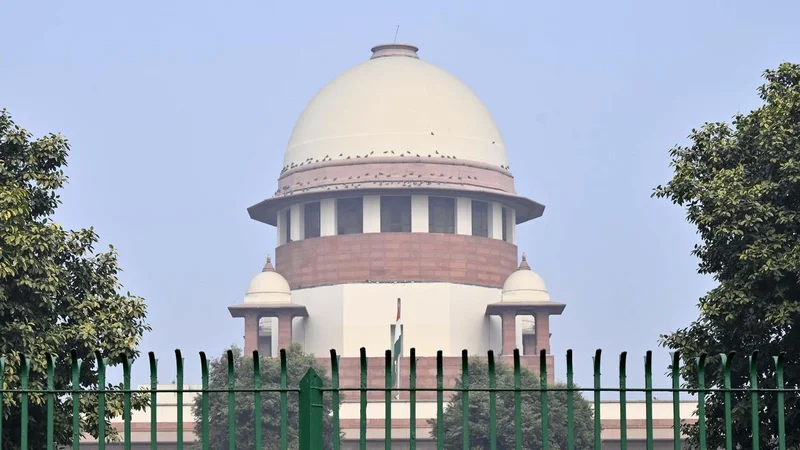
The Supreme Court on Friday (August 21, 2026) praised the repealed Mahatma Gandhi National Rural Employment Guarantee Act (MGNREGA), calling it a “salutary scheme” that was neither a freebie nor an exploitation of rural workers.
The court’s accolade came amid claims by civil rights groups that MGNREGA’s successor, the Viksit Bharat Guarantee for Rozgar and Ajeevika Mission (Gramin) or the VB-G RAM G Act, has seen a 50% decline in employment generation, despite an increase in guaranteed work days from 100 to 125 per household annually.
‘MGNREGA was effective’
The new law reflects a shift from a demand-driven, rights-based framework to a centrally controlled model. Also, the funding burden on States has increased three-fold, shifting from a 90:10 ratio to 60:40.
“MGNREGA was a good, effective scheme. It did a wonderful job in rural areas and was implemented pan-India. It was neither a freebie nor exploitation,” Chief Justice of India Surya Kant, heading a three-judge Bench, orally observed.
The Bench was hearing a petition filed by activist Aruna Roy seeking directions for the government to pay delayed wages under the MGNREGA, along with compensation.
Advocates Prashant Bhushan, Cheryl D’Souza and Neha Rathi, appearing for Ms. Roy, urged the court to examine whether a law could prescribe minimum wages lower than the threshold determined by the State concerned.
Fundamental right argument
The petition also sought to elevate the statutory guarantee of rural work to the status of a fundamental right under Article 21 (right to life) of the Constitution.
“The Constitution does not make the right to work a fundamental right. It is more a democratic aspiration under Part IV (Directive Principles of State Policy)... To achieve that aspiration, the state formulates the policy by which work is provided at a graded, compensatory level. Should we treat it on par with Article 21?” Justice Joymalya Bagchi asked Mr. Bhushan.
Mr. Bhushan said the right to lead a dignified life is part of Article 21. “A dignified life requires you to get employment at minimum wages. Anything below minimum wages is forced labour,” he submitted.
Justice Bagchi said a minimum wage threshold might risk shrinking employment opportunities, while Chief Justice Kant noted that wages were usually linked to prevalent local conditions.
Justice V. Mohana stated that the issues raised by Mr. Bhushan must be examined afresh in light of the new law, rather than under the MGNREGA. “We have to see fresh details, fresh statistics,” Justice Mohana said.
Mr. Bhushan submitted that States were required to provide nearly half the funds under the new law. “The number of employments has come down by half. States have no money,” he said.
The court asked him to file a new petition while disposing of the current one.
Published - August 21, 2026 06:11 pm IST