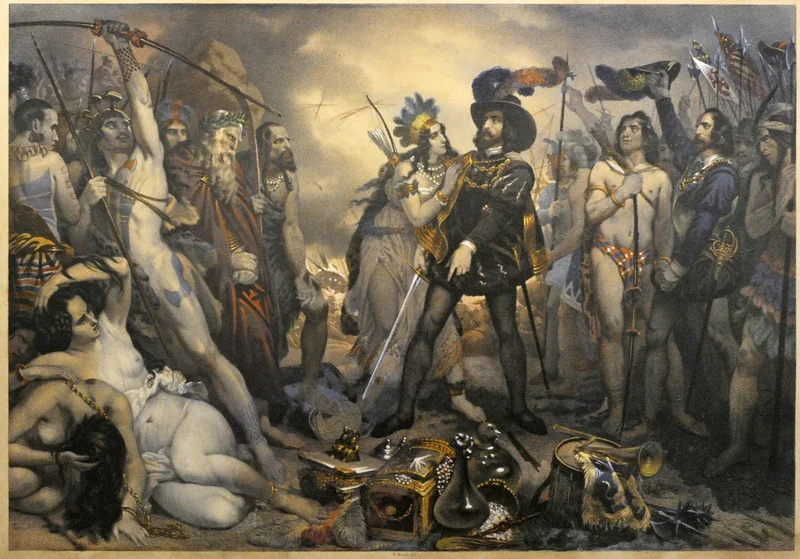
Alejo Carpentier, a deep connoisseur of the origins, essences and behaviors of New World identity, and the author of the identity concept he called “American Magical Realism” — which he also stylized in his novels — stated that the “discovery” of America, which took place in 1492, was the most momentous event in history, because from that encounter mankind finally had a full understanding of the world it inhabited. What happened from that moment on changed everything. For everyone.
Many disruptive events and phenomena followed thereafter. As is well documented, after Columbus’s discovery the conquerors’ drive drastically and brutally transformed the lives of the continent’s original inhabitants: not only was another worldview imposed, but violence was used to do so and, as collateral damage, diseases were introduced — processes that reached genocidal levels among Cuba’s Indigenous populations, among others. Of course, the American adventure also altered the makeup of European societies, from those directly involved in conquest to populations that began to ease their famines with the various benefits arriving from the other side of the Atlantic, such as the potato.
Undoubtedly, two of the most dramatic conquest processes, judged by the huge number of sociohistorical changes they produced, were those that took place in Mesoamerica, home to the peoples grouped under the names Maya and Aztec, and the campaign in the southern part of the continent against the vast Inca empire, the Tahuantinsuyo.
The arrival of a civilization that was materially and technologically more advanced, and theologically at a monotheistic stage, unleashed a historical tsunami that altered the fate of the native cultures
In every case, the arrival of a civilization that was materially and technologically more advanced, and theologically at a monotheistic stage, unleashed a historical tsunami that altered the fate of the native cultures, transformed by blood and fire; for with the evangelizing cross came the invading hordes’ material violence in search of the riches abundantly found across what would soon be called the Americas.
Those campaigns of conquest and the convulsive upheavals they produced — their historical significance tinged with the astonishment of the scarcely conceivable, but often justified ideologically by the evangelization that, it was repeatedly claimed, would bring salvation to so many unbelievers — gave rise to a varied and abundant literature. In that corpus, known as the chronicles of the conquest, there was everything: from more or less official letters and documents —opened by Columbus’s letters to the Catholic Monarchs and capped by Hernán Cortés’s letters on the conquest of what would become the Viceroyalty of New Spain — to indispensable works for understanding the dimensions of what occurred, such as the two volumes of the Comentarios reales by the highly gifted Inca writer Garcilaso de la Vega on the Andean empire and the events related to its fall; followed, as almost always happened, by disputes among the newcomers, and the work of the ever-mnemonic soldier Bernal Díaz del Castillo, emphatically titled Historia verdadera de la conquista de la Nueva España (A True Account of the Conquest of New Spain), which was published in 1632, nearly 50 years after the author’s death.
When, in recent times, several of those events and processes from half a millennium ago — in another world, another system of epochal ideas and concepts — have once again become political controversies with score-settling included, the publisher Libros del Asteroide has issued a substantial edition of Bernal Díaz del Castillo’s work. Prefaced by a well-documented introduction by Jordi Gracia and capped with an illuminating epilogue by Andrea Martínez Baracs, this 2026 edition of the Historia verdadera… presents a bold adaptation. Under the guidance of specialist in medieval and Renaissance Hispanic literature, Lorenzo Martín de Burgo, the edition modernizes the 16th-century lexicon (a “rendering into contemporary Spanish”) and removes or condenses chapters considered repetitive or tedious. The editors’ explicit aim has been to make a classic work more accessible to contemporary readers.
From its very title the work declares its intentions: to narrate what the author considers the truth of a history already beginning to be manipulated by certain interests
Of course, the work of editors and specialists may be open to debate. And although the end often does not justify the means, I, for one (having read the original text, which remains in my emotional memory), applaud such a daring endeavor, which will surely draw in readers who would otherwise be unlikely to be attracted by the magnetic yet challenging immersion in this indispensable document within the historical landscape of Hispanic literature and the history of the nascent relationship between Europeans and the wider world, culminating in Columbus’s expedition.
From its very title the work declares its intentions: to narrate what the author considers the truth of a history already beginning to be manipulated by certain interests, whether through lack of information or, at times, for even murkier reasons, such as specific relations of power and material gain. It is therefore no accident that Bernal Díaz’s chronicle launched a barrage of criticism at Francisco López de Gómara’s Historia general de las Indias, published in 1552, a few years before Díaz began drafting his account.
Such an intention is fitting for attempting a concise assessment of the qualities of any historical writing. Although the discipline is considered a “social science,” its scientific character is often in doubt. For, to begin with, it carries a very real stigma: history is written by the victors, a condition that must be coupled with its class-based nature, shaped by economic, epochal and, above all, ideological judgments and prejudices from which the historian can never fully disentangle himself, even when he claims to reveal the truth and documents it.
In this case it is important to note that Bernal Díaz had the advantage of physical proximity to the events he narrates: he was the only European who participated in the three expeditions that culminated in the discovery and subsequent conquest of the territory, later led by Hernán Cortés, which ended in the fall of Aztec power in Tenochtitlán. However, it is also necessary to warn of the drawback of his partiality, since he was, precisely, an actor in the events; and although he writes with the purpose of establishing a truth, it will always be contaminated by the original sin of his historical and cultural condition (his ideology), which imbues him with a worldview decorated by visceral intellectual traits such as religion.
The Mexica capital, the lacustrine city of Mexico-Tenochtitlán, housed about 300,000 inhabitants when Paris reached 200,000.
One of the most notable literary merits of Bernal Díaz’s work lies in his narrative ability to generate dramatic tension despite recounting a well-known story. Conceptually, his mediated yet perceptible grasp of what that conquering campaign meant is also noteworthy. Recall that the Aztec capital, the lacustrine city of Tenochtitlán, housed about 300,000 inhabitants at a time when Paris had 200,000. It was a highly stratified society with strict controls over its population and despotic toward subjugated neighbors, yet economically prosperous and advanced in a wide range of human activities. Hence the chronicler’s admiration for such beauty, opulence and social organization that runs throughout the work, allowing him to state that they could “see things never heard of, nor seen, nor even dreamed of, as we saw them,” for “they seemed like enchantments told in the book of Amadis,” while repeatedly justifying the civilizing character of a process he accepts as a great historical and spiritual necessity.
At the same time, the soldier-writer does not hide the plunder that drove the much-vaunted civilizing action. It would be worth counting how often words such as gold, silver, and riches appear in his chronicle and noting the complaints about the unfair divisions of those spoils. He does not conceal many European misdeeds — horrors such as, among many, the enslavement of Indigenous people, branded with hot irons like beasts — nor the internal disputes among the invaders… and, of course, the fate of expeditionaries like him, bearing the countless scars from the battles they fought and who, in the end, barely received the scraps of the great spoils obtained.
It is no coincidence that in the closing section of the chronicle, after the Aztec capital is taken, with Moctezuma long dead and his successor Cuauhtémoc even murdered, while Bernal Díaz continues to record the many “benefits” the Spaniards’ arrival brought to lands of idolaters, he also recounts how among the Europeans the shameful feast of tricks and underhanded deals that the conquering campaign devolved into begins. And so Bernal Díaz records when he reflects: “Here you will see how much distance there is between the old conquerors and those recently arrived from Castile, who do not know the nature of Indian warfare and their cunning. In this the conquest ended.”
It seems that, as always in history, some gain more than others, and some grow rich. But the big losers were not those who failed to acquire more wealth or more enslaved Indigenous people under the encomienda system. They were civilizations that, due to the ambitions and fanaticism characteristic of that era, suffered a historic catastrophe. And I repeat: as always, for there is no shortage of such ambition and fanaticism in our 21st century either, while a history presented as true is being reissued, in a modernized form, for today’s readers.