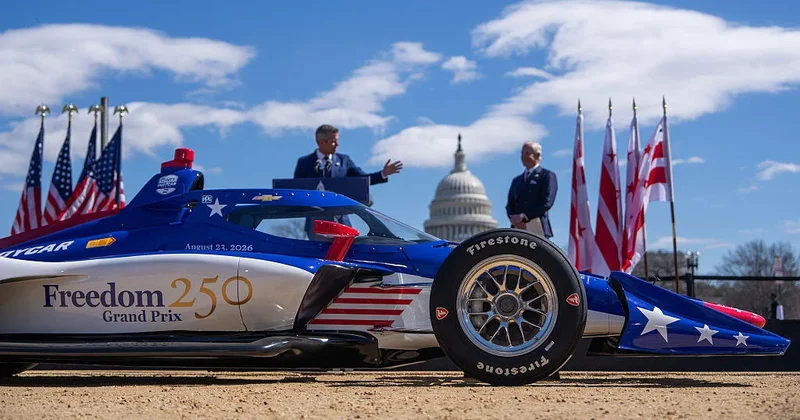
Washington — Twenty-five cars traveling at top speeds approaching 180 mph will zoom around the National Mall this weekend when the racing series IndyCar takes over downtown D.C. for a race commemorating the nation's 250th birthday.
The Freedom 250 Grand Prix of Washington, D.C., is expected to attract about 140,000 people on each day of the weekend. The event is the first major auto race in the capital in more than 24 years.
The area around the track has been transformed over the past several weeks to make way for the construction of grandstands and enormous barriers, with large portions of the area blocked off to traffic and pedestrians. The race will disrupt several popular tourist destinations around the Mall and limit access to those with tickets to the event.
President Trump is expected to wave the green flag to kick off the race, which has been for more than a year. Here's what to know about the D.C. IndyCar race:
What is IndyCar, and when is the race in D.C.?
IndyCar is one of the world's leading open-wheel racing series, generally regarded as second only to Formula 1 in global popularity and prestige. The series is among the fastest racing categories, with cars capable of reaching 230 mph. Its premier event is the Indianapolis 500, one of three races that constitute the "triple crown of motorsport."
This weekend's race will be IndyCar's first in the nation's capital and feature 25 drivers. The race itself begins at 1 p.m. ET on Sunday, but cars will be on track over the course of both Saturday and Sunday, given how an IndyCar race weekend is structured.
The drivers will have two practice sessions on Saturday — the first at 9 a.m. and the second at 1 p.m. These sessions allow the drivers and their teams to get accustomed to the racetrack and try out different car setups and strategies, which is especially important on an unfamiliar track.
Qualifying for the race will take place from 5 p.m. to 6:30 p.m. on Saturday. In qualifying, drivers compete to set the fastest lap over three rounds, with slower drivers eliminated after the first and second rounds. The final results set the grid — who starts where — for the race itself.
A special exhibition — the International Race of Champions, or IROC — will be on track Saturday in between IndyCar sessions.
What's the layout of the track?
The track is 1.7 miles long and features six left-hand turns and one to the right. In a nod to the country's birthday, the race will be 250 miles long, or 147 laps.
The starting grid is directly to the west of the U.S. Capitol on Third Street Northwest. The cars then take a left and speed down Pennsylvania Avenue, before another left-hand turn down Ninth Street Northwest past the National Archives.
The track then briefly goes down Constitution Avenue, past the National Gallery of Art. Drivers will hang a right down Seventh Street Northwest, cutting across the National Mall to reach Independence Avenue Southwest. The track will take the drivers past the Smithsonian Air and Space Museum and National Museum of the American Indian before hitting Maryland Avenue Southwest and looping back to the starting line in front of the Capitol.
IndyCar also released a more detailed map showing gates, amenities and other information for attendees here.
Can I still get tickets to the IndyCar race?
Tickets for general admission to the race were free, but the window for requesting them closed back in June. General admission tickets are nontransferable and aren't available on resale sites, either.
"No other GA tickets are available for the Freedom 250 Grand Prix," the race's website says. "You must have a ticket for venue access and race viewing. There are no viewing options or fan zone access available without a ticket."
The only way to get access to the race area now is to purchase a hospitality package, which comes with access to the "Champions Club" with food, drinks and prime seating. But the Champions Club packages for Sunday or the whole weekend are sold out — the only remaining option on Ticketmaster as of this writing was for Saturday, and that carries a price tag of $3,582.70 for a pair of passes.
How can I watch the IndyCar race on TV or streaming?
Fox Sports is IndyCar's broadcast partner and will show the weekend's action on various Fox platforms. The network released a full schedule of its coverage plans last week.
Saturday's IndyCar practice sessions and qualifying will be broadcast on FS1 and FS2, Fox Sports' cable channels. On Sunday, a 90-minute preshow and the grand prix will be broadcast on the Fox broadcast network.
All of Fox's coverage can be streamed on the Fox One app as well.
How did the race come together?
IndyCar is owned by Penske Entertainment, a subsidiary of Penske Corp., whose president is Bud Denker. Denker is also the chairman of the grand prix and has been instrumental in planning for the race.
"This is my dream, a little over a year ago, to bring an IndyCar race to our nation's capital," he said during a press preview on Capitol Hill on Thursday.
Denker told NPR he envisioned a race to celebrate America's 250th birthday over a beer with Fox Sports CEO Eric Shanks last year. But it almost didn't happen. Congress needed to approve his plan to host the race on Capitol grounds. After pitching his idea, Denker was running into roadblocks on Capitol Hill and didn't have the votes to get it approved.
He told NBC Washington that on Jan. 21, he had 51 people to call, from leaders in Congress to the White House, to say it looked like the race wasn't happening. Then, Transportation Secretary Sean Duffy called him and suggested the race could move forward under an executive order, with the route adjusted to avoid congressional jurisdiction.
Mr. Trump signed the order in January laying the groundwork for the revised race. The directive instructed Duffy and Interior Secretary Doug Burgum to locate and designate the route, and secure the proper permits and approvals. The track was finalized in March.
"INDYCAR racing is a source of pride and entertainment for our Nation, which is why I am pleased to announce the Freedom 250 Grand Prix in Washington, D.C.," the president said in his executive order. "This race, the first motor race ever to be held in our nation's capital near the National Mall, will showcase the majesty of our great city as drivers navigate a track around our iconic national monuments in celebration of America's 250th birthday."
Mr. Trump has sought to make the country's 250th anniversary elaborate, with celebratory events running for much of the summer, including the UFC fight on the White House's South Lawn in June.
Is Trump going to be there? What has he said about it?
Denker said Mr. Trump will wave the green flag to begin the race. Organizers also said there's a special viewing box for the president's use, should he want it.
Mr. Trump is also expected to take a ceremonial "lap of honor" around the track in the Beast, his presidential limousine, according to the New York Post.
The president has expressed excitement over the race. While he said he doesn't have much time to watch racing, he said he loves it. Last month, the president invited some of the drivers for this weekend's race — Álex Palou, Felix Rosenqvist and David Malukas — to the White House to promote the event.
"It will be an awesome display of American patriotism and raw horsepower and ingenuity," the president said when he welcomed the drivers to the White House. "You're going to see cars at the level that they've never been at before, with cars racing more than 190 mph and even higher than that down Pennsylvania Avenue. It wasn't exactly designed for that but what Sean Duffy has done with these incredible, brilliant people is amazing. It's going to be a sight for the ages."
What's open and closed on the National Mall for the race?
Preparations for the race have already shut down much of the area around the track, snarling traffic in D.C. and causing headaches for residents, commuters and tourists alike.
Some popular tourist destinations fall within the perimeter of the racing action and won't be accessible to visitors.
Three Smithsonian museums will limit access to those with tickets to the grand prix area on Saturday and Sunday: the National Air and Space Museum, the National Museum of the American Indian and the National Museum of Natural History. The National Gallery of Art and the National Archives will also require a ticket to visit over the weekend. The National Gallery's East Building will be closed entirely on Sunday.
The National Park Service has also released a list of closures related to the event, including several memorials and parks around the National Mall.
The roads aren't expected to open up immediately, either, since it will take a while to tear down the walls, fencing and other equipment set up for the race. Some will remain closed through Sept. 15.
How much is the race costing, and who's paying for it?
The total price tag for the race is unknown, but IndyCar's parent company has said it is footing the bill for most of the cost.
Denker, Penske Corp.'s president and the race's chairman, told NBC Washington that Penske is paying for the "vast majority" of the cost for the weekend. He declined to detail the precise numbers, but said the price tag "far exceeds" the company's roughly $21 million budget for IndyCar's grand prix in Detroit. Sponsorships have helped offset the cost.
Denker told NPR that the only cost to the government will be for security provided by the Secret Service, D.C.'s Metropolitan Police Department and other entities.
Denker also said the company has not accepted any federal money to produce the race or money from Freedom 250, the group that organized other events commemorating the country's 250th birthday in the nation's capital. Organizers, according to The Athletic, said any profits from the race will go to charities chosen by D.C. Mayor Muriel Bowser.
The Associated Press reported that organizers paid to build 1,800 walls to surround the track, with each weighing 10,000 pounds. The organizers also installed metal detectors where ticket holders will be screened by the Secret Service, and spent less than $3 million for some road repairs along the track. More than 220 manhole covers along the track needed to be secured to prevent them from becoming dislodged during the race.
Has D.C. hosted an auto race before?
Yes, but not for some time.
The last major auto race in the capital was the Cadillac Grand Prix of D.C. in 2002, part of the American Le Mans Series. It took place on a temporary track in the parking lots around the now-torn-down RFK Stadium.
The roar of the race cars speeding 180 mph around the track greatly exceeded noise limits set by the D.C. government.
"The track noise gave the impression yesterday of a series of hurricanes passing over. The combined car engines would roar unrelentingly for 30 minutes to an hour, then go dead quiet until the next qualifying heat or race," The Washington Post reported at the time.
The race was supposed to be held every year for the next 10 years, but the 2003 event was scrapped after organizers failed to fix the noise problems and ran into other operational issues. The city later terminated the contract.
Will the D.C. IndyCar race happen again?
Denker told NPR this week that the race in D.C. is a one-off affair.
"This is a one-time-only event, because we're celebrating the country's 250th one time," Denker said.
But Bowser, the D.C. mayor, and Mr. Trump have said that they would like to see more D.C. races in the future. Bowser has called the race the "first, to be followed by second and third," according to the AP.