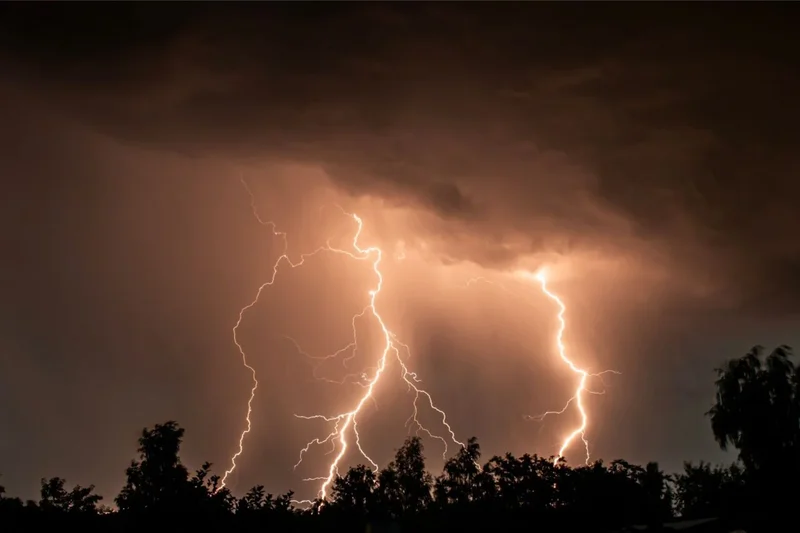
When lightning strikes the ground, the impact creates small vibrations that propagate through the ground. These âthunderquakesâ were believed to be too small to be useful to scientists; if anything, they might even be noise blocking out more tangible signals.
Enter high-quality fiber-optic cables. Researchers at Pennsylvania State University buried telecom cables under their campus, connecting the network to the kinds of acoustic sensors used in seismology. Remarkably, the sensors recovered information on the tiny changes caused by 458 thunderquakes over two years. In a paper published today in Science Advances, the team explained that it successfully used the dataset to create detailed images of the geological structures below Penn State, up to around 328 feet (100 meters) underground.
âIn other words, a storm in the sky can help us see underground,â Tieyuan Zhu, the studyâs co-author and a geophysicist, told Gizmodo. “We are turning what seismologists traditionally consider environmental noise into a useful scientific signal.â
Shallow vibrations
According to the paper, seismology has tended to focus on âsources within the solid Earth,â like earthquakes that literally shake up geological structures tens of miles below the surface. On the other hand, itâs reasonable to assume that things in Earthâs âfluid spheres,â like atmospheric phenomena, would âinject energy into the ground and generate measurable seismic motion,â the paper explained.
However, this hasnât been studied too extensively, the team said. Whatâs more, thunderquakes are âfar too weak to cause damage, and people generally cannot feel them,â Zhu explained to Gizmodo. But theyâre also ideal candidates for studying the uppermost part of Earthâs surface, owing to their high-frequency energy, he added.
The team had found earlier that normal telecommunications fibers were sensitive enough to pick up thunderquakes. Zhu said this naturally raised the following question: âCould we move beyond simply detecting thunderquakes and actually use them to image the subsurface?â
Noise to signal
For the latest study, the team used a technique called distributed acoustic sensing, which sends out laser pulses through optical fibers and measures how changes in ground motion affect the fiber. This effectively allows a single cable to âact like thousands of closely spaced seismic sensors,â Zhu explained to Gizmodo. To ensure reliability, the team also separately collected geological and geophysical data to compare readings with the thunderquake data.
âBecause seismic-wave speed depends on the properties of the material through which the waves travel, these measurements allowed us to estimate the shallow subsurface structure,â Zhu said. âThunderstorms happen frequently, but their seismic energy has largely been ignored. Our study shows that this energy can become a renewable and essentially free source for probing the ground.â
Above and beyond
Zhu told Gizmodo that the teamâs next step is to test the same method in other locations and geological environments. For instance, differences in the physical features of either the storm or the environment could influence the quality and depth of the final image. On a more fundamental level, Zhu hopes to better understand the electromagnetic forces at play for the seismic energy associated with lightning.
In the paper, the team also noted that the same method could feasibly help explore subsurfaces on other planets and moons. Saturnâs Titan, for example, has been known to experience thunder. Thunderquakes wonât replace conventional seismic surveys, Zhu told Gizmodo, but they certainly âoffer an additional, naturally recurring source of informationâespecially in places where earthquakes are infrequent or where conventional surveys are difficult or expensive.â
âThe broader message is that the ground is continually responding to activity in the atmosphere and at the surface,â he concluded. âSignals that once looked like noise may contain valuable information about the hidden world beneath our feet.â