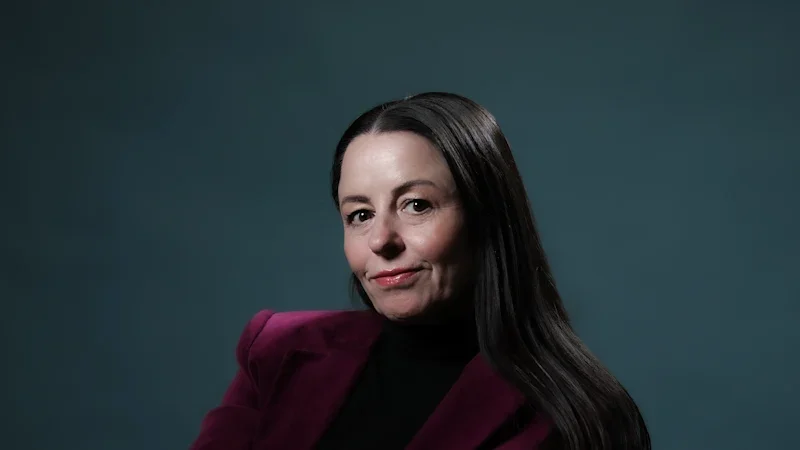
Think of Myf Warhurst and the word “bubbly” might spring to mind. With everything she does – from Spicks and Specks, the Eurovision Song Contest or her documentary The Truth about Menopause – Warhurst is the ray of sunshine; the nice one. But she’s no longer playing nice. She’s taken on the patriarchy in a new book, Middle Rage (out August 25). And she’s mad.
When I heard you’d written a book on rage, I thought maybe it was about you shaking your fist at climate change or losing it over smaller things, like parking tickets. But this book is really serious – about tackling patriarchy head-on. What does the patriarchy mean to you and why did you decide to focus on it? Initially, it was going to be this funny book about all the things in middle age that annoyed me. But because [with menopause] you have this great awakening, you lose your oestrogen, and all of a sudden it’s like you’re overcome with a laser focus. You can see everything clearly. You see the inequality everywhere. And rather than just getting sad about it, I was feeling furious, and then I looked into that and realised, “Oh, anger’s not something that women have really been allowed to have over the years.” Girls are encouraged to play nice, keep it small, don’t be too expressive. There’s all this conditioning that has got us here, and it all leads to one thing, and that is the patriarchy. That’s an easy thing to jump to and say, “Oh, you know, it’s the patriarchy’s fault,” but it’s a system by which we live, and it’s a very clear system that advantages one over the other. It also disadvantages men, because little boys aren’t allowed to become the full human beings that they could become by showing their emotions, and they’re forced into a system that kind of makes them go to work and do shitty jobs for everyone who’s making the money at the top.
I’ve also had a couple of relationship experiences whereby I realised my own conditioning allowed me to put up with certain behaviours that I shouldn’t have ... I’m terrified of [releasing the book] because people aren’t going to expect it from me, but I’m also really proud of it.
What makes you terrified? Girls, especially, learn how to people-please because they realise it makes them safe in an environment. So it’s very hard to strip back all those layers of conditioning and know I might disappoint some people with this book and know that some will think I’ve changed or lost my mind. But this person has always been there. I just hadn’t shown that side of my personality until now.
‘I never thought it could happen to me because I’m a very well-educated, very privileged white woman.’Myf Warhurst
You also talk directly to men in the book, don’t you? The thing is, I grew up with great men, and maybe that was a luxury and a privilege. My brothers are fantastic; they’re creative, they’re very emotional, they respect me, as do my male friends. But I think it’s probably having had good experiences that led me towards not questioning other men who have come into my world in the same way, because I just trusted a little bit blindly. And I think it’s a Gen X thing, too; the way that generation was brought up. We were brought up on love stories and romances, where the ending was always tied with a neat little bow, and you got married, and then the story stopped.
The book went to some dark places, particularly when discussing one of your exes around the time of COVID-19. You describe it as an unhealthy relationship that left you financially in debt. You wrote that things got so dark that there were nights you went to *** sleep hoping you didn’t wake up. What was that like? *Well, fortunately, it was a long time ago, so now I can talk about it. But also, writing the book allowed me to work through it myself. I haven’t included anything particularly salacious, but I think it was important to note that when you get caught up in relationships that are unhealthy, it can really lead you down a dark path because you feel like there’s no way out, especially if you’ve been manipulated to believe that you’re the problem. But it was also important for me to note that if I
don’tsay these sorts of things, then other women will be frightened to do so. I never thought it could happen to me because I’m a very well-educated, very privileged white woman who exists in a world full of kind people. How did it happen to me? It does because you’re not looking for it.
What are the top few things you’d recommend to women about recognising controlling behaviour? Just look for patterns, look for repeat behaviours – patterns like denying your reality when you say something happened or how you felt. If they say that’s not how it was, or you’ve remembered it incorrectly, then that’s a huge red flag. Your interpretation of a moment is your interpretation. There is nothing wrong with it. They could also, in the same breath, say they love you, which is confusing and can be quite manipulative. So, look for the patterns, and once you see them, you have every right to just get out in those early days. You don’t have to make it work … Women, especially of my generation, Gen X, were brought up in a culture where we’re taught to believe we are the ones that make it work, regardless of how difficult it is.
How do you reflect on that relationship now? You go through all the emotions. You go through the lows. It wasn’t great and I wasn’t great. For me, it was incredibly educational. It’s taken me until 50 to really see these kinds of behaviours for what they are, and I’m disappointed about that. I wish I’d known [about them beforehand], and I do think younger generations know this stuff a lot earlier than we do, or we did. So, I am genuinely, weirdly grateful because finally it all makes sense, and I’m able to look at this next chapter, whatever the hell it may be – who I can become – without worrying about whether or not I have to have a relationship. I grew up with all those thoughts of feeling “less than” because I never managed to get relationships right. Now, it’s like, “Well, it’s not working now, I can see it. I don’t want that any more.” I see it as fortunate now. I can write a book like this because I’ve got the time. Because I haven’t got kids.
You’ve talked in the book about calling out bad behaviour more now because you’re at this stage of your life. Can you give me an example of that? Look, the theory is real. The practice is harder and I think it’s going to take time to really stand behind everything I’ve written. It’s not like I’m walking around being furious all the time. But I’m a bit more straight-up. I’m not writing those emails any more that say “just checking in”, “no worries if not”. I still do it sometimes, and I check myself … You don’t change inherently as a person. It’s just understanding that you are allowed to be direct, and you are allowed to say what you want or need, and if that disappoints someone, then that’s OK. It doesn’t mean becoming a Karen, either – I use the term in the book, the ladies with the can-I speak-to-the-manager haircuts. Like, that’s entitlement, that is patriarchal behaviour.
It’s interesting there’s no male equivalent to “being a Karen”. There was a news story a couple of years ago where you were in a dispute with a neighbour about a fence. Do you feel like you were depicted as a “Karen” in that situation? That was over legal boundary issues, of which I’m certainly not an expert, and I wasn’t actually involved in that argument – I was in the house at the time. I think the media are always very quick to portray women in a negative light. It gets clicks. It’s the algorithm. I do think there’s this resistance to women speaking up about anything and having an opinion, and that is, again, the last gasp of the patriarchy just trying to put women back in their place. But similarly, for men, they’ve been allowed anger but have had to suppress other emotions. We are allowed as women to cry – I mean, I do it all the time – but men aren’t. And so many men I’ve spoken to while doing this book say that they haven’t cried for years.
What really struck me in the book was the experiences you’ve had with creepy men, like the guy who kept texting you while you were on the radio saying that he was on his way in to see you *** from the country. How scary was that for you? *That’s pretty normal when you’re in the media, though. And my experiences are very similar to most women who are in the public eye. Actually, I’ve probably gotten off pretty lightly compared to women who are very vocal online today and are very vocal in the media. I’ve also realised that what we were taught, which was not to call it out, not to cause a fuss by responding, meant you’re feeding the beast. I actually think maybe staying silent is not the answer.
What would you like people to take away from this book? This book might disappoint some people who pick it up and go, “Oh, that’s not what I was expecting.” But I hope that they can keep an open mind and see it as a way to reconnect with understanding how broader systems work and how that affects all of us, and I think that’s where we need to look right now. Because a lot of women are feeling very frustrated at the moment, and I think it’s important to understand why. How many women were killed by their intimate partner in the last week here in Australia? It was five. A week before that, it was four. Like, what is going on? Things need to change, and I think this book might help people want to change things around them and to help younger generations learn so they can have a safer and more productive time of it, and to make choices that are better for all of them, not just for a system that works against them.
Middle Rage by Myf Warhurst is published by Hachette Australia on September 8.
If you or anyone you know needs support, you can contact the National Sexual Assault, Domestic and Family Violence Counselling Service on 1800RESPECT (1800 737 732), Lifeline 131 114, or Beyond Blue 1300 224 636.
Read more from Good Weekend magazine: