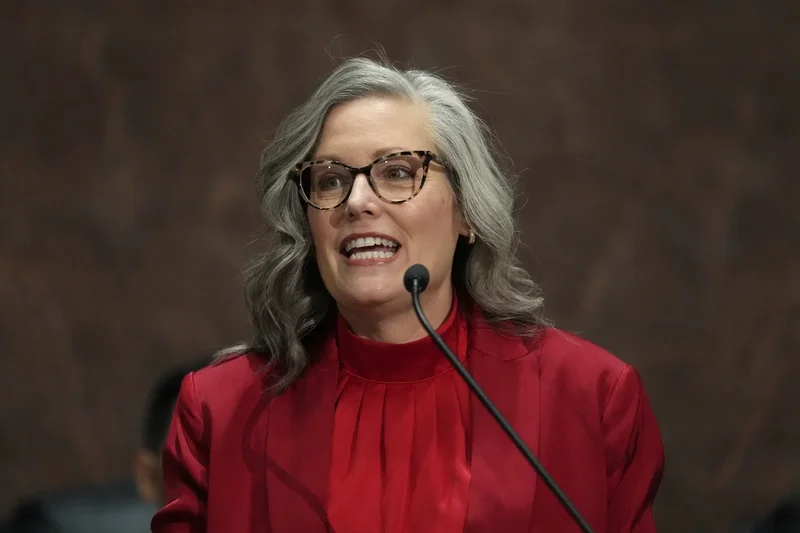
State prosecutors declined to file criminal charges against Arizona Gov. Katie Hobbs over allegations that she took part in a pay-to-play scheme with a group home company that received a rate increase from the state after contributing $100,000 to her inaugural celebration, Attorney General Kris Mayes announced Friday.
The Democratic governor has been accused of giving preferential treatment to Sunshine Residential Homes after the Arizona Republic revealed the company contributed to the inaugural fund and Arizona Democratic Party and later received a 30% payment increase. Only Sunshine and one other company were given increases during the 2022-2023 contracting period.
The investigation has turned into a political millstone for Hobbs as she seeks a second term as governor. Her Republican opponent, U.S. Rep. Andy Biggs, has run an ad underscoring the investigation into Hobbs.
Hobbs denies wrongdoing, saying she wasn’t involved in the decision to grant the increase.
“The investigation has not uncovered any evidence of the necessary quid pro quo to support a bribery charge,” Mayes said in a statement.
While the situation did not meet the standard for criminal charges, Mayes said her investigation “shows there is a need for legislative reform" around the transparency of political donations.
Mayes, like Hobbs, is a Democrat. A separate investigation by Republican Maricopa County Attorney Rachel Mitchell and the state auditor general is continuing. It’s unclear when the latter investigation will be completed and how it differs from the attorney general’s examination.
The company gave $200,000 to the state Democratic party in the months leading up Hobbs’ November 2022 showdown against Republican Kari Lake. After her narrow victory, Sunshine gave another $100,000 to Hobbs’ inaugural fund weeks before she took office in 2023 and another $100,000 to the party in August 2023, according to records.
The company's founder, Simon Kottoor, and his wife, Elizabeth Kottoor, each contributed a total of $10,000 to Hobbs’ gubernatorial campaigns.
Sunshine sought an increase in 2022, but it was denied about a month after Hobbs took office. The company tried again and was approved in May 2023, raising its rate from $149 to $195 per bed.
The Arizona Department of Child Safety said Sunshine told the state it would reduce its bed capacity if it didn’t get a rate increase and instead would use such beds to house unaccompanied immigration children for the federal government.
The ultimatum came as the federal government was reimbursing group homes at nearly twice the rate paid by the state, which had already seen some providers starting to do work for a federal program that serves unaccompanied immigrant children, the agency said.
Sunshine is a large provider, with a total of about 290 beds at the 28 homes it operates. It also provides 70% of beds for siblings in foster care in metropolitan Phoenix. Losing Sunshine’s beds would significantly affect the state’s ability to place children in homes and would likely lead to siblings in foster care being split up and sent to different homes, the agency said earlier this month.
“The potential loss of approximately 290 beds was a serious capacity concern that required careful consideration of the consequences for children and the broader child welfare system,” the agency said in a statement.
The agency said then-DCS Director David Lujan approved the increase and that the governor and her staff weren’t involved.
All providers that previously had contracts with the agency received rate increases during a new round of contracts in 2024, when Sunshine also saw its rate increase to $234 per bed.
In seeking the investigations, Republican state Sen. T.J. Shope pointed out the group-home company was under scrutiny for its care of Jakob Blodgett, a 9-year-old who stayed at a Sunshine home in Glendale in December 2022 after his father was arrested on a drug charge. He died days later at a hospital from complications of Type 1 diabetes, including the serious complication known as ketoacidosis.
A lawsuit alleges poor management of the boy’s diabetes while in the foster care system and that child welfare authorities and Sunshine were negligent in exposing the boy to harm that resulted in his death. While the state has denied the negligence allegations, two Sunshine employees responsible for providing direct care for Blodgett during a crucial stretch of his decline in health testified they didn’t have the necessary training or knowledge to manage a Type 1 diabetic.
The Maricopa County Sheriff’s Office interviewed several Sunshine employees as part of its criminal investigation into Blodgett’s death. No one has been charged. The county agency said the investigation remains open.