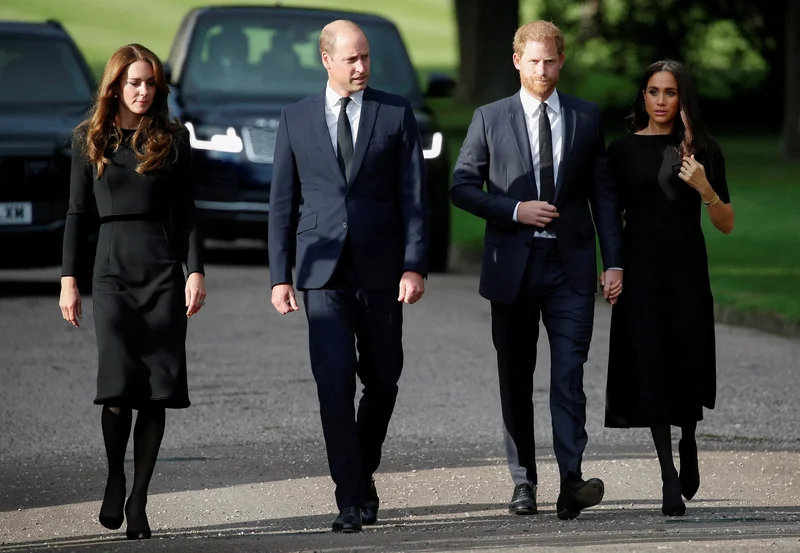
Prince Harry and his wife, Meghan Markle, have a long road ahead when it comes to mending fences. News of their planned return to the United Kingdom “for an extended period,” after six years in the United States, was met with a mixture of surprise, skepticism, hostility and irony when it broke on Wednesday night, first reported by People magazine and The Daily Telegraph.
The decision has taken King Charles III by surprise and, above all, Prince William, who continues to maintain a firm distance from his younger brother. Harry remains deeply unpopular with the British public, with just 27% expressing a favorable view of him. Meghan Markle fares even worse, at 18%. The couple rank only marginally above the disgraced Prince Andrew in public opinion polls.
“It provokes a crisis for the monarchy because the monarchy’s responses are often poor when they don’t know what to expect. With this, you certainly don’t know what to expect,” Richard Fitzwilliams, a consultant and expert on British royal affairs, told the Daily Mail in reference to the Sussexes’ return.
Surprise… but no change
King Charles III only learned of the move last Sunday, despite having had an opportunity to hear about it directly from Prince Harry when the Duke and Duchess of Sussex and their two children spent several days with the King and Queen at their private Highgrove residence in July.
Buckingham Palace has chosen to overlook the apparent slight, but its silence carries a double message: the monarch is pleased at the prospect of seeing his son, daughter-in-law and grandchildren more often in a private capacity, yet nothing will change regarding the decision that Harry and Meghan remain private citizens, with no public representative role within the monarchy, unlike other members of the royal family, as was agreed following their departure in 2020.
The media, however, have greeted the decision as a gift that promises a fresh round of blockbuster headlines. The return of Harry and Meghan, together with their children, Archie, 7, and Lilibet, 5, has dominated front pages, spawning analyses heavy on questions and short on answers, as well as a flood of opinion pieces.
Where they will live is one source of fascination, with most speculation centering on affluent areas of the Cotswolds or Northamptonshire rather than London itself. When they will arrive is another. Reports that the couple has already enrolled their children in a London school point to September, when the new academic year begins in the U.K. But above all, the question is why.
When Harry lost his legal battle against the British Home Office in May 2025 over the level of security provided to him and his family while in the U.K., he said: “I can’t see a world in which I would bring my wife and children back to the U.K. at this point.”
What has changed? Several things, experts say. In July, the Sussexes also spent time with Harry’s maternal family, the Spencers, and the experience appears to have been a positive one. Lady Diana’s siblings provided a welcoming environment for the couple and their children and, perhaps, the perfect rationale for relocating back to Europe while retaining their status as private citizens.
The desire to raise Archie, 7, and Lilibet, 5, in a British environment is also thought to have weighed heavily on the decision. So too may the health of King Charles III, who, although his cancer is reported to be in remission, continues to require close medical monitoring.
“I would love reconciliation with my family. There’s no point in continuing to fight. Life is precious,” Prince Harry said in May last year in an interview with the BBC. “I love my country, I always have done, despite what some people in that country have done ... and I think that it’s really quite sad that I won’t be able to show my children my homeland.”
Security for the Sussexes
Harry had just lost his final appeal against a decision by the Executive Committee for the Protection of Royalty and Public Figures (RAVEC), the Home Office body responsible for security arrangements, to deny taxpayer-funded protection for him and his family during visits to the United Kingdom.
The Sussexes’ decision to return, however, raises the possibility that the issue could be revisited. Some royal watchers and experts on the House of Windsor suggest that movement may already be taking place behind the scenes, although the British government has declined to comment publicly. “This is a private matter. It’s a matter for Harry and Meghan, and we wish them well in the moves that they’re making,” Prime Minister Andy Burnham said on Wednesday.
The couple’s every move is scrutinized by a segment of the British public that remains resentful over their abrupt departure to California and their repeated criticism of the royal family, which they at one point accused of racism. Suggestions that the move may be driven by tax considerations, however, appear less convincing. Harry has not spent the 10 years outside the United Kingdom that would allow him to qualify for non-domiciled tax status, and as for Meghan, the U.S. tax authorities would continue to claim a share of her income, wherever it is earned.
Both have renewed a multi-year deal with Netflix to produce series and documentaries. The new terms and financial details of the agreement have not been disclosed, though reports suggest they are significantly more modest and flexible than the $100 million deal the couple signed with the streaming platform in 2022.
From now on, British tabloids and much of the mainstream press are likely to focus on every rapprochement and falling-out between the two brothers, who will find it harder to avoid each other while living in the same country.
“In the long term, the return of the Sussexes to the U.K. opens up the prospect of two rival courts – William’s and Harry’s. In the short term, Harry will be able to deepen his rapprochement with his father,” said Peter Hunt, the BBC’s former royal correspondent. “[Harry’s] presence back home will make it harder for his brother to duck a reconciliation. The surprise return of Harry and Meghan is likely to have left William apoplectic.”