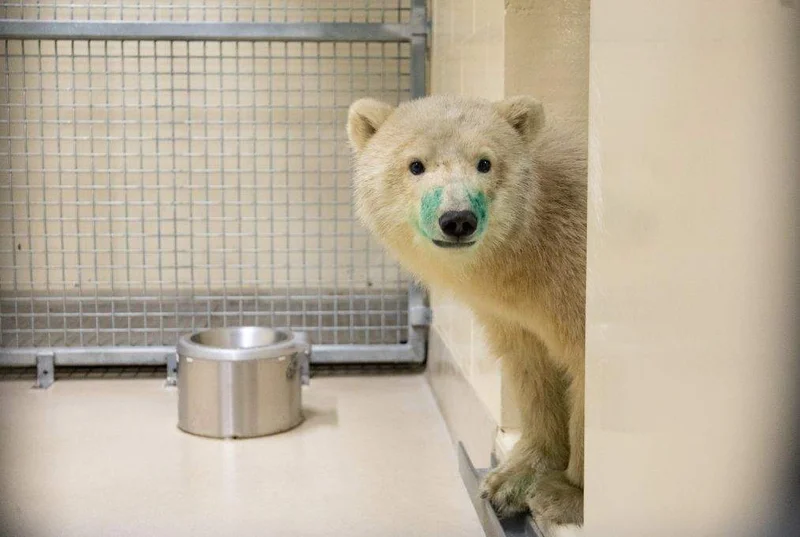
A nine-month-old polar bear is quarantining at the Assiniboine Park Zoo in Winnipeg after he was found orphaned in northern Manitoba.
The unnamed polar bear cub arrived in Winnipeg late Thursday evening, the Assiniboine Park Zoo said on social media. He was transported via plane, accompanied by zoo veterinarians who assessed his medical needs earlier that day in Churchill, Man.
“The bear is doing very well,” Chris Enright, the senior director of zoological operations at the Assiniboine Park Conservancy, told Global News in an interview Friday.
Enright said the cub appears to be healthy but is still being monitored closely by zoo staff.
“We found a few minor issues that (zoo vets will) be treating him for, but in broad strokes, he checks out very well,” Enright said.
The cub was found in Churchill after his mother died. Enright said the province is investigating her death.
He is not ready to be viewed by the public yet, Enright said, as the possibility of disease or other ailments cannot be ruled out since the mother bear’s cause of death is unknown.
Get breaking National news
“It might take weeks. It might take months. We’ll really go based on what he’s showing us he’s comfortable with,” he said.
The cub will remain at the Leatherdale International Polar Bear Conservation Centre as an “ambassador for its species, Churchill, and the Arctic” once he’s done quarantining, the zoo’s post said.
“It takes about two weeks for a cub to really start to enjoy life in human care, and from that point on, there’s no looking back,” Enright said.
Conservation officers and the province of Manitoba deemed him a candidate for the zoo’s conservation facility, in accordance with the provincial Polar Bear Protection Act. If the young bear was left alone in the wild, it would die, the zoological operating director said.
“Polar bears rely on their mom for anywhere from about a year and a half to two and a half years, and it takes that time to really grow big enough to hunt seals, but also to learn how to hunt seals,” Enright said.
At the cub’s young age, he said the bear has not had enough experience practicing hunting and could not feasibly survive in the wild.
“To leave it in the wild would mean it would starve,” he added. “It doesn’t have the skillset yet, but we can give it a great life here where that isn’t a factor.”
The cub doesn’t have a name yet. Enright said the zoo hopes to involve the community, as well as its northern partners, in naming its newest baby.