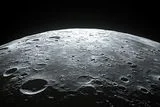
Setting foot on extraterrestrial ground like the moon and Mars is certainly a leap for humankind, but astronauts may also involuntarily bring along other lifeforms that didn’t ask for the ride. Although outer space doesn’t offer great conditions for biological survival, with deadly radiation and extreme temperatures, that doesn’t mean no life could survive or at least leave traces behind.
Some microbes have already proven surprisingly resilient, so researchers from NASA wanted to know which ones could potentially survive on the moon if introduced during future crewed lunar missions under the Artemis program.
Published in Science Advances, the research team ran simulations with common spaceflight-associated microbes at potential landing sites near the moon’s south pole. Combining lunar radiation profiles with these simulations, they found that shaded crevices and craters could allow terrestrial microbes to survive for up to seven days.
“When we created lunar maps with purple, red and blue representing different surviving microbe species, we were surprised at how colorfully they turned out,” said study co-author Stefano Bertone, a research scientist in the University of Maryland’s Department of Astronomy, in a statement. “So much for ‘nothing can survive on the moon.’”
Astronauts May Contaminate Space With Microbes from Earth
With humans planning to build bases on the moon and hoping to crew missions to Mars within the next few decades, scientists are increasingly wondering how to tell the difference between local, innate chemistry and potential contaminants introduced by astronauts.
Microbes, for example, go wherever we go. With billions of bacteria on our skin alone, they can escape from spacesuits and habitats, according to NASA, potentially contaminating extraterrestrial environments with every footprint. Even with strict sterilization procedures, “there’s potential for a lot of human contamination of the lunar landscape and, inevitably, the science we do there,” explained Bertone.
Understanding the contamination astronauts leave behind is therefore essential when searching for signs of life beyond Earth, basically making sure we can tell the two apart.
Read More: Blood Falls in Antarctica May Harbor Ancient Microbes, Preserving Traces of a Lost Ocean
Craters on Moon’s Poles Could Protect Microbes from Radiation
First, the researchers wanted to see which microbes could survive where on the moon. Because previous studies have suggested that microbial survival in the moon’s equatorial regions is very unlikely, the team focused on the polar regions.
At the poles, sunlight behaves very differently. The moon’s slight axial tilt prevents sunlight from reaching some terrain, even at relatively low elevations, such as the rim of a crater. These permanently shadowed areas can stay extremely cold, potentially preserve water, and shield microbes from damaging radiation.
“Incorporating the bumps and craters was a key to this study,” said Bertone. “The question was, how well can the moon’s surface topography shield some areas from UV, and is it enough to keep any of our study organisms alive?”
The researchers simulated microbes common in spaceflight environments across three lunar south pole regions that may become landing sites for upcoming crewed Artemis missions. They combined these simulations with models showing how radiation from the sun reaches the moon’s surface, creating colored maps of areas where some microbes could survive for up to a week.
One microbe that stood out was the UV-resilient Aspergillus fungus, which showed higher survival rates in areas that received even partial sunlight.
Moon’s South Pole May Become Natural Laboratory for Microbial Survival
The scientists noted that their simulations only considered microbes in a stagnant, cryptobiotic state, without conditions for growth. For microbes to actually grow, the moon would need to provide habitable conditions, such as liquid water, for which there is currently no evidence.
However, the researchers view the moon’s shaded areas at the south pole as a natural laboratory for testing the real-life limits of microbes under conditions that are difficult to recreate on Earth. Going forward, the team wants to use more advanced ray-tracing models and conduct further microbial studies to track how terrestrial microbes fare outside their home habitat.
“In planning human operations to the moon or elsewhere, we need to know everything we can about what’s been left behind,” Bertone said.
Article Sources
Our writers at Discovermagazine.com use peer-reviewed studies and high-quality sources for our articles, and our editors review for scientific accuracy and editorial standards. Review the sources used below for this article:
- This article references information from a study published in Science Advances: Potential survivable niches for microbial life on the lunar south pole
- This article references information from NASA: Human-Related Microbes May Survive Moon’s South Pole, NASA Finds