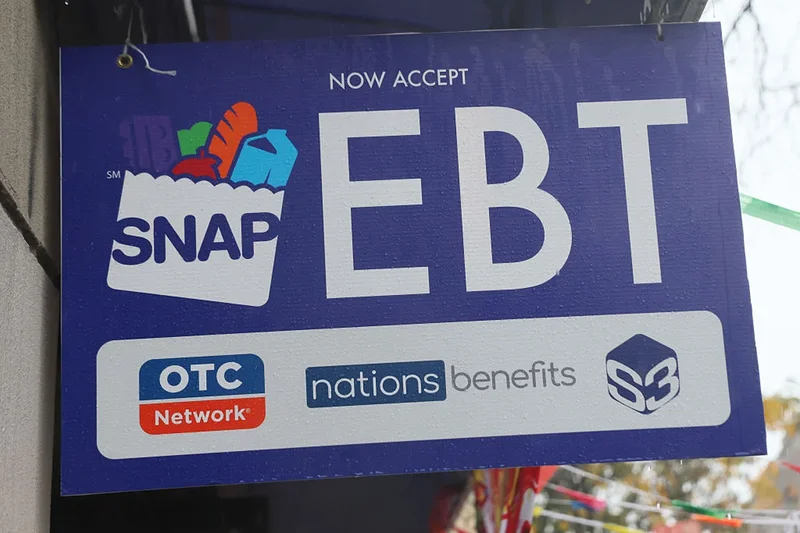
Participation in the largest federal food aid program in the United States has fallen by over 13 percent in a single year—a decline far sharper than government projections as work mandates and other measures in President Donald Trump's "big beautiful bill" take effect.
Among those losing coverage in the Supplemental Nutrition Assistance Program, or SNAP, are people unable to meet stricter criteria, along with eligible households disqualified due to missed deadlines or lacking paperwork, according to advocates. The precise breakdown between these two groups is not yet known.
It also remains unclear how many people lost benefits because state agencies running the program were overwhelmed by the regulatory updates. Arizona felt this acutely, recording the nation's largest drop in enrollment.
Tia Fields, a social safety net analyst at the advocacy group Invest in Louisiana, said the main factor driving coverage losses is not non-compliance with work rules. "A lot of it is administrative paperwork," she said.
Proponents of welfare reform hope the shrinking rolls stem from recipients earning enough to surpass income limits—a sign that policy revisions are working as intended for a program they argue is prone to fraud.
"If there are people that are leaving the welfare rolls because they're working and they're moving forward," said Rachel Sheffield, a research fellow at the conservative Heritage Foundation, which pushed for stricter requirements for SNAP, "that would be a step forward."
Arizona recorded the sharpest reduction so far, dropping more than 50 percent over 12 months, according to figures from the U.S. Department of Agriculture, which administers SNAP. Decreases exceeded 20 percent in Georgia, Louisiana, Nevada, and Florida, where the Department of Children and Families stated the decline "is reflective of the state's strong focus on advancing opportunities for Floridians and their families to achieve economic self-sufficiency."
Eligibility requirements are tightening
More than 1 in 10 people in the U.S. rely on SNAP to purchase food, with most beneficiaries earning incomes below the poverty line. Delivered on debit cards restricted strictly to groceries, monthly benefits average $344 per household.
Recent federal statistics show SNAP enrollment fell from 42.2 million in May 2025 to 36.6 million in May, representing a decline of over 13 percent within a year. The figures for May are preliminary and subject to revision.
Average monthly beneficiary numbers have dropped below 40 million in only two years since 2010—specifically 2019 and 2020. Enrollment began falling after reaching a peak of 43.3 million in October 2024, with the decrease accelerating following last year’s rollout of Trump’s "one big beautiful bill," which reduced taxes and restructured social safety net programs.
Expanded work mandates under the program have now taken effect across most of the country, though some locations will not implement them until next year.
Work rules have long applied to many adults aged 54 and under without minor children. However, the new legislation requires most previously exempt individuals to work, volunteer, or enroll in school to receive benefits. This expansion includes adults aged 55 to 64 and individuals with children aged 14 to 17. Those aged 65 and older, people with children under 14, and individuals with health limitations remain exempt, whereas other previously protected groups—including homeless people—are no longer exempt.
The nonpartisan Congressional Budget Office projected in February that the new mandates and related factors would reduce enrollment below 34 million by 2036. Yet the agency did not anticipate such a rapid decline; by May, recipient figures had already fallen to levels originally forecast for 2030.
Experts foresee additional consequences when states are obligated to pay a share of benefit costs if their payment error rates—where recipients are paid improperly—exceed 6 percent. Recipient advocates express concern that states may reject applicants entirely to prevent potential errors. This cost-sharing provision is scheduled for October 2027, although Congress has weighed a potential delay.
Changes have been hard to implement in Arizona
In Arizona, enrollment plummeted by 55% from April 2025 to April 2026 — the biggest drop in the country, with more than 400,000 fewer people getting benefits now.
The state said the drop was driven largely by the state's own struggles putting new federal requirements in place.
“Implementing the federally mandated changes triggered unprecedented call volumes and administrative hurdles, including additional verification requirements, creating real barriers for applicants,” said Brett Bezio, a spokesman for the Arizona Department of Economic Security.
Bezio said that hiring more staff members and introducing ways for people to submit their documents online have stemmed the enrollment drop in recent months as the state has reduced the chance for people who qualify to lose benefits.
In Phoenix, LaDiamond Lopez lost her benefits in January, with officials telling her she needed more documentation about her income and household — something that's needed for officials to determine whether enrollees meet work requirements.
She’s been skipping meals and some bill payments to ensure her children have enough to eat.
In her quest to be reinstated, she had previous employers sign forms confirming she no longer worked for them and added her children — ages 3 and 9 — to her apartment lease. She expected payments to resume in August, but she doesn’t know if they’ll last.
“I was approved at the end of May, but now they’re asking me for more documents,” she said. “It’s a panic.”
Other factors could be driving down enrollment
The Heritage Foundation's Sheffield says that some of the drop in SNAP use is likely a natural decline after peaks in the coronavirus pandemic era.
Paco Velez, the president and CEO of Feeding South Florida, said the 22% one-year enrollment drop in Florida is driven partly by immigrants who are in the U.S. legally but fear being targeted by Trump's immigration crackdown if they're seeking government benefits.
Invest in Louisiana's Fields said SNAP enrollment declines have broader consequences. For instance, children in households that receive the benefit can be automatically enrolled in free school lunch programs or in the SNAP for Women, Infants and Children program for low-income mothers, young children and expectant parents if they meet the other criteria.
“What happens when that child can’t pay for lunch?” she asked.
Some food banks have ramped up donations to try to meet a demand that they say has risen as SNAP rolls have declined. But that isn't expected to bridge the gap fully.
“We’re very worried about it because we know that no other organization or program can replicate the scale and success of SNAP, ” said Carolyn Vega, a policy analyst at the advocacy group Share Our Strength. “We know that schools can’t fill this gap. We know that food banks can’t fill this gap.”