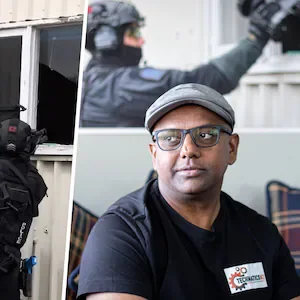
Police using the Christchurch-made robot Cerberus-X. The device was designed and manufactured by Ravi Sanyal's company, Techmatics. Photo / Anna Heath
For decades, when there was a potential threat, a suspicious vehicle or an unknown risk, the answer was simple: send in a person.
Increasingly, that’s no longer the case.
Across border protection, aviation security, policing and critical infrastructure, robots are becoming thefirst eyes on the scene, gathering intelligence and assessing danger before frontline staff step into harm’s way.
From inspecting the underside of imported vehicles and shipping containers to searching vessel hulls and helping police to assess potentially dangerous situations, machines are being deployed in places where officials would once have had little choice but to send a person.
The result is a growing reliance on technology to go where people once had to.
And many of the machines helping to drive that change are designed and built in Christchurch.
Techmatics Robotics manufactures a range of inspection and surveillance robots used by government agencies and security operators in New Zealand and overseas.
Its technology is used at ports, airports, prisons and other high-security sites where gathering information before deploying personnel can improve both safety and decision-making.
Founder Ravi Sanyal said the company began with a far less dramatic challenge: a building inspector who didn’t want to crawl beneath houses.
“His exact words were, ‘I wish there was a robot that did that.’
“And I just said to him, ‘I’ll make you one,’ and then I went on YouTube to see how to make one and did it ... and fast forward [to] 2026, we have a company, and we have a team of people making them.”
Agencies say the rise of robotic technology is being driven by both safety and increasingly complex security threats.
Customs assistant comptroller of maritime operations Paul Campbell said remotely operated and uncrewed technology had become an important part of its maritime border security arsenal.
“These tools are designed to complement frontline expertise by supporting safer and more informed decisions about when and how officers are deployed,” he told the Herald.
“The main drivers are the scale and complexity of the maritime environment, and the way transnational, serious and organised crime groups continue to exploit international supply chains and conceal drugs on or around vessels.
“It adds to the intelligence, data, partnerships, frontline expertise, X-ray technology, at-sea boarding capability and specialist detection tools already used to protect the border.”
Recent investments for the agency include remotely operated vehicles (ROVs) capable of inspecting hulls below the waterline and uncrewed surface vessels (USVs) used for maritime monitoring and intelligence gathering.
“This technology extends the reach of our officers, allowing them to gather information, monitor activity, and assess risk in environments that can be difficult, complex or difficult to access,” Campbell explained.
“It provides greater visibility and awareness, helping Customs make more informed decisions and target resources where they are needed most.”
Based in Middleton, in the west of Christchurch, Techmatics is made up of Sanyal and six robotics experts. Every part of the design-and-build process is done onsite.
Among the company’s offerings are the Hades range of robots for subfloor, under-vehicle and pipe inspections, and the “throwable” Cerberus-X tactical robot, designed for security operations and tactical surveillance missions.
The gadgets had been used by the Ministry for Primary Industries, the Australian Federal Police and state police in Western Australia and Queensland, the Australian Army, the Reserve Bank of New Zealand and Corrections, Sanyal said.
Police have been using the Cerberus-X, which boasts full voice communication capabilities and can be used as a covert listening and surveillance platform.
It can literally be thrown into a room or building, and officers can scan for offenders and other dangers. It also has a thermal imaging function for trickier environments.
Sanyal revealed that the Australian Army had engaged his company to supply a crawlspace inspection robot; Queensland police used another for “negotiation support and tactical surveillance operations”; and the Driver and Vehicle Standards Agency in Britain was using under-vehicle robots for examining bus and vehicle carriages.
The aim is to identify security threats such as explosives or weapons on vehicles entering secure zones, including the Glastonbury music festival.
In New Zealand, Sanyal said Aviation Security, Corrections and the Reserve Bank had used robots to search under vehicles for contraband such as drugs or weapons because they “provide a safer and more efficient alternative to handheld inspection mirrors”.
Custom inspection robots have also been picked up by both New Zealand and Australian biosecurity authorities, enabling the agencies’ inspectors to examine the underside of vehicles for threats such as snakes, spiders and insects that could endanger biodiversity and agricultural ecosystems.
“These robots inspect incoming vehicles, containers and machinery to prevent harmful organisms from entering the country undetected,” Sanyal said.
Biosecurity New Zealand commissioner Andrew Spelman said Techmatics’ Hades robots had been used since 2019.
“Biosecurity New Zealand is continually looking for innovative ways to improve the detection of biosecurity threats at the border.
“The technology reduces the need to ramp vehicles for inspection, improving staff safety while enabling efficient and thorough inspections.
“The latest generation of robots includes advanced imaging capabilities to help identify biosecurity risks, including pests such as the brown marmorated stink bugs.”
The agency was looking at “other cargo-related inspection uses” for the robot technology.
“For example, since 2025, we have been working with Techmatics to trial the technology for inspecting the undersides of shipping containers.
“The aim is for the robot to operate beneath containers lifted by forklifts or hoists, reducing the need to place containers on hardstands for physical inspection by officers.
“The technology could be particularly beneficial at smaller ports where access to hardstand facilities is limited. We are currently considering a proposal to use similar robotic technology to inspect the sides of shipping containers.”
Sanyal said it was important to him that all the robotic devices were designed, tested and manufactured in Christchurch.
Keeping design, software engineering, electronics and manufacturing under one roof allowed the company to quickly service and adapt products for customers.
There was so much demand for his products that he was looking towards a bigger space and adding more staff to his six-man team.
His ultimate goal was to keep refining his current offerings, rather than add more robots to his menu.
“We just want to make a few more variants – but not too many – and just specialise and be really good at it.
“I’m very proud … very thankful and really amazed at this company. Every day. This is not work for me; this is great. I just have fun, and I’m happy, and we make things, and we make it happen.
“Sometimes it’s difficult because you’ve got challenges to go through, and we’ve got people to satisfy and make them happy with our products. But when you actually see them in operation, finally, it’s just very satisfying.”
Police said the agency used drones, but that was as far as they had gone with any robotic or remote-controlled technology.
“While New Zealand Police’s use of robotics is currently limited, we are always looking to other jurisdictions and organisations to identify developments that may enhance our capabilities and assist us in keeping our communities and staff safe.”
From inspecting cargo containers for invasive pests to helping police gather intelligence before entering a potentially dangerous scene, the robots may perform different jobs.
But the principle is increasingly the same: before sending in a person, agencies are asking whether a machine can go first.
Anna Leask is a senior journalist who covers Christchurch issues and national crime and justice. She joined the Herald in 2008 and has worked as a journalist for more than 20 years with a particular focus on family and gender-based violence, child abuse, sexual violence and homicides. She writes, hosts and produces the award-winning podcast A Moment In Crime, released monthly on nzherald.co.nz.